Why New Zealanders should care about the student protests in India

Supporters of the Cockroach Janta Party (CJP) celebrate in New Delhi on July 25 following the resignation of education minister Dharmendra Pradhan, after days of protests demanding he step down. (Photo: Elke Scholiers/Getty Images)
Amid the growing ties between our two countries, there are lessons for Aotearoa in the recent gen Z-led protests in India and the complex, confounding societal forces roiling the world’s most populous country.
India has been in the news in New Zealand a lot recently for reasons relating to the increasing political and commercial ties between our two countries. Less covered has been a burgeoning protest movement in India and what it says about Indian society today.
As a gender studies scholar of contemporary India (and as an Indian New Zealander), watching the recent student protest movement in my mother country has made me feel both distress and respect. Distress at all that the students have suffered and endured; and pride at the vitality, ingenuity and strength these young Indians have exhibited on the streets and online.
The protest movement – largely student groups and newly formed political project “Cockroach Janta Party” (CJP) – has been propelled by feelings of a squandered future. The trigger was the breakdown of trust in India’s national examination systems. Every year, millions of Indians sit major, extremely competitive public exams in the hope that they will gain entrance to myriad public jobs, professions or university courses.
Allegations of examination irregularities and corruption, including the leaking of papers in advance, caused immense suffering for young people and their parents – including cases of suicide. Many students argued that these failures of public administration undermined merit and threatened their educational and career prospects, but also highlighted systemic corruption and nepotistic opportunities for politically connected families. What began as frustration over exam administration expanded into broader demands for transparency, fair governance, better employment opportunities and institutional accountability.
In the face of these protests, the state’s instinct – as has sometimes been the case across India’s almost 80-year history as an independent nation – was to respond to dissent with excessive force. Law enforcement on the streets of New Delhi used lathi – long wooden sticks (some studded with iron rings and nails) – and tear gas on the country’s young people. Symbolically important for the world’s largest democracy, the leader of the opposition was arrested and briefly detained.
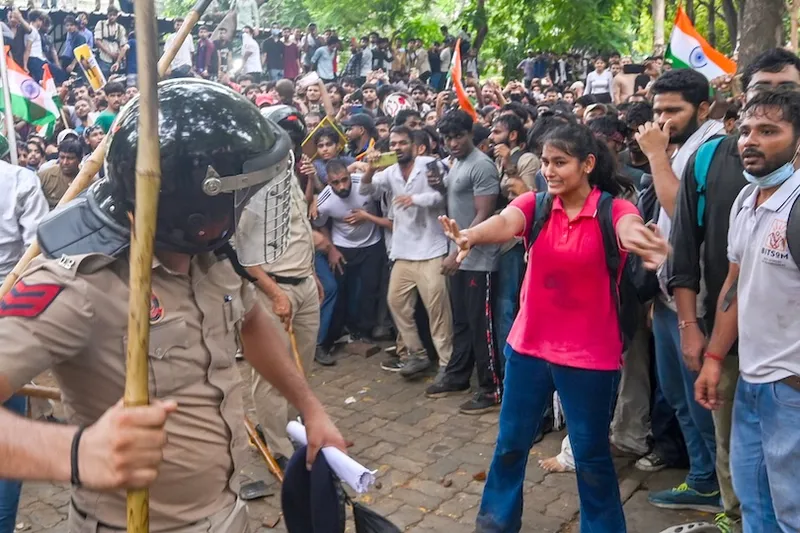
Protests helped bring about an independent India and have been a common feature throughout the last eight decades. But this student protest in July 2026 has had some unusual features – certainly in the Indian context.
A wide variety of people, ideas, memes, costumes, slogans and forms of expression have been seen during student-led demonstrations. Many identities and creative voices have come together in a single protest movement. This reflects India’s magisterial diversity. Students from different regions, backgrounds, professions and political beliefs have united around common concerns, particularly issues related to education, employment and government accountability.
Students from universities, coaching institutes and schools, along with graduates and job seekers, participated alongside activists, educators and civil society organisations. Despite differences in language, religion, region and political opinion, participants were united by concerns over educational fairness and future employment opportunities. This broad coalition demonstrated that student activism in India is no longer confined to a single campus or issue but has evolved into a nationwide civic movement.
Another of the defining characteristics of these protests has been the innovative use of social media. Unlike traditional demonstrations that relied mainly on speeches and banners, today’s student protests have embraced memes, humorous placards, viral videos, pop culture references and internet slang to communicate their message. Protesters have creatively used characters from movies, cartoons, anime, superheroes and gaming culture, leading many online users to describe the demonstrations as a “multiverse” because so many different cultural references appeared together in one movement.
The protests have seen a blend of satire and political expression. Protesters frequently used humour to criticise authorities, which in turn reduces fear of political participation. Online campaigns, creative artwork and symbolic performances became powerful tools for mobilisation and public engagement. This reflects a shift in how gen Z participates in politics, combining digital activism with peaceful street demonstrations.
This approach has helped attract younger audiences and increase the visibility of the protests across digital platforms. It has also made the Indian authorities, in their responses to the protests, seem in comparison clunky, old-fashioned, lethargic and generationally out of touch.
But new technologies can and have also been used to try and stifle protest and intimidate the young. Protesters, especially women, have been harassed online by government supporters – including via doxxing: the publication of personal details, including home addresses, online. This has opened protesters up to real world harassment – including through rape and death threats. Too often, the same law enforcement forces eager to use tear gas and batons at protests have been missing in action when female protesters have been threatened online with death and rape.
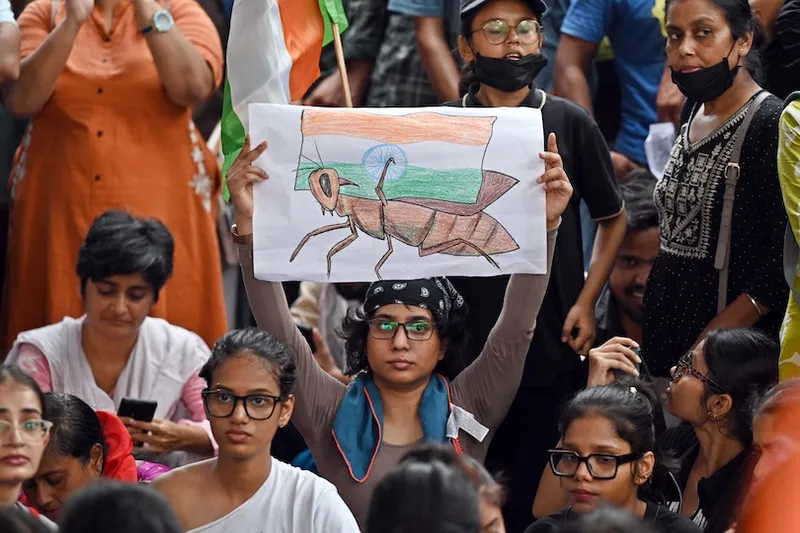
Women protesting publicly (and on social media) have sparked a particular social crisis – where certain forces cannot accept women’s right to public space and thus mobilise to shut them down through both threats to them and their families and a moralising logic of “women should not behave like this (ie not show up vocally to protests!)
To understand India today, then, is to be aware of and look unflinchingly at the violent misogyny that Indian women still experience – especially those who challenge the status quo.
There are lessons in all of this for New Zealand as we enter our own election season. Political activism, and indeed protest movements, are changing. Younger generations express themselves differently, using more diverse communication technologies and strategies. There can be, in this, a gap in understanding and communication between the political and media elites who practise and cover politics and younger generations with vastly new ways of getting their political information and expressing their views.
But there are also old-fashioned lessons about empathy and collective action in the face of patriarchal control.
Mass protests, while sparked by injustice, are fundamentally acts of hope. They imagine a better future. These young women have shown bravery that is beyond measure – and they should inspire every single one of us to speak up and demand to stay in public spaces, to be loud, to be brash, and to shape democratic futures through collective action.
To look at India from Aotearoa New Zealand, it’s important that we not just see the economic opportunity. We must also look at, and think, about the complex, confounding societal forces roiling the world’s most populous country, and those brave young Indians fighting for a better, more just future.

Nayantara Sheoran Appleton
Dr Nayantara Sheoran Appleton is a senior lecturer in the School of Science in Society at Te Herenga Waka—Victoria University of Wellington.


