I'm sorry all the time

Michelle Langstone, chronic over-apologiser (Photo: Supplied/Image: The Spinoff)
Chronic over-apologiser Michelle Langstone vows to stop saying sorry so much.
“I’m so sorry to bother you,” I said to the nurse in the maternity ward at Auckland Hospital, just an hour after the birth of our little boy. “But I need help getting into the wheelchair. I know you’re so busy, but would you mind helping me? Sorry. Thanks! Sorry for taking so long to leave! Does someone need this room? Sorry.”
Then an orderly came into the room and began to mop up some blood that had pooled on the floor and I apologised again. “Oh God sorry – I don’t know how that happened. Sorry! Do you want some help?”
Exactly how I thought I could help is a mystery to me. My pubic bones had separated during the labour and I was unable to walk. I couldn’t even lift my legs properly; not to put on the undies lined with a brick-width cotton sanitary pad, not to make my way to the door holding my baby like the treasure he was. I couldn’t do fuck-all, and the epidural had worn off, I didn’t know where my baby bag was, and I desperately needed to pee or leak blood into the toilet, or both.
In all honesty it was the best day of my life regardless, but let’s pause for a moment to consider my actions. A woman (me, hi!) gives birth and has some medical issues afterwards. Happens most days, I’d hazard a guess. But then that same woman apologises profusely for asking for help from the medical professionals tasked with caring for her while in hospital. What is wrong here?
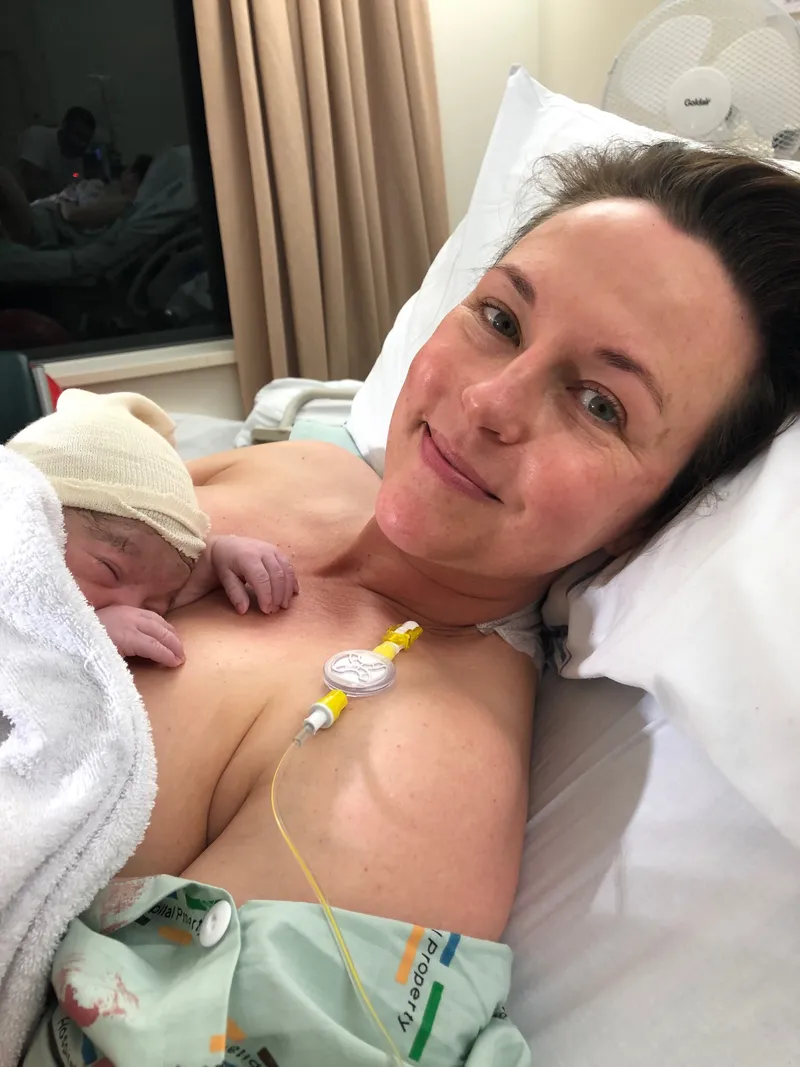
Me. I am what is wrong, because I’ve spent my entire life apologising needlessly, and shrinking to take up as little space as humanely possible on this planet while not bothering anyone. While the wheelchair apology after the birth of my son is an extreme example of an apology I needn't have given, it is just one instance in the literally hundreds of thousands of times I have said sorry for things I should not even be sorry for.
Unlike Elton John, sorry is not the hardest word for me. It was in fact one of the first words I ever uttered as a child, and I have really run with it since. In my family I was always the little peacemaker, running between siblings and parents, trying to ease perceived strife. Back and forth I’d go, diligently saying sorry – sorry that happened, sorry you’re sad, sorry, what can we do – like one of those wind up toys that hop manically across the bench and then smash onto the floor. Now I’m 47 and I’m still going strong in this fruitless and, frankly, irritating endeavour.
Why do I over-apologise? Because I like to make sure that I can diffuse any potentially difficult or unpleasant situation – either caused by me, or by any individual going by, I’m not fussy – by providing a blanket apology to smooth over any manner of sins that might be committed at any time that I dare to draw breath on this planet.
If you’re reading this and thinking, “Wow, this writer needs to chill out”, join the club.
I recently ranted to my (very attractive, loving and kind) husband about how irritated I have become saying sorry for things I’ve got no control over. Of saying sorry for things I need help with, even though I never begrudge helping anyone else. Nobody else says sorry as much as me, I said. I’m so over it. I’m not even sorry most of the time, it’s my default setting. His answer? Just stop saying sorry then?
What a gift, I thought, as I smiled sarcastically, for it to be so simple. How extraordinary it must feel to not be burdened with apologies and instead feel at ease in the world.
My sister (also a chronic apologiser) argued that it’s our personality type and that’s just how we go on the planet, but I disagree. It’s learned behaviour. It’s confusing manners and politeness with mea culpa. It’s the absorbed female attitude of contrition at all costs. I can’t point directly to where I learnt this. Not from mum, who is strong and stoic and elegant with her succinct apologies, and not from any of the women I looked up to as a kid. I think I just absorbed it by osmosis from the world around me, like the good little semi-permeable membrane I am.
It’s not just me of course. I nipped out to buy bolognaise sauce in the middle of putting this together, and I overheard three sorries from the same lady at the supermarket who was just asking for help finding something on a shelf, and couldn’t see because she didn’t have her glasses. Moments later I, not to be outdone, said sorry to the cashier for taking between five-to-10 seconds to find my rewards card. I often hear myself apologise at supermarkets – for having lots in my trolley and holding up the queue, for reaching for a basket at the same time as someone else, and for being in the yoghurt section when another customer wants yoghurt, which must annoy them, surely.
Other needless sorries include but are not limited to: I’m so sorry I can’t come to work the ambulance is coming to assess me; sorry but I forgot my canvas bag, could I please buy one; sorry can you pause The Traitors I need to pee; sorry can you help me move this, it’s too heavy for me; sorry have you got a plaster because I’m bleeding; sorry could I please return this it’s faulty; and sorry to bother you but do you know where the bathroom is?
And on and on ad nauseum.
But now I’ve hit the wall. I’ve made sorry the go-to panacea for every perceived act of wrongdoing in my existence. I’ve thrown sorries out the way the bakery throws out stale buns at closing time, not even because I mean it, but because I have made it my default setting. It’s tedious as hell. I am so sick of myself that I’m taking drastic action. If I have a genuine reason to apologise then I just want to do it once, and with dignity, like the vast majority of the population. But how?
I’ve got no idea, but in the interests of liberating myself from this wincing, remorseful prison, I’m giving myself 30 days to try and find out. An experiment, if you will, where I get tough on this whole sorry situation, and break the habit before it breaks me.
The rules are simple.
- No unnecessary apologies for 30 days, including but not limited to all the scenarios I have presented in this essay. Try alternate phrases that acknowledge an awkward moment without an unnecessary apology, like: “Excuse me, I didn’t see you there” instead of saying sorry for bumping into someone, or “Do you have a moment?’ instead of “Sorry to bother you, can I ask you something?” I may apologise when it is obviously required, but even then, only once. None of this 17 apologies and then following up the next day with a half a dozen sorry texts. One and done eg: “I made a mistake there. I’m sorry.”
- The establishment of a Sorry bank account into which I will transfer $1 each time I say sorry unnecessarily. (Current running total at time of deadline is $8. Damn you, supermarket)
What am I expecting to see? Enough money in my Sorry account for a trip to Vietnam. Jokes, but I am hoping to regain some confidence, instead of it being drained from me with every sorry that rasps pathetically from my lips. Incidentally, it turns out you don’t actually have to apologise profusely when one apple gets into the tangerines that are being weighed at the farmer’s market. Who knew.
I expect to slip up a lot at the start. Sorry (not sorry), I’m only human. I’m also wondering if my posture will improve, now that I’m not going to be collapsing into myself in a shape of regret every five minutes.
I’ll report back in one month. If you’re like me (and I suspect we are legion, and mostly women, and we all know why that is, so let’s not dwell), then why don’t you join me? I can’t think of anything more liberating than a collective banishment of the apologies we never needed to make in the first place.

Sign up to The Weekend, delivered straight to your inbox.


