‘It’s mesmeric’: The Christchurch supermarket thousands of seagulls call home

An artist’s impression of the gulls at Pak’nSave Moorhouse. (Composite image: Tina Tiller/The Spinoff)
Woolworths has Ooshies. New World has knives. Pak’nSave has seagulls.
It was some time in autumn, 2013, when Lucy D’Aeth was doing her regular early evening cycle ride home down Manchester Street. Much of the CBD was still cordoned off as a red zone and D’Aeth had been working in community mental health following the devastating earthquakes that left the city with “almost nothing”. But on that cycle ride home, specifically where Manchester Street meets Moorhouse Ave, she was confronted by a scene that shifted her focus well above the daily grind of post-quake Christchurch.
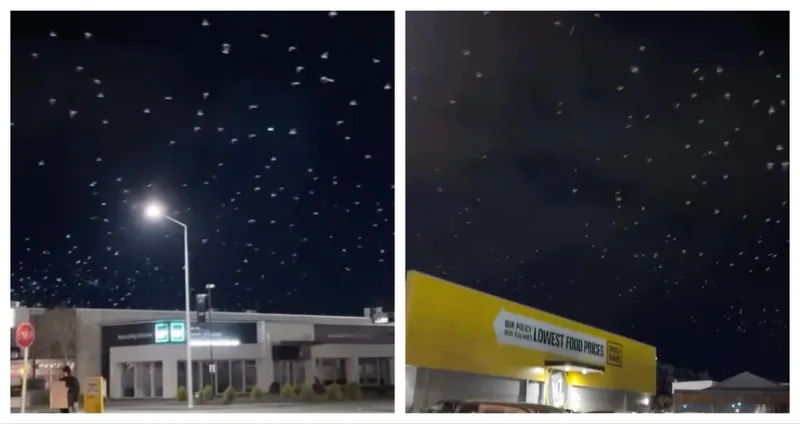
“It was that beautiful, ugly noise that made me take notice first,” she recalls. “The sky had been totally silent, but then suddenly it was so full and so noisy.” As thousands of red-billed gulls launched into “a remarkable choreography” from the roof of Pak’nSave Moorhouse, she stopped in her tracks along with a dozen other bystanders. “It was mesmeric,” she says. “The world’s going on around you, but this thing is happening above that is completely out of sync with rush hour, post-quake Christchurch… we all just didn’t know what to say to each other.”
She may have been speechless in the moment, but the scene later inspired D’Aeth to pen a poem published in Tākahē journal in 2016: “twice now / I’ve witnessed the murmuration of seagulls / over PaknSave on Moorhouse / white against the evening sky / and the yellow of the tilt-slab temple” she wrote. “The gulls wheel and scream / and melt into the dark.”
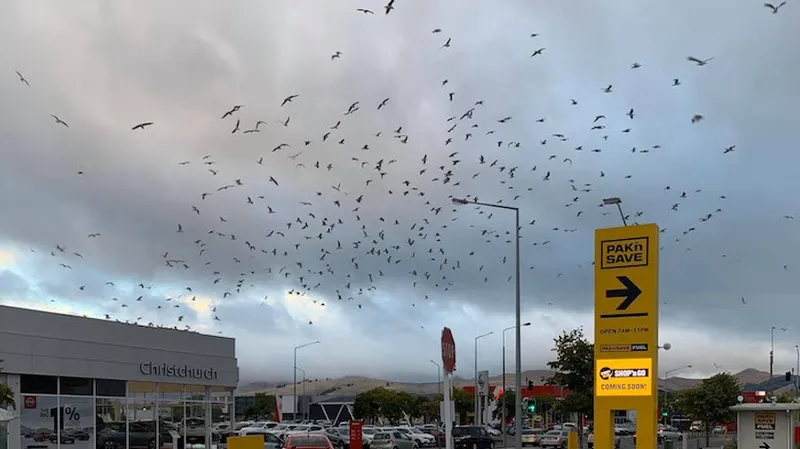
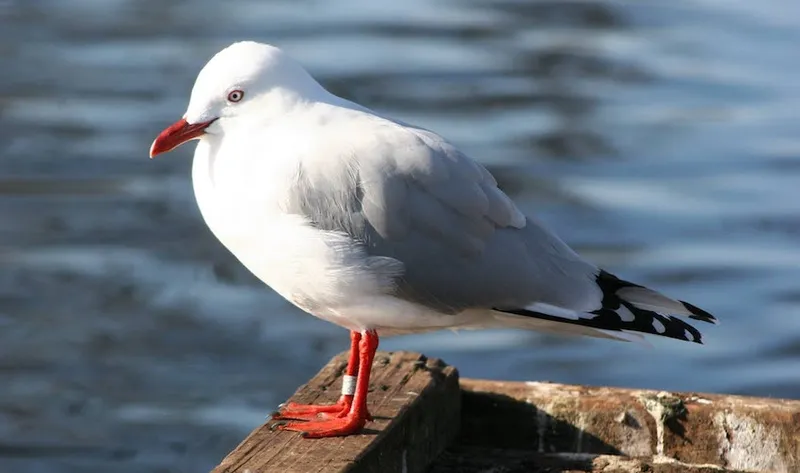
Well over a decade later, the Moorhouse murmuration is still going strong. Ornithologist Peter Langlands runs bird-watching tours around Christchurch city and has been fascinated by the tarāpunga, or red-billed gull, since coming across a banded bird as a teenager at Cashmere High School in the 80s. Although he hasn’t done any specific studies on the Pak’nSave flock, he has witnessed the “impressive” scene several times. “There were definitely several thousand birds there, which is a nationally significant part of the species population,” he says.
The birds likely come to Pak’nSave to roost over winter months from nearby coastal breeding sites like Scarborough, or further afield in Kaikōura. “It’s a safe and secure open space where they can basically roost undisturbed, and obviously they’ve got good vigilance to any predators – you’re not going to have anything like stoats, ferrets, rats or cats on the roof of a Pak’nSave,” says Langlands. “It’s definitely an interesting urban spectacle, but it’s probably not too much of a problem either – I imagine the rain just washes off all the gull shit.”
While Pak’nSave declined to respond to The Spinoff’s questions, gull shit-related or otherwise, Langlands says the Moorhouse flock is a reminder that the “charismatic” species remains vulnerable in the modern world. Since 1983, the total population of tarāpunga has halved due to changes in the marine food supply, leading to some raising the alarm about “the end of the everywhere bird”. “They are now coming into closer contact with people, which means issues with entanglement and being hit by cars, and doesn’t lead to favourable outcomes.”
This is also not the first time that a declining species has set up shop in a surprising spot in central Christchurch. Following the demolition of the quake-damaged PricewaterhouseCoopers building on Armagh Street, the site became an urban colony for the black-billed gull, then the most threatened gull species in the world. The affectionately named “seagull pit” became a tourist attraction of sorts, gathering rave reviews on Google as a “wonder of the world” for more than six years. In tribute to Joni Mitchell, the site is now a Mainland carpark.
As Mitchell might also attest, we don’t know what we’ve got till it’s gone, which is something D’Aeth encourages people to consider every time they bear witness to Pak’nSave Moorhouse’s “free show” at dusk. “People pay a lot of money to go and see the wildebeest surge over the plains, but you can get exactly that as you’re cycling home from work outside Pak’nSave,” she says. “I just think it is a beautiful thing about the city that also captures our sense of defiance: even if you don’t get us, we don’t really care.”
Indeed, newer arrivals are taking notice. Master’s student Nikita Abrol moved to Christchurch from India just six months ago, and found the Pak’nSave seagulls “fascinating” to behold. “I have never seen that many seagulls back in my home country, and so I opened my camera and made a video straight away,” she explains. In the video of the flock provided to The Spinoff, her husband can be heard speaking frantically in Hindi in the background. Translation? “move away, they’re going to shit on you, they’re going to shit on you.”
Reflecting on first encountering the gulls in the aftermath of the quakes, D’Aeth also adds that keeping your eyes open to bizarre spectacles, even somewhere as inane as a supermarket parking lot, can have a tremendously positive impact on your resilience in trying times. “One of the most beautiful pieces of research that came out of the earthquakes found that those who coped better had a greater capacity to experience awe,” she says. “It’s important to notice these remarkable things that put us back in our place as tiny creatures within something bigger.”
“In that sense,” she adds, “I’d say the seagulls are doing us a massive favour.”

Alex Casey
Alex Casey is a senior writer at The Spinoff with over a decade of experience writing about popular culture and social issues in Aotearoa. She lives in Ōtautahi and likes watching reality TV and walking the dog, occasionally at the same time.


