


In the space of a month, Auckland will host two premier international clubs. One of those matches should’ve been held in Wellington, argues Jesse Gerritsen.
It’s closing in on 16 years since Lonely Planet gave Wellington its moniker of the “Coolest Little Capital” in late 2010.
Say what you will about the appointment of such a title, but from a footballing perspective, it made sense. I was lucky enough to witness the bedlam just a year prior as the All Whites qualified for their first Fifa World Cup in 28 years by beating Bahrain at the cake tin. The whole city was also still basking in the afterglow of a visit from football’s king of coolness himself, Sir David Beckham, who had graced Wellington with his presence to play the Phoenix in an exhibition match for the LA Galaxy in 2007.
That the Phoenix existed at all to host him was a minor miracle. The club was barely eight months old, born out of the collapse of the Auckland-based New Zealand Knights, whose implosion took professional football in this country down with them – until Wellington property developer Terry Serepisos heard a radio appeal while getting a haircut and put up $1.2m for the licence. What followed was 17 years of Wellington keeping the lights on for professional football in New Zealand. In 2015, the Nix looked on the brink again, being refused a long-term renewal of their licence. It took a fan campaign, Save The Nix, to force an extension, and even then every season came with attendance and TV targets hanging over it. Talk about a Phoenix from the ashes.
And still they came. A run to the semi-finals in 2024 in front of the biggest crowd in the club’s history, and a year later Hollywood-owned Wrexham AFC came to town, with over 25,000 turning out to watch the Nix hold on for a famous 1-0 win.
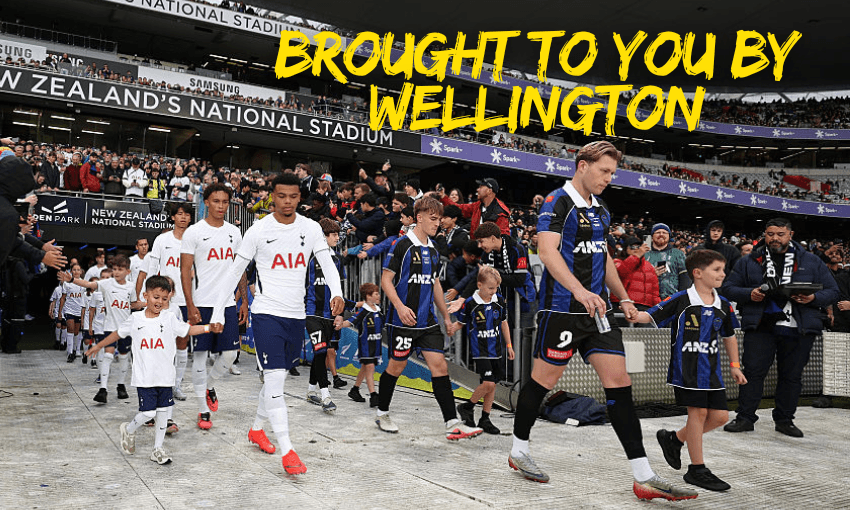
It was the end of the Fifa World Cup which left me bereft of footballing action, and my wandering mind searched to replace the loss. Fortunately, I didn’t have to dwell in melancholy too long as flicking through the multitude of streaming services to find a distraction in the form of more sports, I soon found some football to watch. Auckland FC’s preseason fixture against Tottenham, the first match of the New Zealand International Football Festival. As half time sounded, Spurs up 1-0, an ad flashed up onto my screen. In 13 days another English force in the formidable Chelsea FC Women’s side would be playing at Eden Park.
I thought at first I was seeing some incredibly diligent advertising – a worthy, if not eager, promotion for the incoming Auckland FC Women’s team for the 2027/28 A-League season. But Chelsea FC won’t be playing an Auckland FC squad, nor New Zealand’s existing and first-ever professional women’s team in Wellington. Instead, it will be a pickup XI and, like a claw machine at the arcade, the squad was a cherry-picking of stars from other teams. Including our own Phoenix captain.

Mackenzie Barry is a Phoenix foundation player, the club’s most-capped women’s footballer, and the woman who led them to their first grand final earlier this year. She is contracted to Wellington until the end of next season. On Saturday she’ll wear someone else’s badge.
The 20-strong squad was completed last Thursday, and she’s joined by eight other Football Ferns and three American imports: midfielder Claire Winter, goalkeeper Lindsey Harris and forward Nya Baccelli.
The reason Auckland can do this at all is a quirk of the women’s game: A-League women are contracted to their clubs for only eight months of the year. This leaves a four-month window each winter where the players that a club has developed, paid and built a season around are, technically speaking, available.
Now, I’d get it if this were an A-League All Stars side – our history-making Phoenix Wāhinix lining up alongside the best of the league. Which, as it happens, is exactly what’s happening four days later in Sydney, when Brooke Nunn, Grace Jale, Pia Vlok and Makala Woods face none other than eight-time Women’s Super League champions Chelsea. It does make you wonder why Auckland didn’t just wait the four days for the makeshift side to materialise.
Honestly, I’m not arguing Wellington should have got the Tottenham game. Auckland has the bigger city and the bigger stadium, proved by the record crowd of more than 40,000 who turned out. Fair play, guys. And I am, mostly, happy for them.
The Chelsea game is different. This is the first time a Women’s Super League club has played in New Zealand, and there is a professional women’s team here – one that reached its first grand final in May.
Except Wellington never got to celebrate it. The Wāhinix booked their place by beating Brisbane in extra time at a sold-out Porirua Park. The grand final itself was played at AAMI Park in Melbourne. The best season in the club’s history, and the city got one sellout followed by a final across the ditch.
So, when the biggest women’s club fixture in this country’s history came up, there was an obvious place to put it. Sky Stadium held nine games at the 2023 World Cup and averaged nearly 26,000 across them. Wellington has the stadium, and the team. But Wellington won’t be hosting the big game.
Maybe that’s just what happens when money talks. Auckland arrived two years ago on Bill Foley’s chequebook and won a championship inside two seasons, which is a good lift for the game and competition here. But I’d be lying if I said there wasn’t envy underneath it. We spent years being told we weren’t commercially viable, having to prove our worth – and then the public money that brought Chelsea to Aotearoa, the government’s own $70m Major Events and Tourism Package, sent them not to the capital but 650km north. What worries me is that in 10 years the story of professional football here starts in 2024, and the club that built the women’s game gets reduced to the welcome mat.
The Coolest Little Capital title may be fading with time, but none of its meaning goes away because a government cheque gets cashed in Auckland. We are the Coolest Little Capital that could. That could build the professional game in this country twice. Once in 2007, when nobody else would take the licence. And again in 2021, when we started the first professional women’s team in Aotearoa and spent five years building the only professional pathway for women in the country.
On Saturday, the captain produced by that pathway runs out at Eden Park for a club that doesn’t exist yet. We weren’t left on the sidelines. We were asked to supply the players.