One of New Zealand’s most recognisable young artists talks about making 365 faces in 365 days, losing control of her work and remembering how to create when nobody is watching.
All photos by Chevron Hassett unless stated otherwise.
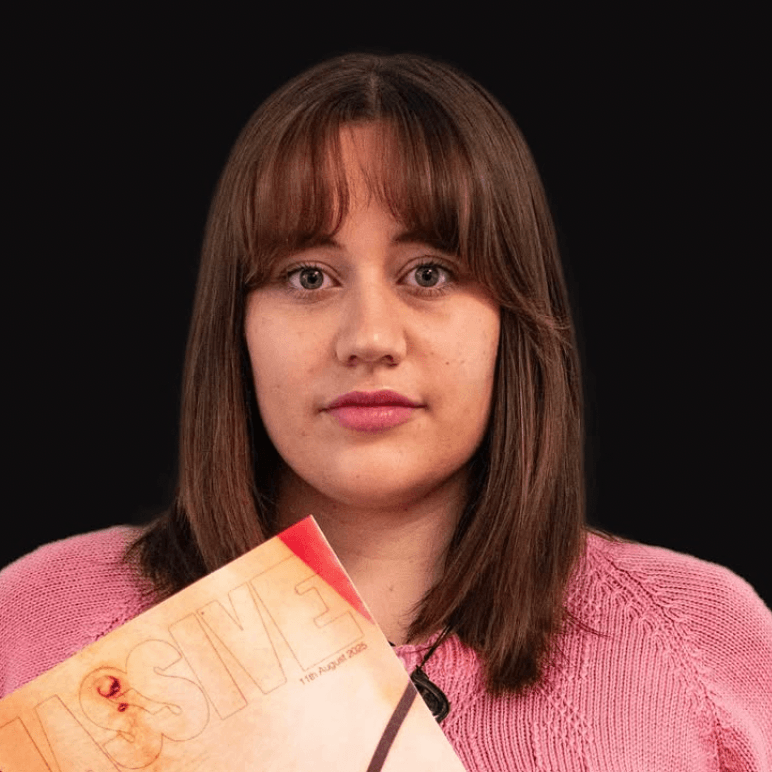
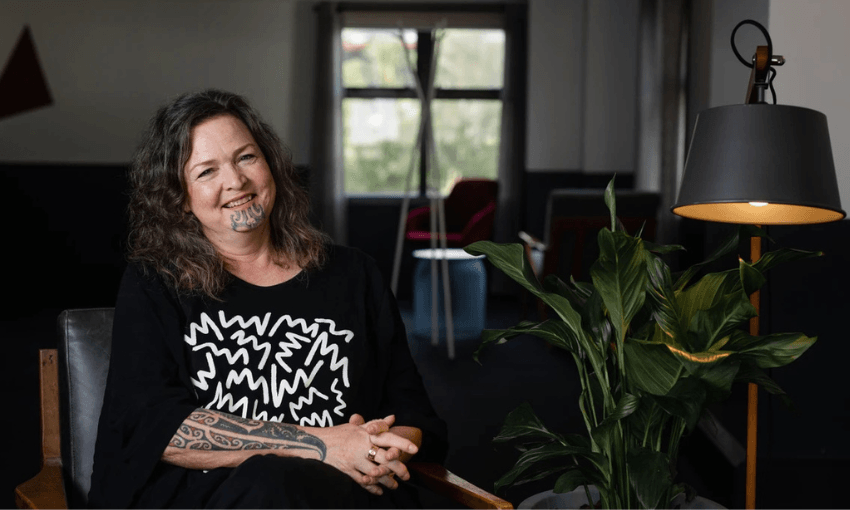
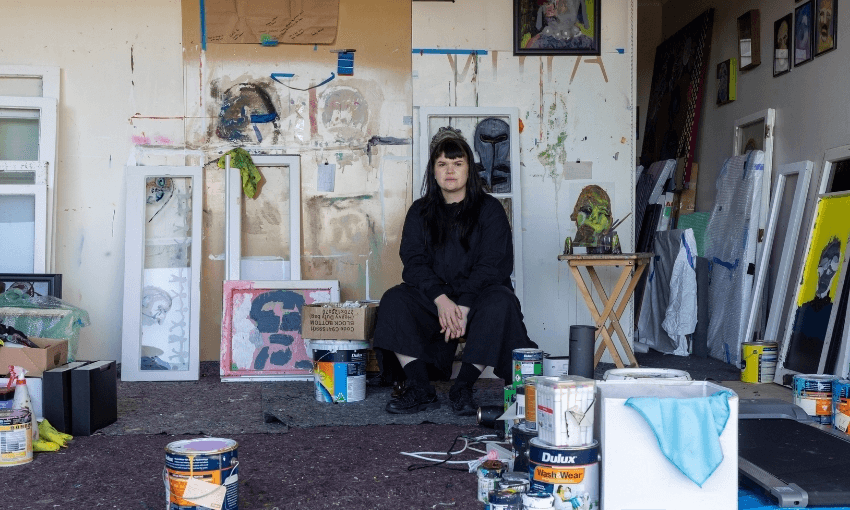
Hannah Ireland has become one of New Zealand’s most recognisable young painters, her works exhibited across galleries and institutions and held in important collections throughout the country. Known for her large-scale, hazy, gestural portraits, often uniquely painted on the reverse of glass, Ireland’s latest project turns towards something intimate and more personal.
For her most recent exhibition Making Faces, curated by Liam Jacobson at Puku, Ireland made a portrait every day for a year. Away from the usual demands of exhibitions and audiences, the project became about the everyday rhythm of making and this time, making something for herself. We caught up with her in the studio to reflect on her kaupapa and what’s next in the pipeline.
Before you became an artist, what did you imagine your life was going to look like?
Not this. Prior to becoming an artist, I was studying pre-med at the University of Auckland with the intention of becoming a doctor. I was drawn to the idea of helping people, of doing something that felt useful.
It was through studying healthcare during my first year at university that I came to understand that care can take shape in many forms. There are lots of ways to help people, and visual art can be one of them. It has the power to connect people, offer different perspectives, or simply make someone feel a little less alone. I think that impulse to care has stuck with me. The way I act on it has just evolved.
You then shifted to studying fine arts. Was there a moment during those studies that you thought art could become your practice?
I don’t think there was a lightbulb moment. I actually went into Elam [School of Fine Arts at the University of Auckland] as a painter. Painting was my sixth subject at high school, alongside all the sciences, and it was really the only thing I knew when I arrived. But Elam felt a bit like being a kid in a candy store. I started experimenting with photography, film and performance, and over the course of my undergraduate degree I began to identify less as a painter and more as an interdisciplinary artist.
It was during my honours year, my fourth and final year at Elam, that I decided to dedicate the year-long project to painting. It was a bit of a love letter to it, an acknowledgement that my life might have panned out very differently if not for painting. I wanted to leave Elam as a painter, much as I had entered it.

To my surprise, people were really enthusiastic about my paintings. I started being offered exhibition opportunities after art school, and then I won the Molly Morpeth Canaday Award (the country’s longest-running premiere art award), which felt like a fairly convincing argument to keep going.
Where did you grow up and how do you think that place shaped the person and artist you’ve become?
I grew up in South Auckland and moved to Flat Bush when I was around 13. I was homeschooled for most of my childhood, so I often joke that I grew up in a house. I’m one of eight kids, right in the middle, and we grew up in a close-knit Christian household. It was a pretty contained little ecosystem, with family, school and faith, all under one roof. There was always something happening, and I think I became quite good at observing the social dynamics around me.
Then I went to high school and suddenly my world got a lot bigger. There were new personalities, friendships, hierarchies and social dynamics to navigate. I became aware of how differently we can move through the world depending on where we fit – how friendships, groups and relationships can subtly change the way we see ourselves and each other. I found that really fascinating. There was always more going on than what was immediately visible.
I think that curiosity has stayed with me. I’m still interested in people, the relationships we have with one another, the spaces we create between us, and how we make sense of ourselves through being in relation to one another.
How would you describe your practice to someone?
I make faces – that’s probably the simplest way of putting it. I’m interested in people and the things that make us who we are: memory, emotion, identity, relationships and the ways we understand ourselves and each other. Faces are one way into that, but the work is really about the broader concept of how we experience and make sense of being human.
I studied psychology alongside fine art. I’m interested in that space between looking at someone and actually knowing them. The faces I make aren’t necessarily portraits of particular people – they’re more like impressions. They might hold onto a feeling, a memory or something I’ve noticed. I don’t really want to tell you exactly who you’re looking at or what you’re supposed to see.
I’m also quite interested in experimenting with materials and letting the work take me somewhere I wasn’t expecting. I don’t always want to be completely in control of the outcome. I like that uncertainty. I think the work can mean something slightly different to me than it does to someone else.

Your work has become distinctive. Do you ever feel tension between developing that language and wanting to break away from it?
Absolutely. I think there’s always a bit of tension there. I’m always trying to find new ways of making, but I also want to develop a visual language that feels like mine. The trouble is that as soon as something starts feeling too comfortable, I want to disrupt it. I think I like knowing that I can still surprise myself.
You’ve exhibited your work at galleries and institutions around the country, where you’re often making towards an exhibition or deadline. You’ve said Making Faces was something you wanted to make for yourself. Why?
I needed to remember that I’m a maker before I’m an artist. So much of being a practising artist is making work that eventually gets sold. That’s how we pay for the studio, materials and time to keep making. It’s a beautiful, muddy ecosystem when you think about it, but it also means the work is always at risk of becoming a product.
I wanted to make something that didn’t have to go anywhere: No gallery, deadline and no one needing to like it. Just me making for the sake of making.
You committed to making one portrait every day for a year. Was the challenge ultimately about making 365 drawings, or something else?
It started because I was moving studios and didn’t have much space. I thought, I’ll just make a face every day. Something small, something easy, something that doesn’t require a studio. I started by challenging myself to do it for a week. Then a week turned into a month, and a month turned into a year.
But I think the real challenge was showing up. Some days I had something to give and some days I really didn’t. What I liked about the whole thing was that the drawing didn’t care. It wasn’t really about making a good drawing; it was about the act of drawing and simply turning up. It became a way of staying in conversation with my practice, even on the days when I didn’t have much to say.
When you look at all 365 drawings together now, can you see that year of your life in them?
Yes, although sometimes I recognise the feeling before I recognise the day. I’ll look at one and think, ‘that’s strange, I don’t remember making that’. Then I’ll realise, actually, I know exactly what that was. I think the body often knows what’s happening before we have language for it. That’s something I trust in painting too. Sometimes the work understands something before I do.

You spend time creating an image and then deliberately disrupt it, particularly through smudging. Why?
I wanted to lose a bit of control, or give some of that control over to the material. There’s something quite funny about spending time making a face and then immediately smudging or rubbing it away. But I like that the material gets a vote. That’s become increasingly important to me – thinking of the material less as a tool I’m controlling and more as something I’m in relationship or communion with.
Sometimes the best thing you can do is get out of the way.
Has spending a year making something primarily for yourself changed what you want from your practice going forward?
Sometimes just turning up for yourself and your practice each day is enough. We don’t always have the foresight to see how each little thing accumulates over time. Time spent in the studio, time spent making – they’re all building blocks. We don’t need to see the full picture.
It reminded me that the small things count – you don’t have to make a masterpiece every Tuesday. I’m interested in keeping some space in my practice where things can be unresolved, private or even a little bit silly. I’m trying to protect the part of making that existed before I knew anyone was watching.
What are you trying to get better at right now?
Painting. Still. Always. I’ve spent a few years away from painting on glass, so I’m wanting to revisit that material and way of working, and see what happens when I bring everything I’ve learnt over the past few years back into it.
I’ve also enrolled in a leadlighting course. I’ve been wanting to play with stained glass for some time now, and I suppose I’m trying to get better at being proactive about stepping outside the studio and asking for help – taking classes, learning new skills and being more collaborative.
A tool you can’t live without in the studio?
Aside from my paint and paintbrushes, probably my hairdryer or headphones. My hairdryer is basically attached to my hip, especially when I’m painting on glass, and my headphones are usually glued to my head.

What’s something you’ve always wanted to paint on?
A car exterior, windows included. Or an entire greenhouse. I think that could be pretty fun.
Morning or night artist?
As of recently, morning. But typically, I’m a night owl.
Any advice for young artists?
Stay curious, make things that excite you, and don’t worry too much about getting it right. There’s no right way to be an artist, so give yourself the space to experiment and find your own way.
Which one of your paintings would you wish to hang out with in person?
Honest answer, I’d be happy to hang out with any of them. It would be like catching up with old mates. Can’t complain about which one.