Tāmaki Makaurau poll: Oriini Kaipara leads Labour rival by just two points

Tāmaki Makaurau candidates (from left): Green candidate Florence Te Ohaere, Te Pāti Māori MP Oriini Kaipara and Labour’s Kerrin Leoni. Photo: Composite.
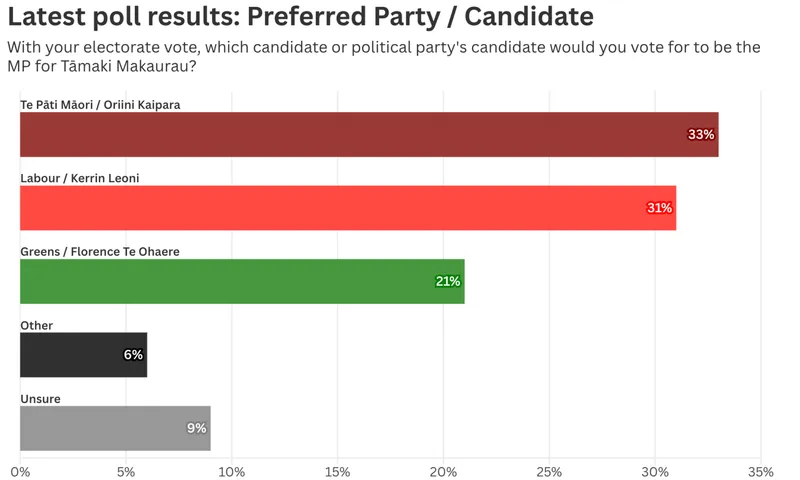
A new poll puts Te Pāti Māori MP Oriini Kaipara on 33% and Labour’s Kerrin Leoni on 31%, with the gap well within the margin of error. Green candidate Florence Te Ohaere is polling at 21%.
This story was originally published by Te Ao Māori News.
A new Whakaata Māori-Curia poll has Te Pāti Māori MP Oriini Kaipara only slightly ahead of Labour candidate Kerrin Leoni in the electorate seat of Tāmaki Makaurau.
Kaipara received 33% of the vote, compared with 31% for Leoni. Green candidate Florence Te Ohaere received 21%, while 9% were unsure and 6% chose “other”, meaning they preferred someone else.
When undecided respondents were excluded, Kaipara received 36% of the decided electorate vote, compared with 34% for Leoni, 23% for Te Ohaere and 7% for “other”.
Support for Kaipara was strongest among voters aged 18 to 39, at 37%, compared with 28% among other age groups. Te Ohaere also had stronger support among younger voters, at 28% compared with 14%. Among voters aged 60 and older, support for Kaipara was lower at 20% compared with 35% among younger respondents.
The exclusive poll was commissioned by Whakaata Māori as part of its Whakatau 2026 election coverage series.
Curia Market Research surveyed 500 Māori adults enrolled in Tāmaki Makaurau between October 5 and 15. The sample included 365 people surveyed by phone and 135 through an online panel. Results were weighted by age and gender. The poll has a margin of error of plus or minus 4.5 percentage points. Curia also polls for the National Party and the New Zealand Taxpayers’ Union.
Most voters rate Kaipara’s performance positively
Asked how good a job Kaipara had done since being elected in September last year, 35% said good, 33% said average, and 13% said poor. A further 19% were unsure.
That gives Kaipara a net approval rating of plus 22 percentage points, calculated by subtracting those who said poor from those who said good.
Oriini Kaipara, a former broadcaster, first entered parliament in September of last year, having defeated Labour MP Peeni Henare during the Tāmaki Makaurau by-election. She won the seat with a majority of 3,519 votes.
Kerrin Leoni is a former Auckland councillor and deputy chair of the Waitematā Local Board. Last year she ran for Auckland mayor and has previously stood for Labour in the Waikato electorate.
Labour leads party vote
Labour leads the party vote in Tāmaki Makaurau with 28%, followed by the Greens on 17% and Te Pāti Māori on 10%. National received 6%, while 9% of respondents were unsure.
Excluding undecided voters, Labour received 31% of the decided vote, the Greens 19%, Te Pāti Māori 11% and National 7%.
Compared with the 2023 election result among decided voters, Labour’s support in the poll is down 12 percentage points, from 43%. Te Pāti Māori is down 19 points, from 30%, while the Greens are up seven points, from 12%.
New Zealand First’s share is up three points to 6%, while National is up two points to 7%.
Cost of living tops local concerns
The cost of living was the most important local issue that could affect respondents’ votes, selected by 37%.
Housing and healthcare each received 8%, followed by jobs at 7%. Education, law and order, and infrastructure each received 6%.
Te Tiriti o Waitangi was selected by 5% of respondents, placing it among the lower-ranked issues in this question.
However, a strong majority said Māori-specific policies should become a permanent feature of government to help ensure Māori have the same outcomes as other groups. That result received 84% in support, while 7% disagreed, and 9% were unsure.
There were mixed views when asked whether the government was not doing enough to help iwi and Māori businesses build long-term economic wealth. A total of 51% said more support was needed, while 41% said the government was doing enough, and 8% were unsure.
Women were more likely than men to say more support was needed, at 62% compared with 39%. Respondents aged 18 to 39 were more likely to say the government was doing enough, at 59%, compared with 23% among other age groups.


