Poll: Chlöe Swarbrick top pick for understanding rangatahi issues

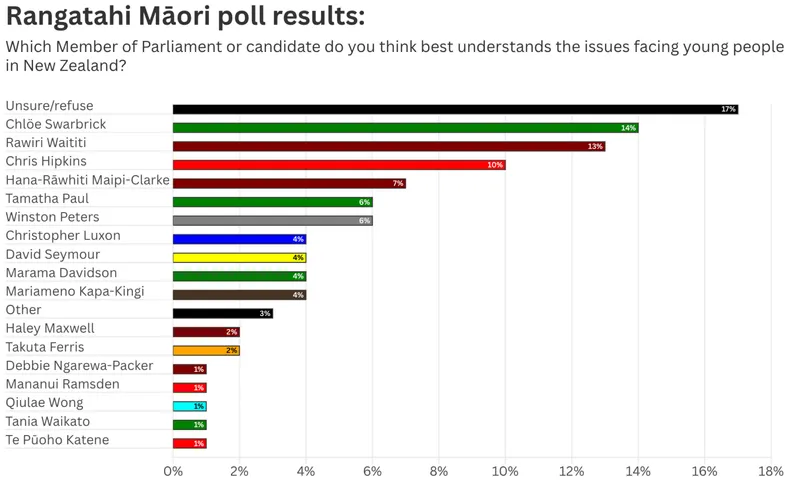
Green Party co-leader Chlöe Swarbrick is the most recognised MP or candidate for understanding young people’s issues in a rangatahi Māori poll, with 14% of respondents naming her.
Labour leads among Māori aged 18 to 29, with the Greens second and Te Pāti Māori third.
This story was originally published by Te Ao Māori News.
A new Whakaata Māori-Curia poll puts Chlöe Swarbrick and Rawiri Waititi at the top of young Māori respondents’ list of politicians who understand rangatahi issues.
When asked which MP or candidate best understands the issues facing young people in New Zealand, 14% named Green Party co-leader Swarbrick and 13% named Te Pāti Māori co-leader Waititi. Labour leader Chris Hipkins received 10%.
Te Pāti Māori MP Hana-Rāwhiti Maipi-Clarke received 7%, one point ahead of NZ First leader Winston Peters on 6%. Maipi-Clarke became the youngest MP in 170 years when she entered Parliament in 2023.
A total of 17% were unsure or refused to answer.
The exclusive poll was commissioned by Whakaata Māori as part of its Whakatau 2026 election coverage series and was conducted by Curia Market Research. The results are being released ahead of a live debate tonight moderated by Whakaata Māori’s Whatitiri Te Wake and includes candidates from various political parties to discuss the issues that matter to young people.
Labour leads party vote
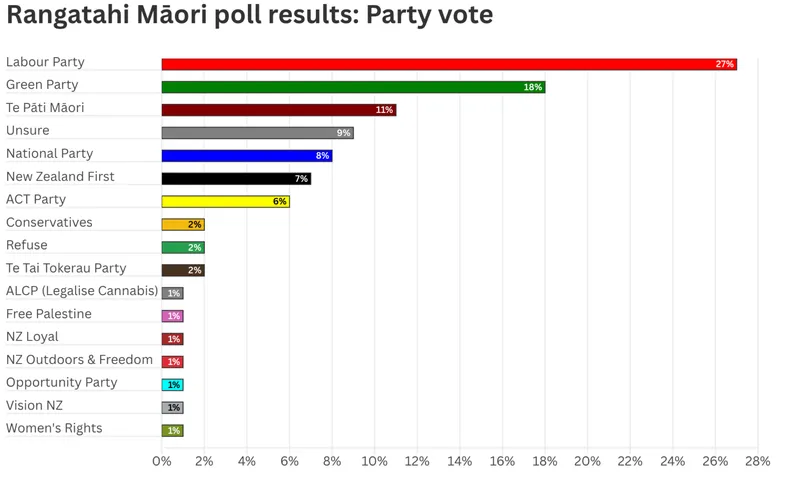
Labour was the leading party choice among Māori aged 18 to 29, receiving 27% of the party vote. The Greens received 18%, followed by Te Pāti Māori on 11%. National received 8%, New Zealand First 7% and ACT 6%. A total of 9% were unsure, and 2% refused to answer.
Excluding the undecided cohort, Labour received 31% of the decided party vote, followed by the Greens on 20% and Te Pāti Māori on 12%.
Curia surveyed 500 Māori aged 18 to 29 between October 15 and 22. The median response was collected on October 20. The sample included 350 people surveyed by phone and 150 through an online panel. Results were weighted by gender, age, area and electoral roll. Curia also polls for the National Party and the New Zealand Taxpayers’ Union.
Rangatahi want te reo Māori prioritised
A total of 73% of respondents said te reo Māori should be a priority for the next Government.
That included 35% who wanted it to be a major priority with significantly increased support, and 38% who wanted it prioritised with some increase in support.
A total of 18% said its current level of priority and support should remain, while 3% wanted it to be less of a priority.
More than half say finding a job has been difficult
A total of 54% of young people said they had found it difficult to find a job in the past 12 months, while 27% said they had not, and 13% had not looked for work.
Of those who said they had found it hard to find a job, 40% said they were aged between 26 and 29 years old, while 39% lived in Wellington.
Most are concerned about climate change
A total of 81% said they were either very or somewhat concerned about the impact of climate change on their generation.
In contrast, 8% said they were not very concerned, while 5% said not at all concerned.
The Anamata Future Generations Debate will take place tonight and will be broadcast live at 7pm on Whakaata Māori, MĀORI+, and the Te Ao Māori News Facebook page and YouTube channel.


