The inaugural talk at Wellington’s library was a plea to normalise climate conversations

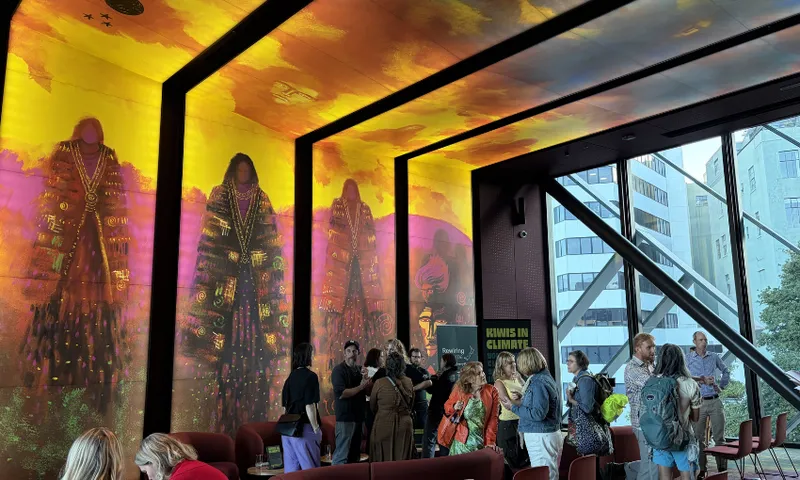
From left to right: Pip Wheaton, Martha Jeffries, John Lang and Marc Daadler seated in Ngā Pou Ruahine which has stunning artwork by Darcy Nicholas (Te Āti Awa, Ngāi Te Rangi, Taranaki, Ngāti Ruanui, Ngāti Hauā).
Made possible by


Books editor Claire Mabey reports back on ‘Kiwis in Climate’, the inaugural public event at Wellington library’s stunning new event space, Ngā Pou Ruahine.
“Will our species survive the climate crisis? That’s a good story,” said award-winning film maker and climate communications specialist Martha Jeffries, one of three panel members taking part in “Kiwis in Climate”, the inaugural public event at Ngā Pou Ruahine, Te Matapihi Library’s lush, adaptable space for public events.
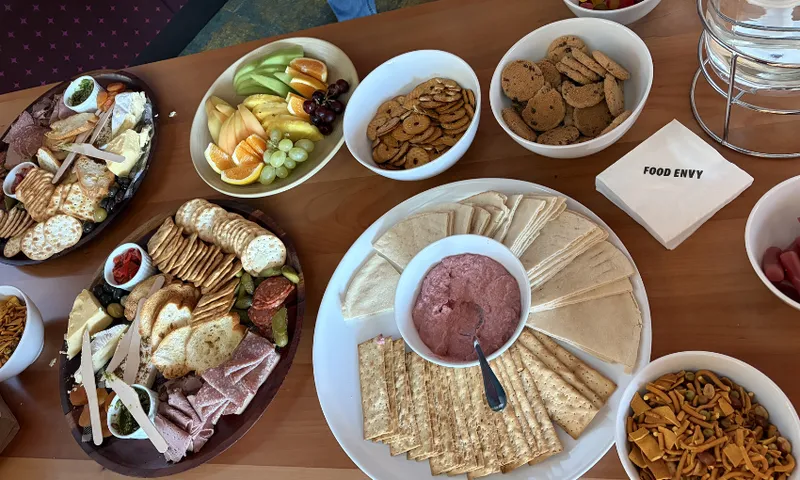
Early evening sunlight streamed in through the wall-to-ceiling windows and over an eager crowd seated on aubergine-coloured couches, kidney-bean shaped bench seats, beanbags, rows of sleek new chairs, and hovering around a generously laden snacks table providing sustenance to sit through what I suspected was going to be a sobering conversation.
The Kiwis in Climate event was riffing off the book of the same name – Kiwis in Climate: Voices for climate solutions in Aotearoa New Zealand, edited by Tessa Vincent. It’s a weighty tome arranged in four parts: “Context”, “Community”, “Business” and “Government” and includes contributors such as Sophie Handford and Mary Moeono-Kolio (on the role of the youth climate movement in fighting for climate justice); food systems expert Emily King; founder of Go Well Consulting Nick Morrison (on why sustainability is good for business); and lawyer Jacinta Ruru, who writes on the topic of giving voice to Iwi in caring for lands and waters. Host of the event, social entrepreneur and “systems changer” Pip Wheaton, explained that the book was designed with busy, distracted people in mind – we’re supposed to be able to read it one digestible chunk at a time.
Wheaton, Jeffries and fellow panelists, Net Zero Tracker‘s John Lang and Newsroom’s senior political reporter Marc Daalder, honed their conversation in on the subject of climate communications and specifically, why it can be so ineffective. Wheaton cut straight to the heart of it by asking Jeffries how climate discourse could get beyond the base.
“We’re not entertaining people,” was the crux of Jeffries’ reply. She spoke to the fact that climate stories can be dull, impenetrable and off-putting with doom-and-gloom angles that turn audiences off by evoking feelings of nihilism. Jeffries was a lively speaker, passionate and energetic: it’s easy to see why she’s been pulled into a conversation that is inherently distressing for anyone remotely concerned about the state of the planet.
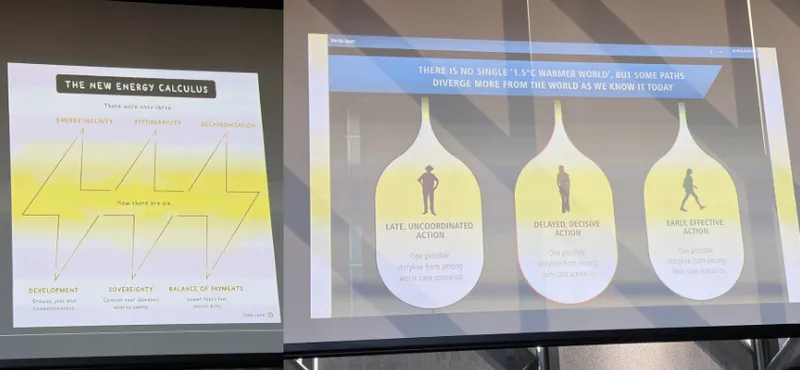
John Lang’s contributions to the conversation were centred on infographics. He shared a range of slides, illustrating a palpable belief in the power of metaphor, the principle of “image before words”, and for trying to stop people in their doom-scrolling tracks with easily digestible visual explanations. Such methodology can combat dense, science-heavy reportage and can capture attention particularly at a time where climate discourse in some media outlets can be problematic. He referred the “Net Zero backlash”, a trend whereby “Net Zero” is being decoupled from climate stories in mainstream media, at least in the UK where he’s based.
Newsroom’s Marc Daalder spoke to the disheartening fact that climate coverage peaked in 2022 and has since seen a steady decline. He pointed out the lack of dedicated climate journalists and the decline of purposeful coverage, citing Stuff’s Forever Project which launched in 2020 with a hiss and roar but has steadily lost momentum. “The media funding model is broken,” he said, explaining that while mainstream media’s audience engagement and reach exploded over the Covid pandemic, the fact that the public service role of mainstream media is not connected to its revenue model meant that media companies still lost money as advertising income dropped off a cliff. Daalder’s solution was for all journalists to see themselves as climate reporters – riffing off Jeffries’ insistence that climate needs to be the context for every story we tell.
“We don’t have an energy problem,” said Jeffries in response to the question of why climate solutions aren’t being rolled out, “but a power problem”. Inevitably politics was central to the conversation. “It’s been death by a thousand cuts,” Jeffries said in relation to the current government’s dismantling of climate policies – action for which the government is currently being taken to the High Court by Lawyers for Climate Action and the Environmental Law Initiative, who are arguing that the changes are unlawful and risky.
The panel all agreed that climate solutions are there for the taking, but that lobbying by the fossil fuel industry has been successful in persuading politicians to maintain the status quo. “The problem is,” said Jeffries, “a lot of people don’t know what good climate policy is. It goes beyond EVs and recycling, but we haven’t done a great job of explaining that and the other side has a lot of money invested in confusing people.”
Daalder wanted people to realise that power can be reclaimed in the fact we live in a democratic country and that we have spheres of influence: we can exert power through consumer choices, by voting and telling politicians what matters to us, and by being role models to our own communities.
The audience question time raised the issue of mental health in the face of the climate crisis. Wheaten and Jeffries agreed that there is a mental health crisis that runs alongside climate discourse: “There is grief, there is sadness and there’s guilt,” said Jeffries. “And we have to process all of that before we get to excitement and joy.” Wheaton elaborated by explaining that without processing the distressing feelings that go along with witnessing the destruction of the environment and with it the quality of life on earth, the positive stories of progress (where excitement and joy comes in) can feel disingenuous.
Lang closed the conversation with a plea for institutions to be fought for, speaking about how distressing it is to see the undermining of the Climate Change Commission and how the ideas generated by such institutions need to be valued so that when political winds change direction, solutions are there for the taking.
As I made my way down the stairs, all the way from the top of Te Matapihi to the ground floor, I considered the fact that the loss and return of our central library is both a great story and a potential climate metaphor – for the basic infrastructure that we stand to lose if it’s not talked about, fought for and protected.
Kiwis in Climate: Voices for climate solutions in Aotearoa New Zealand, edited by Tessa Vincent ($45, Bateman) is available to purchase at Unity Books.
The Spinoff Books section is proudly brought to you by Unity Books and Creative New Zealand. Visit Unity Books online today.

Claire Mabey
Claire Mabey is a children's author of The Raven's Eye Runaways, The Raven's Eye Rebellion, and a picture book Cass and the Beast illustrated by Jill Calder. For a long time Claire worked on literary festivals and is the founder of Verb Wellington. She lives in Te Whanganui-a-Tara with her partner and son.


