The greatest children’s books in the world, according to our childhood selves

Remember when you were young and some books shaped your very brain?
Made possible by
It’s New Zealand Children’s Book Week! We celebrate by remembering the books we loved most when we were kids.
Remember when you were young and your brain was a fresh new page and you had time, and little else to distract you, to pick up a book and immerse in it until you felt like you were inside it? Hanging out with Geronimo Stilton or Anne of Green Gables or Jo, Bessie, Fanny and Dick up in the Faraway Tree? There’s a special alchemy that happens when a child’s mind meets a book that understands them: those early reading experiences settle in our bones and stay with us for the rest of our lives.
To celebrate the very first New Zealand Children’s Book Week, we’ve picked out the books that made the biggest impact on our childhood selves – even if we can’t remember the title or find any evidence of the book ever existing (read on for mystery!).
Anne of Green Gables by Lucy Maud Montgomery
I ordered my first copy of Anne of Green Gables from the Lucky Book Club catalogue when I was in primary school, and stepping into Lucy Maud Montgomery’s world set me on a lifetime love affair with all things Anne. Who was this young Canadian heroine who was equal parts naughty and clever, brash and courageous, impulsive and optimistic? Anne had a face full of freckles, just like me, and even though she always said the wrong thing and was forever getting in trouble, she never stopped being full of the wonders of the world. The glorious 1985 TV series starring Megan Follows only strengthened my love for my literary kindred spirit, and even now, a billion years after I first opened that green book with the drawing of the red-haired girl on the front, Anne of Green Gables is still my go-to comfort read. / Tara Ward
Bow Down Shadrach by Joy Cowley
This is the first book that made my cry – properly weep – and cemented my adoration and slight fear of Clydesdale horses. Shadrach is an ex-circus horse and adored pet of Hannah and her brothers. When Hannah discovers that Shadrach has been sold to dreaded Wuff Stuff, a dog food factory, Hannah mounts a treacherous rescue effort. I had a horse when I was a kid (a knackered old pony) and every time I fed the dog that repulsive goo from a can I felt sick, thinking of Shadrach and Wuff Stuff and Hannah. Cowley, oh Cowley! What a writer. What a tale. / Claire Mabey
Dinotopia by James Gurney
This was one of my most treasured and formative childhood books (I went to a paleontology summer class as a child – yes really – where they said I “showed promise”). Was it the fantastical premise, the anthropological approach or the sublime illustrations that captured my attention? Who’s to say. Is this a distinctly millennial fixation? Possibly. Revisiting James Gurney’s book 30 years later, when I was gifted another copy, proved it’s just as delightful for grownups. And I’d still happily be shipwrecked there. / Emma Gleason
Each Peach Pear Plum by Janet and Allan Ahlberg
This is the first book I remember full stop. Before I could read I was enchanted by the detailed, delightful illustrations and then, once language kicked in, it was that propulsive, building rhyme weaving an all-star cast of characters. The witch in the bramble leering behind Jack and Jill was a deep cut; and Robin Hood in his cherry woodland home complete with bookshelves on the trees was maybe even my first crush. I’ve still never made plum pie (so much to live up to!) but that giant pudding at the end of Each Peach is my favourite depiction of communal feasting. / CM
All of Paul Jennings
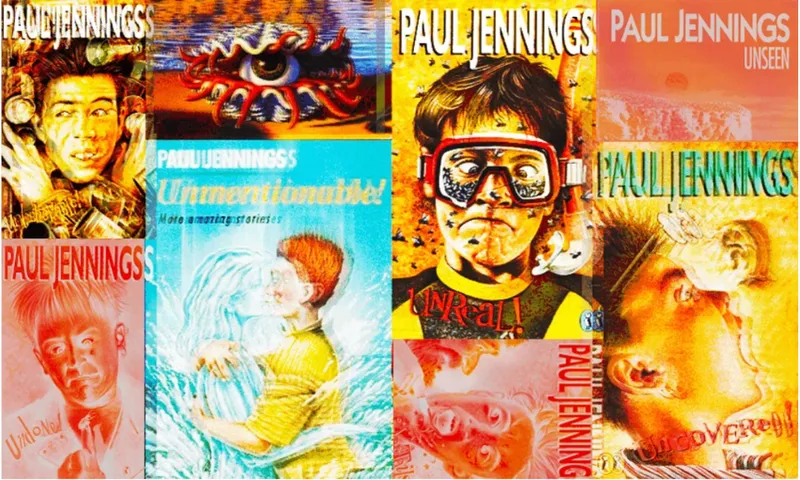
So strange. So Australian. I think my love of unsettling short stories can be traced back to prolific cult author Paul Jennings. This is the man responsible for Unreal!, Unbelievable! and The Gizmo, shaping a whole generation’s reading diet and pop culture taste. The covers are seared in my brain (and I’m not alone, judging by Alex Casey’s dedicated ranking) and so are the stories. To a soft 1990s brain raised on a diet of roll ups, television and chlorinated pool water, tales about ill-fated ice maidens, severed fingers and cane toads felt illicit, almost dangerous, and certainly weird enough to compete with whatever trash was on the telly. / EG
Owl Babies by Martin Waddell and illustrated by Patrick Benson
When your mum is a new-entrant teacher, it’s instilled in you from a young age how important picture books are. My mum also always stressed that there aren’t that many good ones. Owl Babies is a good one. I was easily frightened as a kid, and there was nothing scarier to me than the idea that my parents would go away and not come back. I was also the youngest of four siblings, and this book puts the emphasis on the youngest child, which I always appreciated. In the book, the owl siblings wait for their mum to return and start to worry that she might not. They worry and worry, turning the idea over in their head. The repeated refrain in the book is, “All owls think a lot.” Thinking too much, and in a way that doesn’t help, has followed me into adulthood. Maybe that’s why I connected with those sweet, concerned owls so much. I hope their mum comes back soon. / Robbie Nicol
Squids Will Be Squids by Jon Scieszka and illustrated by Lane Smith
Squids Will Be Squids is honest in a way that kids’ books often aren’t. It’s honest about the fact that a lot of people suck and are annoying to be around. They’re also not evil. They’re just unpleasant and you have to spend time with them anyway. People might be more familiar with Scieszka’s other books, like The Stinky Cheese Man and Other Fairly Stupid Tales or The True Story of the 3 Little Pigs! Both of those books made me excited about satire and breaking the fourth wall, but it’s the morals of Squids Will Be Squids that I have taken with me into adult life. It’s the types of annoying people that Scieszka describes and how he categorises them for you that I continue to think about most often. For example, the titular Squid. She never wants to do any of the stuff other people are suggesting, but also won’t suggest anything fun to do herself. In the end she just leaves and everyone’s stoked she’s gone because she sucks. The lesson? Squids will be squids. I think that’s an important lesson for a child to learn. / RN
The Call of the Wild by Jack London
The first real classic I read, The Call of the Wild transported me to a foreign land in a time long forgotten. I remember strangely seeing myself reflected in the protagonist Buck, a dog forced to shed his learned behaviour and instead rely on primal instinct in order to survive. It was a different style of writing for me and expanded my literary horizons forever after. / Liam Rātana
The Magic Faraway Tree by Enid Blyton
Of all Enid Blyton’s books, this is the one that really, really got under my skin. Both quaint and unsettling, the series followed Jo, Bessie, Fanny and Dick (tragically renamed Frannie and Rick years later) as they befriended characters like Moonface and Silky, exploring the infinite worlds above the tree. For a child, the idea of places with no rules, plenty of magic or sweets galore is understandably appealing. But there was also something intriguingly horrifying about the transient lands and the risk of being stuck. A little danger does young readers good, I think. / EG
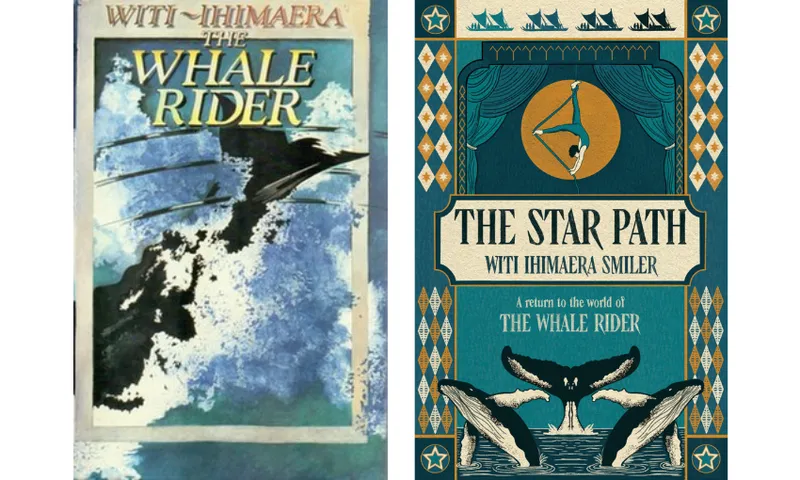
The Whale Rider by Witi Ihimaera
I still have my copy: hardback, that impressionistic cover, full of energy. When I pick it up I travel back in time – to when 10-year-old me was up late in bed, sneak-reading, totally engrossed in Paikea’s story. The Whale Rider is the first novel I remember reading that was set in Aotearoa. I was obsessed with whales (I badly wanted to be the kid in Free Willy) but this novel struck an entirely different note: it expanded my sense of place, my understanding of where in the world I was living – Paikea’s story was an introduction to te ao Māori in a way I hadn’t before accessed from a book. Ihimaera is also the very first author I ever saw in real life: I remember vividly the passion with which he spoke about making up stories as a child. Watching him, spellbound, was without a doubt the moment that catalysed my hunger to become a writer. PSA: Penguin NZ have just announced that Ihimaera is releasing The Star Path, a return to the world of The Whale Rider this September and I cannot wait. / CM
Tu by Patricia Grace
This was the first book I remember reading that I felt genuinely connected to. It was about Māori men and the battles, both figurative and literal, that we face. As an impressionable teenager, Tu aided my development into a man. It gave me perspective and understanding, particularly around what my grandfather experienced not just in the Second World War, but also upon return to Aotearoa. / LR
[Maybe: Better Safe Than Sorry] by [Unknown]
I never read more veraciously than I did as an under-five. All the 80s classics: Peepo, Spot, the hungry caterpillar… But the book that had the most profound and lasting influence is a less celebrated title, one I have been unable to find any evidence of online. The basic premise, and I think the title, was “better safe than sorry”. In my memory, each page presented a different scenario where a child might come a cropper – crossing the road, riding a bike, annoying a dog etc – to ram home the message that’s stuck with me to this day. Is this book responsible for making me the overly cautious adult I grew into? Maybe! Do I owe my life to it? Also maybe. If anyone knows the book I’m talking about, please get in touch. / Calum Henderson
Find out more about New Zealand Children’s Book Week on Read NZ, 15–21 August, here.
The Spinoff Books section is proudly brought to you by Unity Books and Creative New Zealand. Visit Unity Books online today.

Group Think
Multiple Spinoff contributors coming together to collaboratively author a post, video or podcast.


