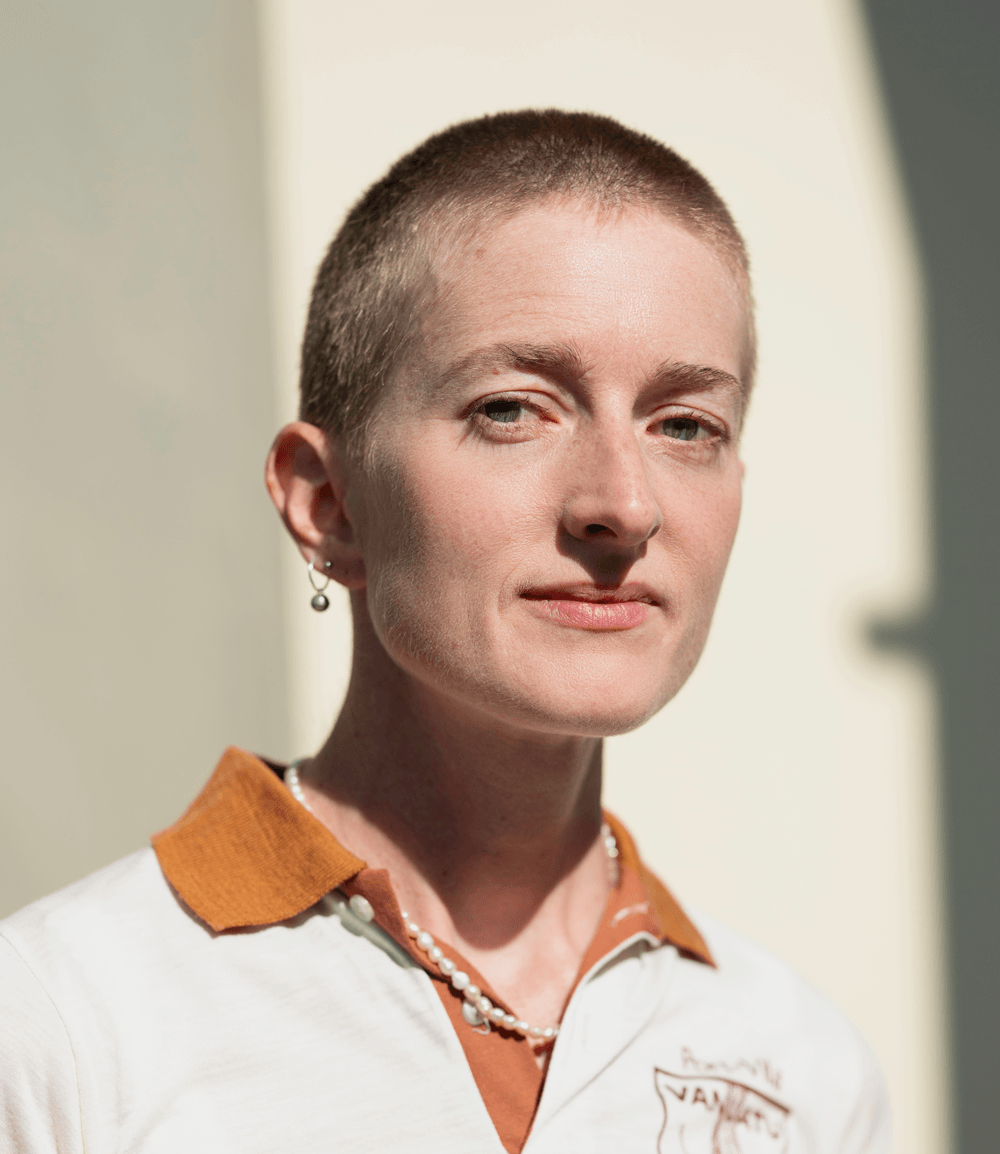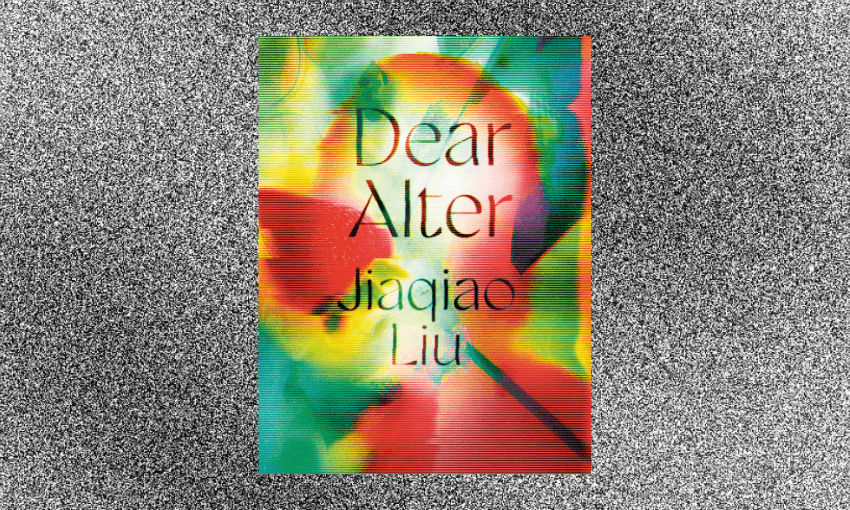


Poet Jiaqiao Liu explains the complex truth behind the AI used in their collection, Dear Alter.
Every time someone asks what my book is about, my answer changes. Robots, memory, souls. This android I met one time and how I stood there for half an hour simply watching it move. Gender, probably. Cyborg consciousnesses, sure – but not AI itself, not really.
Last month, there was quite the commotion in Aotearoa (and beyond) over news that two books were banned from the Ockham New Zealand Book Awards for their AI-generated covers. In response, the New Zealand Book Awards Trust altered their rules to allow AI covers, but not AI-authored text. Any book containing AI-authored text is still not allowed entry.
To my bewilderment, this includes my debut poetry collection, Dear Alter. Bizarre is an understatement – anyone close to me knows that I use an encrypted email client, that I’ve migrated from Google Docs to an alternative with zero AI integration, that I refuse to have my photo taken by tourist companies in case it ends up on a public Facebook page that then gets scraped for training data, that I refuse to give any personal device my biometric information, and that I believe all household appliances (with one exception) should be dumb as bricks.
Dear Alter is not about AI, but it is, in part, about a Roomba – as well as the connections between people, between people and machines and the celestial, language’s failures, and queer possibility. The book contains three poems using lines generated by Verse by Verse, a now-defunct experimental “pre-LLM neural language model” trained on the work of 22 American poets from the 1800s to the mid-20th century (as well as a larger corpus of English poetry, both found on Project Gutenberg; plus internet forum comments). These poems are part of a series called “transmissions from an empty museum”: a search for language with which to convey truths, desires, experiences, and anything else that resists easy description. The speaker (who may be human or may be an android) tries on voices of poets who have gone before, like a child imitating accents, or like Goldilocks trying out chairs. Or, like a young artist.

In 2021, when I wrote the first version of the manuscript during Te Herenga Waka’s IIML Masters programme, OpenAI had not yet released ChatGPT. Meanwhile, it was not a search for an “AI writing partner” that brought me to Verse by Verse. Rather, I was looking for tools I could use to remix text.
Remixing the words of others is a tried and true poetic practice. The cento, for example – a form popular with Modernist poets like T.S. Eliot – is comprised entirely of other texts, creating resonances, surprises, dialogue. In my “transmissions” series, voices of long-dead writers echo through the empty museum, alternating with the voices of the collection itself, remixed and made strange (by inputting a previous draft of the book into Gregory Kan’s leaves.glass text manipulation tool). This is what Verse by Verse was to me: an experiment, an opportunity to fall back in love with language’s delights and oddities.
By the time I returned to edit the book, the world had learned a great deal more about Large Language Models (LLMs) and the generative AI (tools used to generate text and/or images, e.g. ChatGPT) built on them, with varying degrees of willingness and enthusiasm. At the same time, it has become increasingly difficult to engage in thoughtful discussion around AI use, due in no small part to the tech industry’s deliberate hyping up of the term, applying it to a huge umbrella of tools and applications, depending on the exact processes being automated. Since I do not live under a rock, I considered whether it was appropriate to include those three poems. In the end, I decided to leave them in.
Since Verse by Verse was trained on long dead poets, my use of it was not harming a living creative (financially or otherwise), nor was I misrepresenting or demeaning their work (though it could be argued, of course, that having your work fed into a generative model is inherently demeaning). Compared to LLMs like ChatGPT and Gemini (Google’s rival version) which harvest from the entire internet with nary a citation, Verse by Verse’s specificity (22 American poets) was one of its selling points. Upon selecting one to three poets and providing a starting line Verse by Verse suggested lines in each poet’s ‘voice’ for the user to select, which they may then arrange as they see fit. It was presented as an experiment in augmenting the creative process – as inspiration, rather than replacement. It felt only natural to include the tool, and selected poets, in Dear Alter‘s acknowledgements. Furthermore, with such limited scope, the environmental impact of Verse by Verse was smaller than LLMs like ChatGPT. There were no concerns around sensitive or personal data. Yet these justifications are retroactive and purely based on one poet’s personal morals – not exactly a solid foundation for an organisation like the NZ Book Awards Trust.
In truth, the growing “AI boom” made me reluctant to publish this collection. I felt the constant need to clarify: my AI wasn’t their AI, it’s a story, a sci-fi fantasy world, a metaphor! Poets are less beholden to fact than non-fiction writers, but responsibility weighed heavy on me in my post-MA burn out. I bounced between “oh god people are going to think I’m a tech bro” and “what does it matter? who is ever going to read this?” (and the occasional fleeting post-edit “I’m a GENIUS”). Though I know I can’t control how others perceive my work, I hated that I might be misunderstood in this specific way.
I do not believe, for instance, that ChatGPT has a soul, or any kind of agency. I do believe, stubbornly, in the human ability to connect with just about anything – from cars to clouds to constellations. I write poetry about technology because I love the humanity of it all: the acts of creation, the slippages in understanding and communication, the constraints and mistakes, the failures of categorisation. I wrote Dear Alter because the narratives constructed by companies like OpenAI – that AI will solve every social ill, that robots will take over society, that we will transcend labour and our physical bodies – are absolutely, violently dull. Literally violent, because they obscure current real world harms enabled by generative AI (e.g. the exploitation of ghost workers in the Global South labelling hate speech, deepfake scams (pdf), the toxic byproducts, labour and indigenous rights violations involved in mining raw materials (pdf), excessive freshwater use (pdf) and CO2 emissions).
If you are a thoughtful and patient reader, it is impossible to read Dear Alter and come away convinced the poet is a tech bro – or even that the book is about AI at all. I wrote Dear Alter because I feel a kinship with an android I met in a science and technology museum, and with my mother’s Roomba, and with the industrial machine in the art installation “Can’t Help Myself”, programmed to endlessly squeegee up a leaking red viscous fluid. I wrote the collection because I had a knock-off Sega Toys Poo-Chi as a kid but watching Boston Dynamics’s robot police dog acting cute made me want to puke. And also maybe because I’m a little bitter that it’s so easy for a software engineer to believe in a chatbot’s autonomy and personhood when our government just banned puberty blockers for trans kids (note: as of December 17, 2025, this ban has been delayed pending a judicial review).

I do not envy the NZ Book Awards Trust for enforcing blanket rules against AI-generated content. I do, however, believe these rules have been applied hastily and inconsistently, and could be revised further. In our current AI hype hellscape, restricting “AI-authored content” is not a terrible idea. (If I hadn’t been caught in the crossfire, I would have gone “huh. good.” and moved on with my day.) The Trust are setting new precedent for literary accolades – hence, perhaps, the growing pains. The Hugo Awards have been in the news for AI controversy this year, but for using ChatGPT to screen for panellists at an event rather than anything to do with submissions or judging. The Pulitzer Prize Board requires disclosure of AI use, but only for the Journalism category. Awardees have used AI tools for classification in order to analyse large datasets (e.g. searching through land grants written in 1800s cursive; detecting military vehicles in satellite imagery of Gaza) rather than generating images or text. Again, it pays to be specific in our language – classification vs. generation (vs. other uses like transcription/translation and recommendation).
The Ockham’s rules are a reflection of Aotearoa’s literary communities more broadly. While not all local journals explicitly forbid AI-generated content, those that do, do so emphatically: Landfall (fiction, non-fiction, poetry) requires checking a box to confirm submissions are original and not AI-generated, Headland (short fiction and creative non-fiction) does not accept AI-generated material, and Takahē does not accept work “generated or assisted by AI” though this stipulation is limited to general fiction and comics submissions. Sweet Mammalian (poetry) does not permit AI unless a poem is an “exceptionally exquisite” subversion of AI tools, accompanied by a clear disclosure.
Personally, I am more interested in the artistic reasoning behind a writer’s choice to use generative AI. The Tsinghua University professor who won second prize with a novel generated in 3 hours with student-level writing – simply to see if he could – does not interest me. On the other hand, Rie Qudan, whose Akutagawa prize-winning novel “Tokyo-to Dojo-to” (“Sympathy Tower Tokyo”) contains 5% AI-generated content, does. What she used generative AI output for was the dialogue of a character who…is an AI. While I disagree with Qudan on the details (I do not believe generative AI as it currently exists can be a true writing partner or editor) I cannot help but see the creative reasoning behind this choice – that’s literally how it talks!
And while I lack the skills to build my own language model, speculative fiction writer Ken Liu did just that: robo_ken is a simple deep-learning neural network trained solely on his own writing. At first, Liu was disappointed; it failed to produce even GPT-3-level sentences (any single author’s body of work is insufficient in volume for the purposes of training an LLM). Yet embracing its incoherence and randomness led to “50 Things Every AI Working With Humans Should Know”, an experimental sci-fi story where “a machine gets to write like [Ken Liu], and [Ken Liu] gets to write like a machine”.
Writers (and artists in general) have always had a nose for new technologies that might transform our practice in novel and unpredictable ways. Marginalised writers, especially: we are keenly aware that our humanity is conditional. Is it any surprise we tend to be more willing to experiment, given the complex, fractured lives we live? Language cannot hope to express everything, but it is still our home – as well as our playground. The delight Verse by Verse brought me could be compared to the joy of exchanging jankily autocorrected messages in high school – it was bad! It was clumsy! That’s the charming part! When I tried GPT-2 out sometime in 2019, it wasn’t polished like ChatGPT, but it too failed to delight me. So much of poetry is about play. What’s the point if these tools aren’t fun?
Today, in December 2025, the Google research page for Verse by Verse announces the tool’s closure and suggests using an alternative poetry writing partner: Gemini. I will not be doing that. Ethics aside, Gemini does not enchant me. Perhaps this is a me problem: I am specifically interested in what happens when language stutters and fails, when these tools skip like a dirty disc and reveal that communication is kind of a house of cards and we are all solitary existences trying to reach each other’s souls through imperfect means. And if the tool is boring… well, I’ll just pick another one.
Dear Alter by Jiaqiao Liu (Auckland University Press, $30) is available to purchase at Unity Books.