

The essayist and author of Green Sea recalls the childhood landscape of the Christchurch that once was.
This essay was commissioned by Kiran Dass for Word Christchurch’s 2026 edition of Cabinet of Curiosities.
I grew up in Christchurch, in the suburb of Sydenham. We didn’t venture beyond that neighbourhood much, but one exception was when we visited my uncle in the north end of town, in Redwood. He and my aunt lived in a kitset Lockwood home which I had seen them build, both the interior and exterior entirely polyurethaned pine.
My uncle had once been employed in the freezing works in what was called the bag room, where meat was packaged, and for a time would visit us on his lunch breaks, wearing his overalls and smoking a cigarette at our dining table and stubbing it out in a cut glass ashtray we kept solely for these visits. He had an extraordinary facility for slang, for phrases I have never heard from anyone else. “All hair cream and no socks,” he said of someone. Once I watched him work with my grandfather in his garage, making a wooden box. My grandfather cut timber for the bottom then passed it to my uncle to check, who told him the piece didn’t fit.
“How much am I out by?” my grandfather said.
“An ant’s cock,” my uncle said, passing the wood back.
My grandfather said nothing, but cut it again, the correct length this time, an ant’s cock clearly an understood unit of measurement.
We ate tremendous meals at my uncle’s house, prepared by my aunt, and when it came to time to leave, we drove back through what was now a dark city, the streetlights glowing. The highlight of this journey, its thrill and purpose in my mind, came in travelling the length of Barbadoes Street. It runs north to south only, a canal that carried us through a zone of shadow and secrets. This impression was aided by the fact we seldom travelled it in daylight, and by the strangeness of its name, so unlike the Englishness of the surrounding streets: Worcester, Gloucester and Hereford, and so unlike anywhere else in fact. I was unaware at this point of the existence of a country called Barbados. But even if I had been, the street name was not a complete fit. Whoever first wrote it down added an extra “e”, gifting us this long-lived typo, making sure its name was truly its own.
My mother believed that every part of the city was dangerous after dark, but most of all she said this about Barbadoes Street and we locked our doors for the trip. And so from the safety of our Datsun, I peered out.
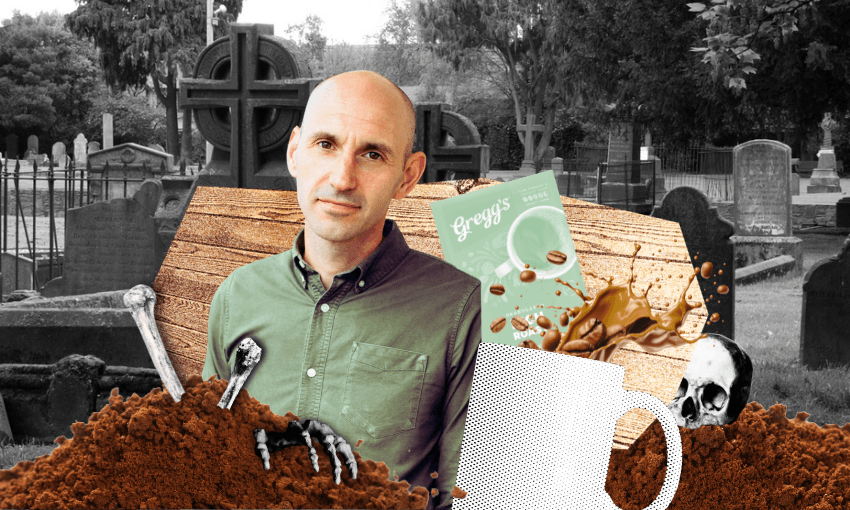
Near the start, the street bisected a cemetery, Christchurch’s oldest, dating to the 1850s. It contained the bones of eminent settlers and, due to the dangerous business of being young in those days, it held many children. A headstone for the Dollan family lists their 10 kids, the eldest only 10 years old, the rest dead before reaching the age of five. This cemetery was already full before that century finished, and was closed in the 1880s following complaints about a terrible stench emanating into the street. It seems likely this was simply coming from the swampy ground nearby, but even so, a member of the hospital board was driven to write to the newspaper warning of the dangers posed. He cited the case of a doctor in Italy who had bottled cemetery air and found it contained a compound called “Septo Pneuma”. When given to a pigeon, the bird died within three days.

The relatively short life of Barbadoes Street cemetery means it is a Victorian artefact entirely, with the tall, lurching tombstones of that era. As we drove past, I would look between them for ghosts. I was obsessed with ghosts then. So much so that my father once took out a classified ad in the Press advertising the services of my brother and I as ghostbusters. Thankfully no one ever called.
While I never did see a ghost on those evening drives, I did learn that the cemetery was home to at least one mystery. Among those buried there was a woman named Margaret Burke, the maid of a local politician who had been murdered by one of her fellow servants in 1871. A month after her burial, a damp red shape like a bloody handprint appeared on her headstone. Despite attempts to scrub it off, this bloody print returned. Over the years it became a tourist attraction of sorts, until eventually vandals destroyed the stone likely in an attempt to own a piece of the mystery for themselves.
The cemetery is just before the point where Barbardoes Street is intersected by the Ōtākaro/Avon River, and by Cambridge Terrace, an area that in early 20th century was the haunt of the Richmond Push – Push being slang for a street gang – who were said to abuse and even attack passers-by. From there, in our car we passed crumbling shopfronts – Kings Cycles, run then by an elderly man and his son, and which seemingly only sold and repaired bicycles that predated the Lange government. There were motels, the karate dojo and pubs, among them the faux baroque Provincial Hotel where iron hitching rings for horses were still set in the pavement outside. These were buildings that promised activity but the one distinctive feature of this memory is that I never saw another soul but for those in cars passing us. The street was always empty, belonged only to the shadows.
And at the very end, the high point, was the Catholic Basilica. It loomed, its tall columns and green dome dwarfing our Datsun. Two angels crouched beside a cross in the centre of the roof, and they watched us pass. The whole thing was lit at night, so that its Oamaru stone facade glowed white, a second moon on that dark street. It gave me goosebumps, was unlike any other building I had seen.

Buried beneath the floor of the Basilica, sealed under concrete was a collection of holy relics, items or even body parts relating to the saints and martyrs. They included human jaw and leg bones, vertebrae and the ground bones of saints. These were collected in Europe by the first Catholic Bishop of Christchurch, who held certificates to prove their authenticity. Relics were then an established part of the Church’s traditions. Many churches around the world claim to hold fragments of the cross on which Jesus was crucified. A village in Italy held an annual procession to display his foreskin. But by the 1970s, relics had become passé, too macabre and superstitious and at odds with the image of a modern church. In Christchurch, the decision was made then to bury them into the floor of the Basilica itself. This history was well described by journalist Oliver Lewis in 2021, who also wrote about the odd choice of receptacle for these relics. Those bones were stuffed into jars that had once held instant coffee. Among them too was a Schweppes bottle containing someone’s old Lotto ticket.
These details strike me as particular to New Zealand. Our insistence on the most practical solution to some need even when it borders on the profane. But it also feels emblematic of the Barbadoes Street I knew: old secrets and ancient bones, the mysteries of death and faith there all along, but out of sight and within the most unassuming of containers.
The Basilica was destroyed in the earthquake, those relics were dug out of the floor. The Provincial Hotel suffered a similar fate and has been demolished. I see Kings Cycles is now a café. The easy conclusion here is that the Barbardoes Street I’ve described is long gone. I could go further. My aunt passed away in recent years. My uncle is an old man living alone now, no longer in his Lockwood home, no longer quite as ready with his colloquialisms.
But really what I’ve described is something that never existed in the first place, at least not in physical form. It was a childhood landscape, a mood, a vibe. Which means it can also never really be gone for as long as I’m around to recall it all. A mystery like the Holy Trinity itself, both here and not.
The Father, the Son and the Holy Ghost;
Gregg’s Rich Dark Roast.