How one man's passion for rugby league is getting kids into reading

David Riley and some of his book subjects (Image: The Spinoff)
Made possible by


Ex-teacher and 'reading warrior' David Riley talks to Claire Mabey about his Ruby League All Stars series aimed at reluctant readers.
Claire Mabey: Hello, David. It's so good to see you! I thought I should ask you about the game before we start… How are you feeling? [We're speaking the Monday after the Warriors' season-ending loss to the Knights.]
David Riley: Oh man. I've been a fan since they started, so I have a thick skin. I think I'm just used to it, eh.
I was at the game; it was amazing. But people were swearing and getting really emotional, and like I just can't take it that seriously, you know. Like I love it, and I really want them to win, but it's not gonna make me turn into like a monster or anything.
CM: One of the things about sports that always scared me (other than balls flying) was those huge, unpredictable crowds.
DR: For sure. It is just random individual people, but they stand out. In the area where I was, it's only one or two people, but they're just really loud and they don't have awareness. They're a minority.
CM: Good! And this brings us to the subject at hand which is the opportunity you've seen to combine passion for league with books. Tell me more about your idea.
DR: So I was at the English teachers' big day out at the end of last year – I had a store there. Right next to me was the National Library who run a service for schools so I asked them, "What are you getting requests for that you can't supply?" And they said rugby league books. I was like, "Oh man, awesome!" Because rugby league is my love. Rugby league books have never sold, you know. I've tried to do it in the past but it's always rugby union. So I went off and visited a school librarian and asked what the boys were taking out and it was these ones [David holds up a copy of one of the books from the Football Superstars series]. There are heaps of books in this series: on Formula One, on football. So I put two and two together and came up with the Rugby League All Stars.
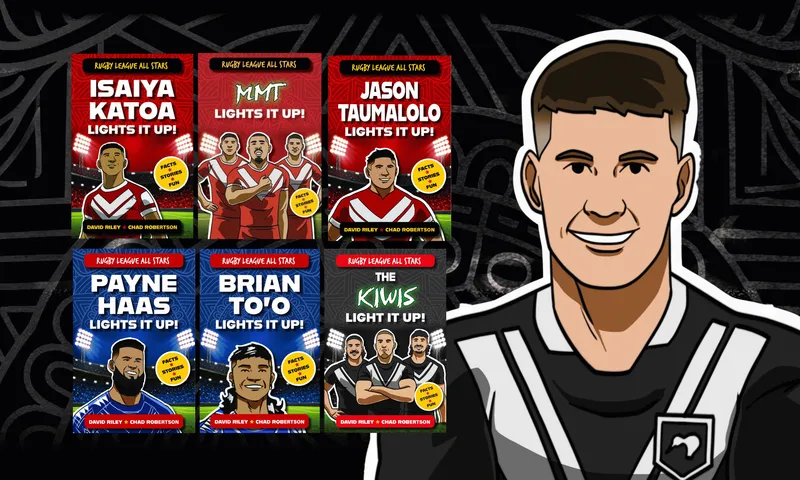
CM: I see they're numbered – is that so they can be collected?
DR: Yes. They're really aimed for kids who love League. They have lots of illustrations, big spaces between the chunks of text. But the thing that's different about these is that they're really New Zealand, and Pasifika. Like this one [David holds up a copy of David To'o Lights It Up!]. I know that Samoan kids who are League fans, even if they don't like reading, if they see this, they will pick it up.
CM: Tell me more about the series: are they all on individual players?
DR: Some are on a team, and others are on individual players.
CM: How do you choose which players?
DR: Easy. The ones who get the loudest cheers.
CM: The books haven't been out for long, just a few months. But how are they tracking so far? What kind of response are you getting?
DR: Well I'm already reprinting them. But the most important thing is the response from the boys is epic: one of the librarians told me the boys were all hovering around her as she was covering the book and she had to limit the borrowing to one week instead of two because they're so popular. I'm getting requests for more already!
I knew this would happen because these boys have been looking for league books for ages but there's been nothing for them.
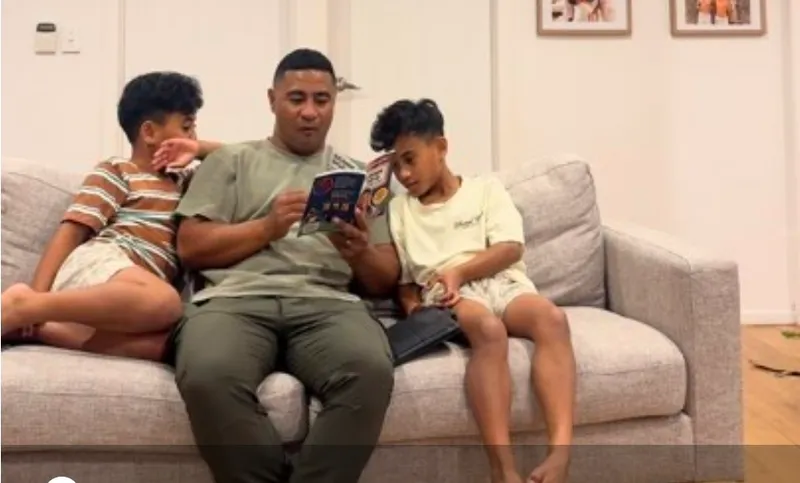
CM: You sent me a photo of one of your ex-students and his son reading one of the books: tell me more about that?
DR: So yes, he's one of my ex-students [actor Beulah Koale] and he's a dad now. He's got twin boys. And he told me that he hates reading and his boys hate reading. So I sent him the Brian To'o book. He tried to give it to his sons to read, and they asked him to read it with them, which is the best thing. And so he sent me the photo of him and his two boys reading it. And this is it for me: that's the ultimate vision, just bringing people together at the end of the day with a book. How beautiful is that?
CM: So beautiful. You've been "the reading warrior" for a long time now. What is it that drives you?
DR: Because I was a teacher and I saw what it was like for the kids who didn't read well – they struggled. When I started teaching the Māori and Pacific kids were at the bottom of all those achievement rates, and 20 years later, when I stopped, it hadn't changed, and a lot of it was to do with reading. So that was initially the main motivator: just trying to provide reading material for kids at school so that they can have stuff to read.
The other motivation is the one I just mentioned before of just knowing how beautiful it is to be connected around a book with your parents or caregivers. No devices, everyone just sitting together, feeling each other's bodies, hearing the breathing, hearing the voice, feeling the the words, talking about it together, like that's just a magic moment, eh? I'm really always trying to think of ways to reach dads, especially young dads, and show them that magic is free. Reading together is a way for them to bond and it sets their kids up for life. The more words the kids get when they're growing, the better they'll do when they get to school.
CM: You still visit a lot of schools. What are you seeing now?
DR: The same. The reading that kids, mostly boys, are doing is not reading that they're interested in. I don't want this to sound mean, but a lot of it is chosen by females and what I've seen in teachers is that we tend to choose stuff that we like. So some librarians might have certain thoughts about this rugby league book but it's actually a life book. It's about the challenges that Brian went through as he was growing up, sacrifices he had to make, and how he achieved his dream.
There are of course wonderful librarians out there. One I'm in touch with regularly is English, about as far different from Pacific children as you can get, and she thanked me for these books because now she talks to boys in her library who she'd never seen in there before. She talks with them about Brian To'o and these other players: the books have helped her to connect with the students who don't usually come into her library. And she sees the importance of that.
CM: There's definitely such a thing as privileged reading positions, eh.
DR: Yes. When I was an English teacher at Ōtara – very high percentage of Māori and Pasifika kids – this lady, she comes from King's College, and what does she do? She puts in our pigeonhole this reading list that came from King's College, and it was all these books that had no connection at all to our kids. I threw it in the bin because I knew there was no way they're going to read this stuff.
The books were awesome, classics. I love them, but there's no way that these kids are going to enjoy reading this stuff, especially if you've not coming from a reading culture in your own family.
CM: And forcing that stuff can kill reading.
DR: The other thing with killing reading is that a lot of reading is associated with testing. If you are constantly not achieving in those tests and getting told you're below average and you're underneath where you should be, that creates a negative connotation with reading.
CM: The Coalition for Books has proposed a New Zealand Year of Reading in its pre-election manifesto. What do you think about that idea?
DR: I really think that's a good idea. But I'm keen to think about how we target families, especially the parents that are not really reading.
CM: If we want kids to read we have to get adults to read, right?
DR: That's right. Especially for boys. If they don't see their dad reading. I think for some kids they see mum reading, teacher reading, but if Dad's not reading they think that's not what men do, that men don't read.
CM: How do you fund this project, David? Do you get funding?
DR: I've tried. It costs $5000 to make one book. I was declined by Creative New Zealand. I'm trying to figure out how to make it work because I really believe in these books and what they can do for kids and their families. I know for sure it'll get kids reading.
CM: I've seen it happen with the football series: kids I know who don't like reading but who love football go after those books. They love the player stories and stats!
DR: Exactly. We have to get the kids off devices, especially at home and especially at the end of the day. It's a difficult thing to think of everybody at home on their own device. Imagine all the parents reading to their kids: tonight that'll be happening all around Aotearoa. It's an amazing, cool thing and we need more of it.
CM: I couldn't agree with you more.
Rugby League All Stars books can be purchased from David Riley's website, The Reading Warrior.
The Spinoff Books section is proudly brought to you by Unity Books and Creative New Zealand. Visit Unity Books online today.

Claire Mabey
Claire Mabey is a children's author of The Raven's Eye Runaways, The Raven's Eye Rebellion, and a picture book Cass and the Beast illustrated by Jill Calder. For a long time Claire worked on literary festivals and is the founder of Verb Wellington. She lives in Te Whanganui-a-Tara with her partner and son.


