
Chris Hipkins prepares to cast his vote in Upper Hutt on October 26, 2026. (Photo: Hagen Hopkins/Getty Images)
In the last of The Spinoff’s leader profiles for the 2026 election, Lyric Waiwiri-Smith sits down with Labour leader Chris Hipkins, the career politician who has spent his whole life studying the game.
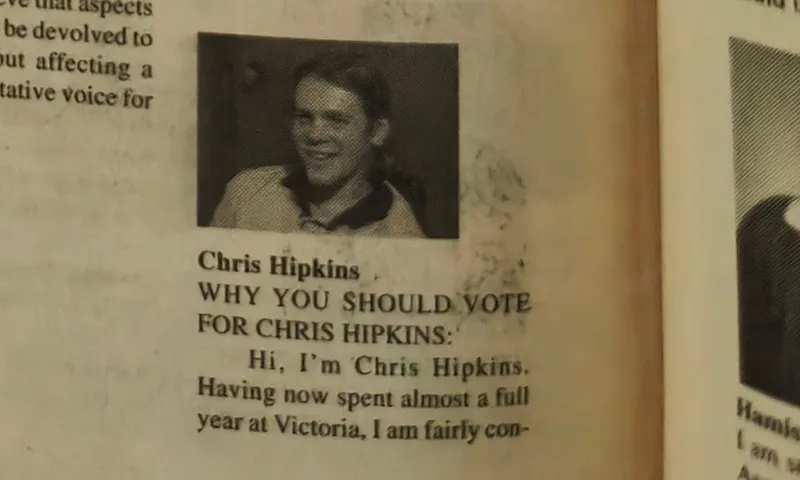
At 19, Chris Hipkins was already running in his third election. Beaming out from the pages of a 1997 issue of Salient, a baby-faced Hipkins is hoping you might elect him as education officer of the Victoria University of Wellington’s Students’ Association (VUWSA). Or activities officer. Hipkins isn’t fussy; he just wants a chance to put some “fresh new ideas” on the table.
It was his first year of a BA in criminology and politics, and “like many… I found the transition from secondary school to university a little daunting”, says the Labour leader now. The piece suggests he’d advocate for more activities like “the successful clubs day, the toga parties and the celebrity debates”, but there’s a hint of the minister-in-waiting too: “Education should be viewed as an investment in our future and should not just be a privilege for the wealthy.
“If you share my vision, vote for Chris Hipkins.”

Hipkins never really left student politics – the electorate just got a lot bigger. On the surface, there’s little that’s changed between the Hipkins of then and the one sitting across from me now. For one, he reckons his “values and beliefs have remained the same”, and for another, he’s still asking you to vote for him. The pitch, too, feels strikingly similar.
The campaign tactics, however, have evolved. The student Chippy’s electioneering strategy involved hijacking the first minute of lectures before the tutor showed up, to secure a “captive audience” and “give them an advertorial on me and why they should vote for me”. Hipkins was a newbie to public speaking, and felt it important to sport a shockingly bright yellow polar fleece to establish a personal brand. He could usually count on the law and politics students to humour him – and the commerce classes to heckle him.
Campus is also where Hipkins cut his teeth in political activism. In September 1997, he joined 300 other students in taking over the parliamentary lawn in protest of the Tertiary Review Green Bill, a university sector reform proposing greater privatisation. Hipkins was one of 74 protesters arrested at that protest – his father had to pick him up the next day after a night in a cell – and he was a first-term MP when, 12 years later, 41 of those protesters received financial compensation and a first-ever apology from the speaker’s office.
Student politics is also where Hipkins made the friendships that have shaped his political career. While VUWSA president, Hipkins met his future health minister Ayesha Verrall, who was the head of the Otago University Students’ Association. Verrall was then a flatmate of Andrew Campbell, future chief press secretary to Jacinda Ardern and Hipkins. While he was VUWSA president, Hipkins’ education officer was Fleur Fitzsimons, who would go on to become a lifelong friend, the vice president of Labour’s women’s chapter, a Labour candidate and the national secretary of the Public Service Association. Fitzsimons’ husband, David Choat, was also a contemporary of student politics and spent a number of years as Hipkins’ adviser.
Yes, Fitzsimons recalls Hipkins’ “terrible fashion sense” with contempt, but she also remembers his “intensely practical” nature. Sometimes that manifested itself quite literally – on one occasion, Hipkins brought his dad and a toolbox into the New Zealand Union of Students Association’s office to remove a jerry-built wall.
That practical streak also extended to the actual work inside the office. University was a “formative time” for the young Hipkins, who was exposed to the different shades of the left – the Maoists, the third-wave feminists, the pro-mana motuhake Māori. But his “personal discipline” meant Hipkins felt just as comfortable collaborating with the radicals as he did answering to the administration. “He was steeped in both institutions,” Fitzsimons says. “He could be the policy guy, and the guy waving the banners.”
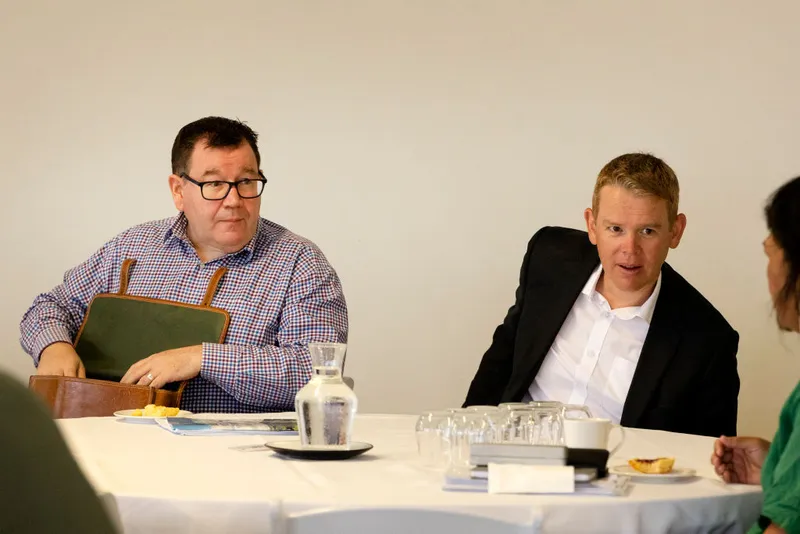
It’s this “unusual combination” that Hipkins still embodies as a political operator today, Fitzsimons says. Governing is not just an action but a “craft”, which Hipkins “studies and reflects on incredibly seriously”. That, lately, has looked like monitoring the rise of far-right political figures overseas and “trying to adopt the lessons that other countries have learned and apply them to New Zealand”.
Eternally a student of politics, and eternally ruminating over the end-of-term feedback. Hipkins has always been “his own worst critic, he will have criticised his own decisions, and we really don’t see that”, Fitzsimons says. “He does have humility about his own actions… He’s open to learning from his own mistakes. Lots of people in politics aren’t.” In case you were wondering, yes: Hipkins is one of those arduously analytical Virgos.
Even after nearly two decades in parliament (and 306 days as prime minister), some things remain a work in progress. “When he became prime minister I said, Chris, you’re gonna be on TV a lot, you need to dress better and get some tailored suits,” Fitzsimons says. “He goes, ‘don’t worry, Fleur; I just went to Ōtaki and got a whole bunch of suits on sale’. I just put my head in my hands.”

That premiership – in fact, the entirety of 2023 – was a particularly bruising time for Hipkins and Labour at large. Jacinda Ardern was out of the picture but resentment over the party’s Covid response lingered, ram raids were on the rise and the economic recovery post-pandemic was essentially nonexistent. Then came the succession of senior MPs and ministers – Stuart Nash, Kiri Allan, Meka Whaitiri, Michael Wood – who crashed and burned their political careers while the party was trying to mount a case for re-election.
We all know how that saga ended. Labour emerged from the polling booths with their 2020 vote share almost neatly halved, losing 31 seats in the blue wave and stepping back into the opposition. A teary-eyed Hipkins conceded his defeat onstage at the Lower Hutt Town Hall and retreated back to Remutaka, taking with him the dying breath of the sixth Labour government. It must have been a jarring realisation, that even after a lifetime of studying the craft of politics, you can still meet your biggest failure once you hit the top.
It seemed the only way forward was to start over again with a clean slate. “People had stopped believing the transformative promises,” Hipkins tells The Spinoff. “They wanted something more immediate – the reason the National Party resonated in 2023 is that they promised to fix the cost of living. That was the number one thing people were basing their voting decisions on, and we didn’t respond to that enough.” As the political adage goes – opposition doesn’t win elections; governments lose them.
What followed was a summer of reflection. Restless nights and continuous brooding led Hipkins’ partner Toni Grace – famously introduced to the country on election night – to intervene with a self-help book: Ryan Holiday’s Stillness is The Key. It sparked a genuine passion for stoic philosophy, an interest Hipkins feels has always laid dormant inside him without the words to identify what it is. Now, he’s the kind of guy who gets by on life advice out of The Daily Stoic or The Daily Dad, and reads Cormac McCarthy’s The Road because it was recommended in Holiday’s monthly newsletter. It’s the kind of earnest reading list that feels comically on-brand for Hipkins; nauseatingly microscopic and earnest about his own midlife crisis.
That period after the 2023 election was “a process of filtering through and going, ‘OK, how much of this was actually down to me and how much of this was beyond my control?’” He’s someone who believes in the endless pursuit of self-improvement and acquiesces to Fitzsimons' assessment of him as the self-critical sort, his own biggest punisher. “But I don’t see it as a vulnerability,” Hipkins says. “I firmly believe that you stop learning the day that you die. I think politics would be a better place if all political leaders had a bit more self-reflection.”
Hipkins lists off our political leaders who stumbled and rose again: Keith Holyoake, Helen Clark, Jim Bolger. The student of politics is certainly hoping history is on his side, repeating his belief that “some of our most successful political leaders in New Zealand have been those who have been around a while and have had a few setbacks along the way”. It’s more preferable, at least, to the Mike Moore route of leading a punishingly short premiership and the Labour Party to defeat at the polls.
You’re given “more reflection time” in opposition than in government, and Hipkins was determined to “make the most of it” by taking up diary writing, he says – something he wishes he did as a minister during the pandemic. “Because every day felt like a year, in terms of what you’re dealing with.” Now, with a second chance at electoral success, “I’ve had the opportunity to set our campaign on my terms, rather than inheriting something that was already mid-flight.”
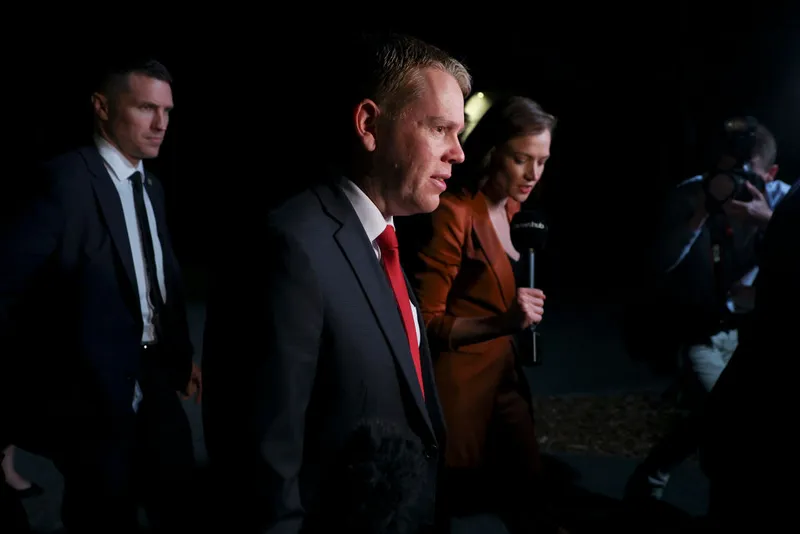
So, after all that self-improvement, what’s changed about this Chippy? He’s emerged somewhat tougher than last election, shedding that cutesy image of a sausage roll-eating boy from the Hutt and hoping for something more authoritative, the kind of guy who calls things “bullshit”. Often, Hipkins presents himself as the relentlessly forward-focused thinker – or the “radical incrementalist” – who’d rather not get bogged down by pesky press gallery journalists on whether this, that or the other Labour policy from days gone by will make a return. He’s also overly cautious of promising potential voters something he can’t deliver on, or bother repealing something a future right-leaning government will revive.
Still, for all the advice offered by Marcus Aurelius and Epictetus, Hipkins keeps letting things get under his skin. He bristles slightly when I suggest the last few weeks of the campaign, backdropped by gang scandals and an uninspiring poll, have been “wobbly”. You can always tell when, in the heat of a media scrum, your line of questioning is pressing all of his buttons. Sometimes, he even sheds a tear.
Suffice to say, he’s not the easiest politician to get a genuine answer out of. Especially this late in the campaign, Hipkins has become prone to snappiness – if you’ve been particularly pushy, you might even get a verbal cuffing from his staffers. Just ask John Campbell, who has spent months trying to get Hipkins to admit why Labour isn’t doing better in the polls. It’s not just the journalists who want to know, but some of the loyal party supporters who feel let down by Labour’s small-target approach and are hankering for something bold and transformative.
But for all of the self-reflection done in private, it often seems like Hipkins struggles to offer something honest to the public. Perhaps it’s easier to try to forget how the 2023 election and the events leading up to it unfolded. He’d rather not remind the electorate he was only prime minister five minutes ago. Ask him about the policies he championed so passionately as a minister – like the fees-free scheme – and it’s like you’ve mentioned that one time he wet himself at a fifth birthday party.
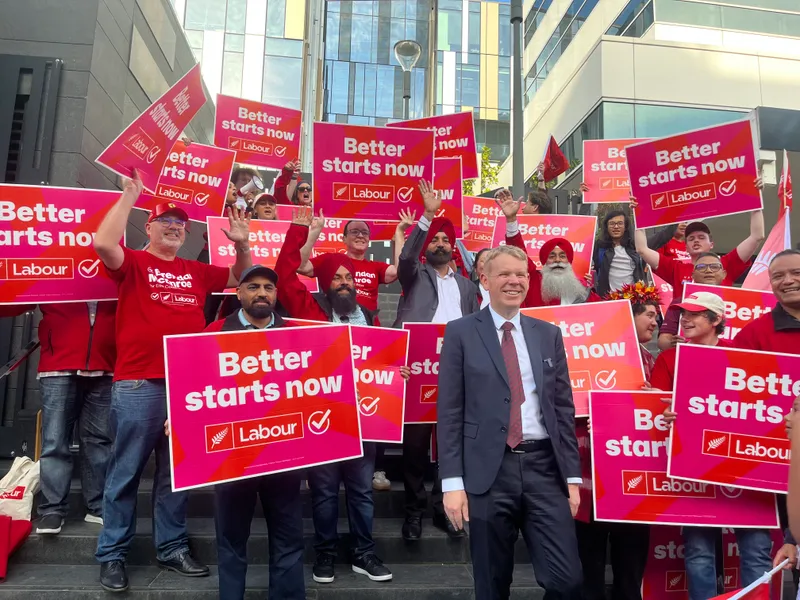
Now that he’s got a second chance, this version of Hipkins moves with more caution than ever. And his party has reinvented its approach entirely, from transformational changemakers to risk-averse universalism. The possibility of him getting a third crack at this if he loses this election is slim. But this time around, the roles are reversed – Labour has done its best to religiously regurgitate its “three free doctor’s visits” offer and remind us how much butter costs and how many of us remain unemployed. On the flip side, the major governing party has often found itself off-message and without the ability to gloat that they’ve brought the cost of living under control.
“Elections are fundamentally about the future. If all you’re doing is trying to scare people, then you’re not giving them anything to hope for,” Hipkins says. “Hope and fear are the two most powerful emotions in politics. Fear, you could argue, is probably the most powerful – but it does not lead you anywhere.”
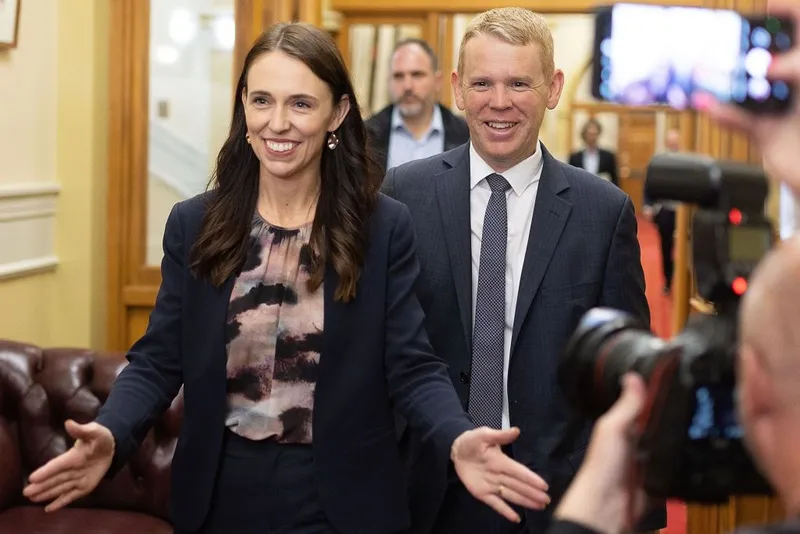
But shouldn’t that mean Labour should be doing better in the polls? Is his small-target strategy doomed to follow the fate of Labour UK and Keir Starmer, whose leadership cracked into a thousand little ming vase pieces. Why hasn’t this variation of Labour gone bigger and bolder like Starmer’s successor, Andy Burnham? Or, if we’re looking for an example closer to home: Hipkins’ predecessor Ardern? It’s not impossible to see the rise in the Green Party’s support as a response to the void of proposed transformative change in Labour.
“The idea that you have to be big and bold and crash major changes through, I’ve never been into that,” says the man who served as minister to Ardern, and oversaw some of the biggest and boldest recent reforms in health, the climate, gun ownership, housing and benefits. “We made some big and bold changes in the six years we were in government, and how many of them have lasted?”

Hipkins has a handful of other regrets in his political career. Many of them might seem to be his own party’s former policies, like funding a gang-affiliated rehabilitation programme or even breathing a word of “co-governance”. Keeping Michael Wood – who resigned from cabinet and was pulled in front of the privileges committee for failing to disclose multiple shares – at a literal distance shows he still keeps a protective barrier around his caucus inner circle. My joke that at least Stuart Nash was another party’s problem this time around only gets a weak laugh.
But asked about regrets, at the top of Hipkins’ mind now is how he treated the National education minister Hekia Parata when he was given the education portfolio in David Shearer’s shadow cabinet in 2013. That was the moment Hipkins began his transition from political nobody, a regular backbencher to a somebody – and he was going to waste no time in blasting Parata, whom he regularly labelled incompetent, over the failures of Novopay (the flawed payroll system that affected thousands of teachers across Aotearoa), and the government’s proposed classroom size reforms and school closures.
He worries that those who were “watching from the outside looking in” would have mistaken their verbal jousting for genuine loathing. "I look back on some of that and think, we could have had a very spirited and heated disagreement without the need for it to be personal,” he says. “I think I probably attacked her more personally than she attacked me.” Hipkins says he now gets “on really well with Hekia – I have huge respect for the work that she's done outside of politics". Parata did not respond to The Spinoff’s request for a response to Hipkins’ comments.
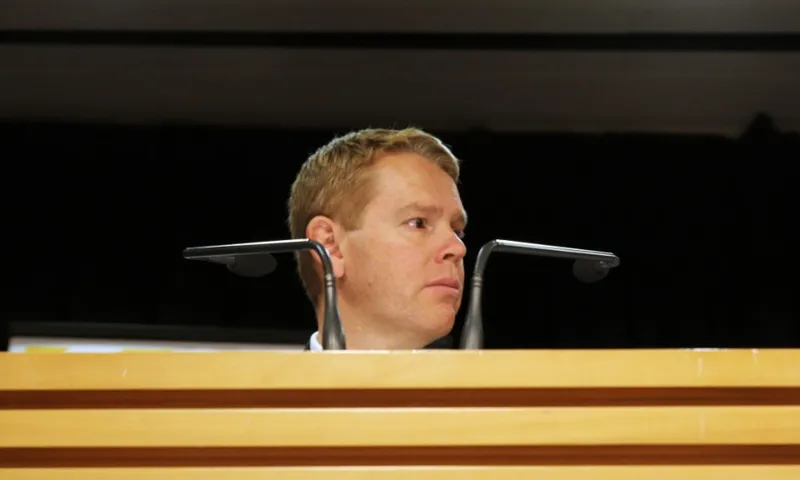
Perhaps it’s recent events that have Hipkins feeling regretful about attacking the politician, not the politics. Recently, prime minister Christopher Luxon dubbed Hipkins as “without a doubt the worst-ever” education minister that Aotearoa has ever seen. Ouch; in Hipkins’ experience, Luxon has “been the most personal of the major party leaders that I have seen in the time that I have been in politics”.
Hipkins is just grateful he didn’t begin his parliamentary career in the age of social media. Let’s be real: for all of the stoic philosophy he’s absorbed, he’s still a pretty emotional guy. He recalls his first full day of door knocking, and how he can “still remember” the fact that two of the 20 potential voters he had spoken to that day were “mean”. “In politics, you have to train yourself to focus on the 18, not the two,” Hipkins says. “The thing I found really hard about it was that those two people had never met me, and had formed a judgement of me simply because I was wearing a Labour rosette.”
There isn’t much time to reflect and unwind when you’re on the campaign trail. At this point in the game, your only salvation is the “15 minutes to stare out the window” you get while in transit from one photo op to another. Recently, Hipkins found some brief respite walking down a beach in Nelson – he reckons he must’ve been the only man in the sand wearing a suit. Well, he and the four members of the diplomatic protection service literally following in his footsteps.
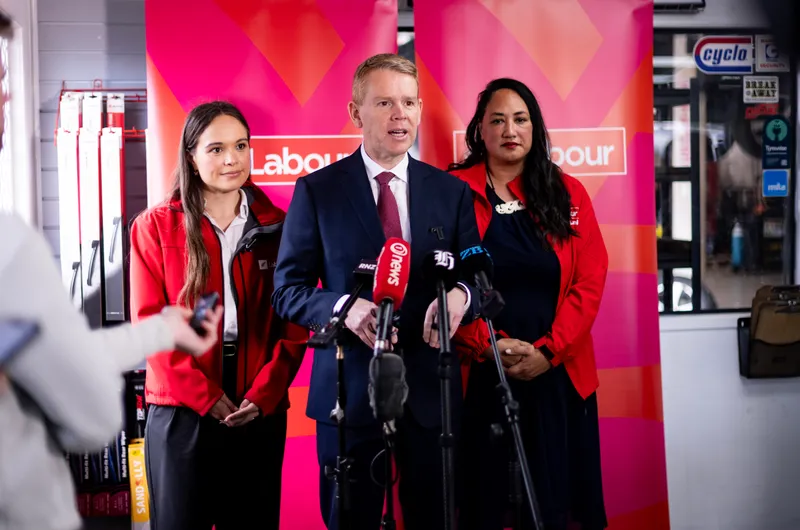
Hipkins has never really been one to divulge too much of his personal life. Perhaps that’s where the disconnect between him and parts of the electorate lie. Every now and then, he allows a peek behind the politician; he reveals he carries his bluetooth stereo everywhere with him, and the music he plays off it was probably Shazam’ed from an episode of Yellowstone. But, because his Spotify account is shared with the family, K-Pop Demon Hunters was his most listened to artist last year. Music helps in those many nights spent alone in a hotel room: “You just feel a little less lonely, if you can listen to a bit of music.”
There’s a smile on Hipkins’ lips as the interview concludes. The walk we’ve taken down memory lane, to days on campus and the political fights and polar fleeces since forgotten, seem to have made him go a bit gooey inside. But as he leaves he’s back to the stoic talking points, how nothing ever really stays the same and there’s always someone better we could be. Which reminds me of a recent conversation I had with his Kapiti candidate Sophie Handford, about impermanence and being able to let all things go. Hipkins nods: “We’re all just passing through.”

Lyric Waiwiri-Smith
Lyric is an award-nominated politics reporter at The Spinoff. She covers parliament from the press gallery, pens the weekly column One MP, One Pint and is endlessly curious about what makes our decision-makers tick. Off the clock, Lyric loves a live gig, a cold brew, and being a Wellingtonian (on a good day).


