John Campbell has been asking Chris Hipkins the same question repeatedly for several months now

There must be a way to resolve this. (Image: The Spinoff)
The Morning Report host really really really really wants to know why Labour is doing so badly.
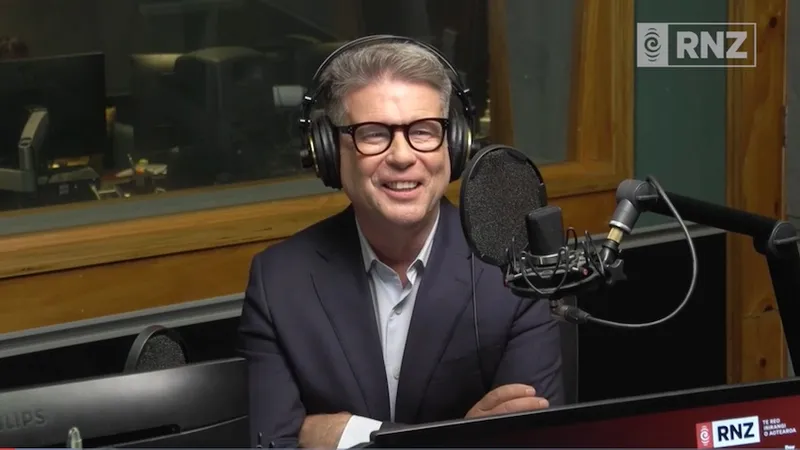
John Campbell almost always gives the same introduction to RNZ’s weekly interview with the leader of the opposition. “It’s Chris Hipkins time!” the Morning Report presenter exclaims, with a similar energy to a parent who’s trying to get their children excited about another meal of beans.
Campbell is clearly struggling existentially with the encounters. It could be the futility of trying to get Labour’s leader to stray from his messaging. Hipkins is a veteran and always makes sure to say “Labour’s focus is jobs, health, homes and the cost of living” at least eight times per minute.
But more than that, it’s the fact that for literally months now, Campbell has been asking Labour’s leader versions of the exact same question without once getting what he’s considered to be a satisfactory response. Forget Matt Damon’s comparatively painless jaunt across the Mediterranean, Campbell vs Hipkins is the year’s most difficult odyssey and it’s still going on.
The soft launch of the saga came in early June. At the time, Campbell’s main focus was Labour’s steadfast refusal to release policy. But the questions started transitioning into something like a critique of the party’s entire schtick. “Have you left it too late?” the presenter asked, wondering if Labour’s refusal to define its own political priorities had given the government an opportunity to define them in its stead. Then again, a minute later. “As David Lange once said, the best way to remain in opposition is to look like one. At some stage, Labour has to look like a government in waiting. In order to do that, you have to have policy, don’t you?”
Hipkins demurred. “I think Kiwis have had enough of big promises that aren’t delivered on, and I’m not going to do that,” he said, seemingly gambling on them preferring no promises at all.
It was a start. Ever since, Campbell has devoted large parts of his regular encounters with Hipkins to the question of why Labour is doing so badly, crappily, awfully or generally rottenly.
“I keep quoting that WB Yeats poem. It’s that beautiful line: ‘The centre cannot hold’. Why are the two central parties losing so much support?” Campbell asked on July 14. Met with a deflection about National’s feats of unpopularity, he rephrased. “But why aren’t you higher?”
Hipkins pointed out that Labour was actually doing pretty well for a first-term opposition party. “We’re probably one of the most popular first-term oppositions since MMP was introduced,” he said. Campbell responded by pointing out that its polling had flatlined since early 2026, despite the dire state of almost everything and government parties oscillating between stabbing each other and themselves. “If the government is so unpopular, why isn’t Labour doing better?”
No dice. But there’s always next time. On August 11, Campbell tried again. “If this coalition government is as bad as you and Labour frequently say it is, why does last week’s Taxpayers’ Union-Curia poll have National up half a point to 31% and Labour down 3.7 points to 27.8%?” he asked. “That’s one single poll in a whole series of polls that are released,” Hipkins replied. “They’re all down, aren’t they?” ventured Campbell. “Well, Labour’s doing significantly better than we were doing at the last election,” Hipkins replied. “You were annihilated at the last election,” said Campbell, before going back to the well. “If this government is as bad as you keep saying, why aren’t you doing better?” Hipkins started retreating into political truisms. “Polls don’t matter on election day,” he said. “Why aren’t you doing better?” repeated Campbell.
As they say, the definition of insanity is doing the same thing over and over and expecting Chris Hipkins to give a different answer to your question. But they also say that if at first you don’t succeed, try, try again to ask Chris Hipkins that same question. So on August 25, Campbell embarked on what would be his most lengthy and exhaustive effort at getting an answer on why Labour isn’t doing better. The result was, if anything, more fruitless. The government has been having a terrible, chaotic time, said Campbell. “Why hasn’t Labour under you been able to capitalise on this?” he asked. This time Hipkins wouldn’t even tangentially engage with the premise. “My message to New Zealanders is that better is possible. They don’t have to settle for more cuts, more job losses, more division under a re-elected National government,” he replied.
The conversation continued in this fashion for some time. “You are magnificently and assiduously ignoring my question,” said Campbell. “Why is Labour going down?” “We’re actually focused on fighting for New Zealanders, the National Party has shown that all they’re interested in is fighting amongst themselves. If they cannot organise themselves, they cannot organise the country,” said Labour’s leader. There was a long silence, redolent with pain. “Can I have another go?” said Campbell, at last. “Go on. This time. National have had a terrible time. The worst weeks in their time in government. Why is Labour down 1.8% during that period?”
Once again he’d leave empty-handed. Hipkins was acting like a politician, giving the answer to the question he wanted rather than the one he was being asked and coming off as rehearsed and evasive as a result. Instead of delivering a substantive defence of Labour’s positions and principles, he was defining himself and his party as simply something other than National. The Labour leader had found himself on the back foot, being attacked persistently on the same issue, and didn’t seem to be able to muster a convincing rebuttal or a credible opposing case.
Come to think of it, in a roundabout way, maybe Campbell did get his answer in the end.

Hayden Donnell
Hayden Donnell is a senior writer for The Spinoff. He previously worked at RNZ, TVNZ and the New Zealand Herald, alongside other media companies that have since closed down or been renamed. His primary passions are local politics and the Big Fresh animatronic fruit and veggies.


