National’s tax claims tripped up Labour, but misleading marketing comes with risks

National party campaign chair Simeon Brown, with some of the party’s recent online posts. (Photos: The Spinoff/National)
Simeon Brown got the better of Chris Hipkins yesterday, but he’s walking a high wire claiming Labour wants to introduce 11 new taxes.
The philosopher Harry G Frankfurt had a theory about the difference between lying and bullshitting. A liar is actively trying to obscure the truth. A bullshitter doesn’t care whether what they say is true or false, only whether it achieves its persuasive purpose.
People often express frustration at media outlets that dance around the word “lie” with cutesy substitutes like “mistruth” and “falsehood”. They do it, partly, because it’s hard to prove intent. Most of the time, when a politician says something false, it’s not necessarily a lie but what Frankfurt would refer to as bullshit.
One such example is a recent series of social media posts by the National Party claiming “the ute tax is coming back under Labour”. Anyone trying to find the news reporting or party policy documents where Labour said it wanted to bring back the Clean Car Discount (the feebate scheme which National dubbed the “ute tax”and scrapped earlier this term) would have been rather confused, mainly because those things do not exist.
The “source” – if you can call it that – for National’s claim was a three-week-old article in the NZ Herald about Labour candidate Michael Wood campaigning in Mt Roskill and in which he cited the Clean Car Discount as an example of something he had achieved in office. No reasonable reader would interpret that as an official Labour policy announcement.
Of course, National is within its rights to say it doesn’t trust Labour’s word when it rules out taxes it has previously floated, like the ute tax. But there is a fine line between accusing opponents of shiftiness and just outright inventing policies to get mad about.
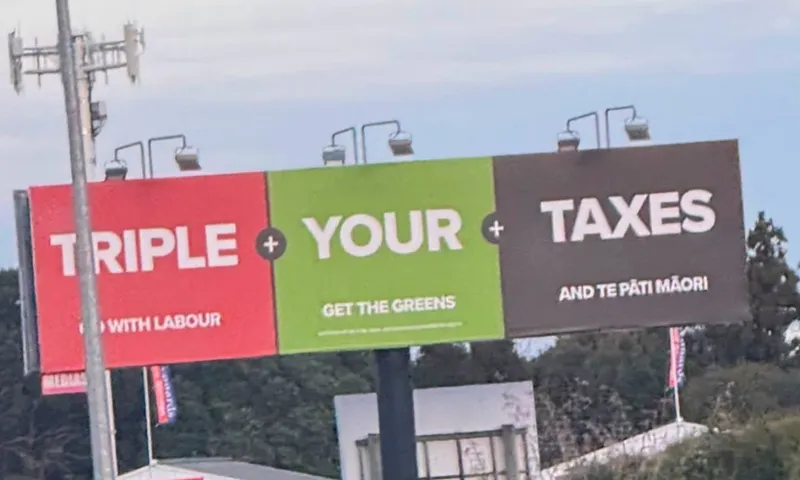
Similarly, National has rolled out prominent billboards claiming that the Labour-led coalition would “triple your taxes”. That’s obviously an untrue statement, and Luxon’s attempts to explain that “triple” refers to three opposition parties that want to raise taxes are too cute by half. People know what the word “triple” means, and it’s not that.
Within the last month, National has run a series of social media posts featuring pictures of Chris Hipkins and claiming that a Labour government would introduce six new taxes, then seven, then nine, and most recently, 11 new taxes. In reality, Labour has announced one new tax (the capital gains tax on investment property) and the reversal of a recently introduced business subsidy. The bulk of the other “new taxes” relate to proposals by other left-bloc parties, not Labour.
National would rightfully be upset if Labour was running around claiming National was going to scrap compulsory KiwiSaver and Working for Families, which were once National’s positions that they’ve moved on from. Or if Labour started running ads saying Christopher Luxon’s party wanted to buy back the BNZ or bring back the Treaty Principles bill, policies which actually sit with National’s coalition partners. Those claims would rightfully be criticised as dishonest.
While it’s easy to clutch at pearls and bemoan these tactics as a breach of the ninth commandment, the reality is that voters do not hold politicians to academic levels of factual accuracy. They generally accept that politicians will make exaggerated, hyperbolic, biased claims to persuade people to support their ideas over their opponents’. They are willing to overlook specific inaccuracies if they speak to a broader directional truth. And opponents who try to correct the record often just end up drawing more attention to an unpopular position. As Ronald Reagan famously said: “if you’re explaining, you’re losing.”
That’s what National Party campaign chair Simeon Brown managed yesterday. National has run posts claiming that Labour plans to bring in a tax on streaming services such as Netflix. Labour’s Reuben Davidson had previously floated the idea, but Chris Hipkins had explicitly ruled it out, and has been busy taking aim at National for pretending Labour still stood by the policy. Then, it emerged yesterday that Labour MP Willie Jackson had a member’s bill proposing a streaming tax in the biscuit tin, and Brown was happy to bring it to the public’s attention via social media. The bill was pulled and Hipkins was left with egg on his face as he spluttered about an “administrative oversight”.
So, clearly, this kind of campaigning can work, but it comes with risks. When people recognise that they are being misled – marketers call this “perceived manipulative intent” – they are more likely to disregard everything that source tells them. In other words: the consequences of misleading tactics is that people eventually stop trusting you. The other big risk is simply that it looks desperate – and after surviving two near-coups in a matter of months, that’s an image National will want to avoid.
Those risks might look OK to Brown, who holds the safe blue seat of Pakuranga. But now that he is the party’s campaign chair, these tactics are being implemented under the official National Party banner and are inherently linked to Christopher Luxon. Risking voters losing faith in your leader is gambling a lot more than risking voters losing faith in a safe MP.
Then there’s the bigger picture. National is pitching itself as the adult in the room, the responsible economic manager who keeps the numpties and yahoos in line, but it’s running an election campaign built on inventing its opponents’ policies. There will be days like yesterday when this will ratchet National up some wins, but in the long term they could leave voters wondering if it’s all just bullshit.

Joel MacManus
Joel MacManus is a senior writer for The Spinoff. He previously worked at RNZ and Stuff, and began his career at Critic Te Ārohi. His writing explores the political, economic and cultural systems that underpin modern New Zealand. He won the 2025 Voyager Media Award for Best Columnist, Opinion or Critique.


