I tried to buy the BNZ. It wasn’t as easy as Winston Peters made it sound

Hayden Donnell (left) has found acquiring a bank more difficult than Winston Peters (right) made it seem. (Collage image: The Spinoff)
There are legal hurdles, financial hurdles, political hurdles, hurdles embedded in the fabric of the universe.
Winston Peters made acquiring a bank sound like a piece of cake in his speech to party faithful in west Auckland on the weekend. “New Zealand First will be buying back the BNZ,” he said, to cheers and claps from the adoring assembly, before immediately making a handbrake turn down memory lane. “Remember, it was sold by the National Party, in total,” he said. The history lesson about 1992 was important, not just for reminding people Peters has been in parliament since the bronze age, but for delivering a ballpark figure on the policy’s cost. He said the National Australia Bank (NAB) had bought the BNZ for $1.1bn in 1992, or $3.5bn in today’s money. “Next the media will be asking ‘what are you going to pay for it, Mr Peters?’” he said. “Well, we’re starting with those things in our memory.” He seemed to be suggesting we could simply pay now what we sold it for then, which was actually $1.48bn, or around $3.4bn today, for the record.
Peters would later amend his estimate on the current purchase price to around $7.5bn – still a lot but maybe manageable for a South Pacific nation with big dreams. His reasons for the acquisition were provocative: Australian banks have been making excess profits off their New Zealand customers, and his opponents were making “stupid, neoliberal, nitwit comments of the past”.
But his policy was light on detail. Peters didn’t say how he’d pay for the bank or how he would go about compelling and completing the purchase. Still, he seemed so sure it would be easy that I thought I’d give it a go myself. “Is the BNZ for sale?” I asked the BNZ media team. “We don’t have any comment,” they replied. We elevated the query to the bank’s parent company, the NAB. “How would one go about acquiring the BNZ if they were interested?” I asked. Once again, no reply.
This was troubling, as a willing vendor is sometimes seen as an important component in a transaction. Massey Business School professor Claire Matthews said the fact the BNZ isn’t for sale could increase its asking price. “Almost everybody’s prepared to sell something if the price is right, but the price has to be right, which means they’re going to be wanting a lot of money.”
Matthews thought the baseline figure for acquiring the BNZ would be its market value of around $13.8bn. But it would likely command a substantial premium above that, given the NAB was under no pressure or obligation to sell. She estimated the price tag could go to $20bn or higher, particularly given Peters and I had only nominated the BNZ for potential acquisition, rather than casting our bank nets more widely. “If you want to buy a bank, why specifically the BNZ?” she asked. “If you were actually talking about improving the competitive sector, you wouldn’t be targeting a specific bank, you’d be saying, we think we need to do something, we think a merger with KiwiBank is the way to go, now let’s do some analysis and work out which is the best one.”
Sure, that might be what you’d do if you were only hoping to actually achieve something rather than also continuing a near 40-year-old grudge against the minister of finance responsible for selling the bank, Ruth Richardson, but that’s not the world we’re living in. Thankfully there was another way to make the acquisition. Under Australian law, I could trigger a hostile takeover of the NAB by simply buying 20% of its shares. The bank’s market capitalisation is around $135bn, meaning I’d need roughly $27bn to kick off the process.
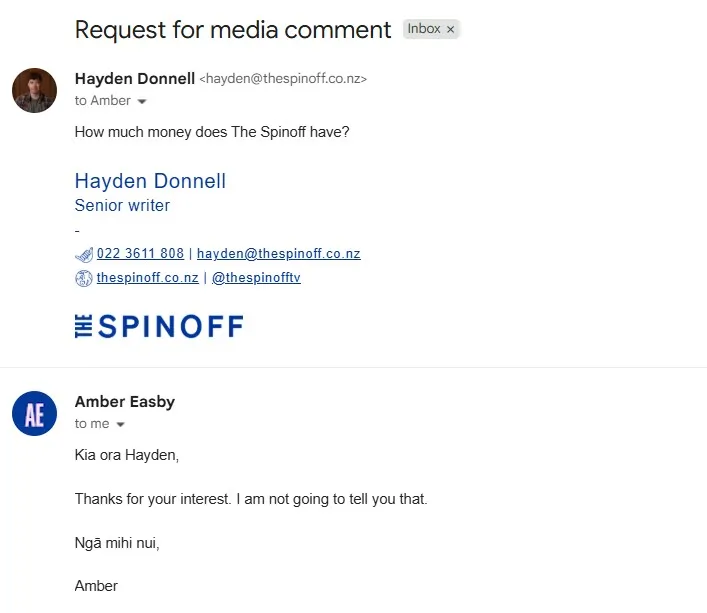
I didn’t have that on hand. But The Spinoff employs upwards of seven journalists and recently launched a members drive. I asked its chief executive Amber Easby how much money the company had. “Kia ora Hayden, Thanks for your interest. I am not going to tell you that,” she replied.
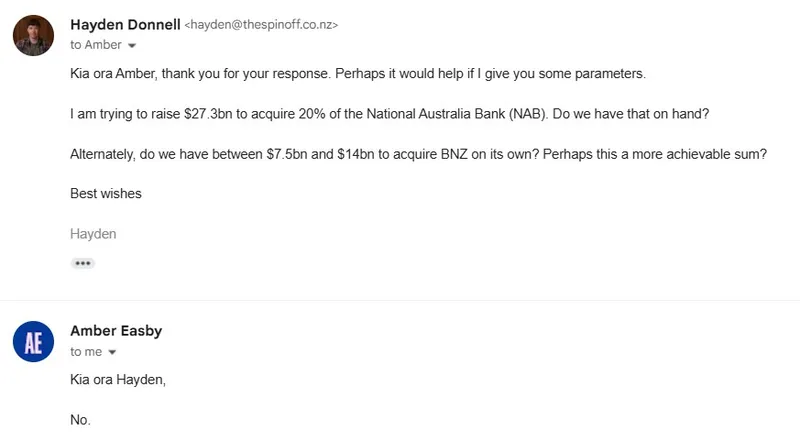
Perhaps she was reluctant because I hadn’t provided vital context. I explained that I only needed between $7.5bn and $27bn to buy a substantial amount of the NAB or the BNZ outright. Could The Spinoff help now it knew my mission and the numbers involved. “No,” she replied.
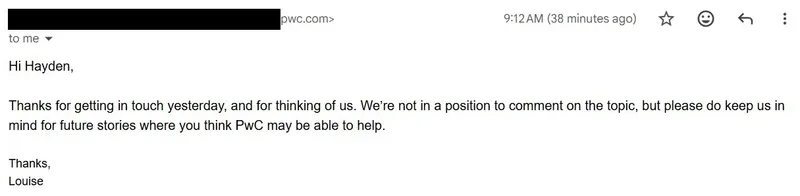
This cut off one of my most promising avenues for funding. Making matters worse, both KPMG and PriceWaterhouse Coopers (PwC) refused my requests for advice on how to move forward.
I was stymied. Thankfully for the government, it has more tools at its disposal. Peters, who once accused the Green party of being communists, now seems to be threatening to nationalise the BNZ if its owner doesn’t comply with his demands. Matthews said a non-communist seizure of the means of financial production was certainly possible but could come with the potential downside of discouraging future investment. “If you’re an international company, why would you come and operate in New Zealand? Because the government has just shown that they’re prepared to acquire the assets of an unwilling seller, and therefore if you come and operate here, there’s a substantial risk to you,” she said. “And let’s face it, we’re tiny. Why would companies bother?”
Matthews pointed to the crisis-ridden health sector as another area you could target if you had $20bn floating around. That would also deliver an economic return by keeping our potential workforce healthier. Even if you were determined to make an investment into a commercial sector to improve competition and lower fees, the supermarket industry would probably be a more pressing target, she said.
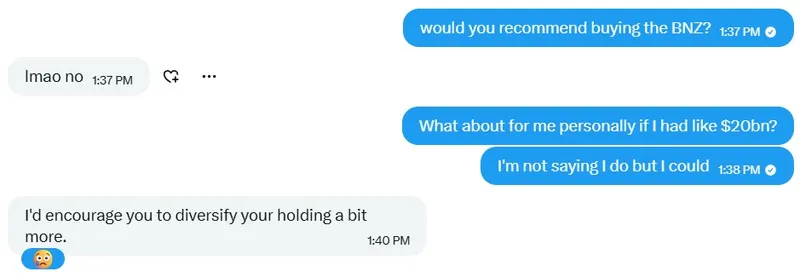
An investment advisor, who agreed to talk to me on condition of anonymity, had similar advice when it came to my ambitions. “I’d encourage you to diversify your holding a bit more,” he said. Matthews recommended putting $10bn in an index fund.
In the end, I gave up. I didn’t have the money to buy the BNZ, and even if I did, there were probably better things to spend it on. It wasn’t just financial hurdles. There were political hurdles, legal hurdles, hurdles embedded in the fabric of the universe. The goal was so unachievable, so far off, it almost felt like I’d been carrying out some kind of stunt announcing my intentions in the first place. In that sense, I had a lot in common with New Zealand First.

Hayden Donnell
Hayden Donnell is a senior writer for The Spinoff. He previously worked at RNZ, TVNZ and the New Zealand Herald, alongside other media companies that have since closed down or been renamed. His primary passions are local politics and the Big Fresh animatronic fruit and veggies.


