Nicola Willis cuts jobs, loves AI, hates NZ First

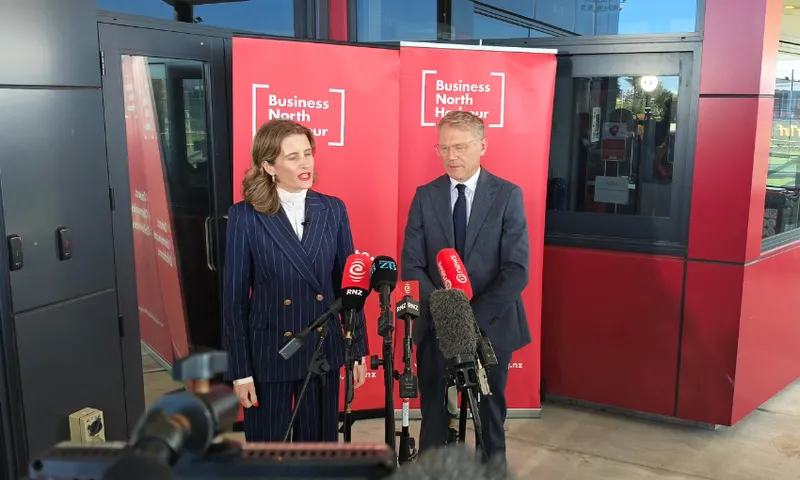
Nicola Willis and Paul Goldsmith at the pre-budget speech.
The finance minister announced public service layoffs, celebrated AI, and took swipes at Labour and NZ First in her pre-budget speech.
Nicola Willis chose the clubrooms of the National Hockey Centre in Rosedale on Auckland’s North Shore as the location for her pre-budget speech. Beyond the moat of artificial turf, the area is a giant industrial estate. The members of Business North Harbour are a practical bunch – “entrepreneurs and Kiwi battlers”, as Willis put it. The major corporate sponsors included a car dealership and a landscaping company. It was a world away from the central city offices populated by public servants, even though they were the ones the speech focused on.
As the suburban business leaders dined on salads and slices, Willis announced that this year’s budget would reduce most government agencies’ operating budgets by 2% in the coming year, followed by a further 5% in each of the following two years. The government has instructed ministries to come up with cost-saving merger proposals.
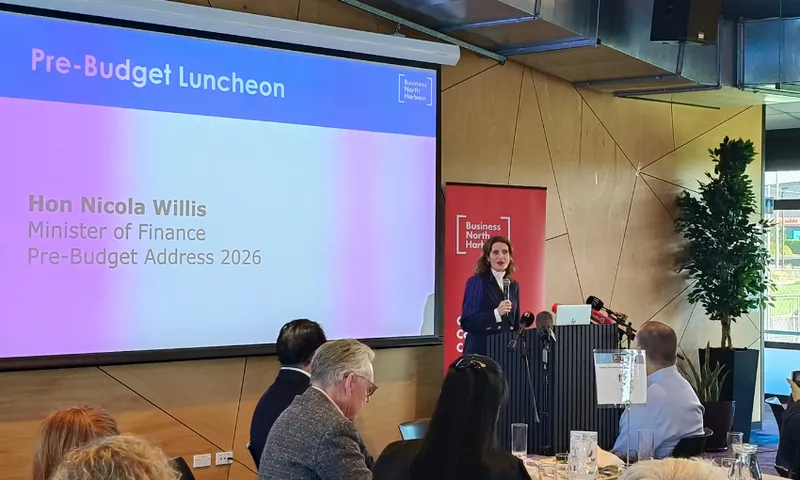
Willis said the government will set a numerical target of no more than 55,000 public service employees by July 2029, a reduction of 8,700 public service jobs. The announcement comes on top of thousands of jobs already cut since the coalition took office in late 2023. “What we’re doing today is doubling down,” Willis said in a media standup after the speech.
The minister softened the layoffs announcement with talk of creating a more efficient public service: fewer departments, better identification and retention of talented staff, and better digital technology. She repeatedly emphasised the importance of incorporating artificial intelligence into the public service and cited an AI scribe tool used in hospital emergency departments as an example. “For too long, the public service has been scared of AI, slow to move to the cloud, and has procured a complex and fragmented set of overlapping IT solutions,” she said.
“In my own office, we’ve been using AI more regularly recently, and it’s incredible,” she told reporters afterwards. “I said to my office: help educate me about this, use these tools yourself – I want to unleash you, don’t be scared, be prepared to use them. And I’ve been really impressed by how my staff have managed to employ these tools to great effect. So I’d encourage anyone, give it a go.”
Paul Goldsmith, the minister for digitising government, said he used Microsoft Copilot to help him form opinions. “It’s interesting. You ask it a question – ‘what are the arguments for and against a particular thing?’ – and it comes up with a starter and gets you thinking about things you hadn’t considered before.”
Beyond the ministers’ enthusiasm for software tools, the speech was notable for how openly combative it was, towards both Labour and coalition partner New Zealand First.
Some finance ministers use pre-budget speeches to rise above the fray and project the image of a responsible economic manager. Willis framed her speech around repeated contrasts with the Labour Party. Or at least a straw replica. “You don’t need to break the bank to get better results. That belief may be pooh-poohed by my opposition colleagues but I know the people in this room get it,” she said.
After the first three questions came from middle-aged men, she joked that it was “always disappointing” that only men asked questions in forums like these. A fourth middle-aged white man took this as his cue to call out a question. He wanted to know if New Zealand should start refining oil again. Willis replied that she “wasn’t standing next to Ardern when the government banned oil and gas exploration”. At another point she quipped “I’m not the one nationalising the BNZ.” Both jabs at NZ First got good laughs from the room.
In the media standup, TVNZ’s Jason Walls asked whether the Ministry of Foreign Affairs and Trade would be exempted, as it was during the previous round of public sector job cuts, and whether she had spoken to foreign minister Winston Peters about it. Willis paused for four seconds (though it felt like much longer) then responded tersely:
“The minister of foreign affairs would prefer more money going into the diplomacy network, our offshore embassies, and the Ministry of Foreign Affairs and Trade. I always seek to communicate to him what I hear from everyday voters, which is: make sure I can get my hip operation faster, make sure my kids are getting better educated at school. Yes, invest in foreign affairs, but not at the expense of the things people really care about.”
Walls followed up: “That was quite a long pause at the beginning. Can we take from that that it was a tough conversation for you and Mr Peters?”. “Yes,” Willis replied.

Joel MacManus
Joel MacManus is a senior writer for The Spinoff. He previously worked at RNZ and Stuff, and began his career at Critic Te Ārohi. His writing explores the political, economic and cultural systems that underpin modern New Zealand. He won the 2025 Voyager Media Award for Best Columnist, Opinion or Critique.


