The great housing cop-out: Auckland Council’s culture of less

The debate is between fewer apartments and way fewer apartments. (Image: Tina Tiller)
As an alternative to Plan Change 120 is chosen, the only debate expected at Auckland Council today is on how much housing to cut.
Buried in the reports informing Auckland Council’s latest effort to create a new housing plan is a single-page preliminary economic analysis. It details the potential economic benefits of four different options. Though the figures are subject to change, the differences are huge. The first would deliver an estimated $700 million return. The second, $1.7 billion; the third, $3.3bn; and the fourth, $3.9bn.
Guess which two the city’s councillors are going to be focusing on as they sit down for their June policy and planning committee meeting? If you picked the ones delivering the most possible economic return, you would obviously be wrong. Those two options are expected to be so unpopular they’ll barely be discussed. Of course our councillors will be focusing instead on the options that deliver the least benefit, as those are the ones that allow for fewer houses.
How did we get here? It’s an excruciating story, but it began in 2021 with the government announcing a world-leading piece of bipartisan legislation that would have allowed three houses of three storeys on almost every section in our largest cities. From there, we’ve proceeded through a dizzying array of watering downs, U-turns, backdowns and “humiliating backdowns”. National first allowed Auckland Council to opt out of the townhouse bill so long as it came up with a plan that would deliver the same amount of housing capacity. Then, following an uprising in Parnell over the possibility of tall buildings bespoiling their suburb, it cut the housing capacity the council had to allow from two million to 1.6 million. Then it cut that figure once more to make doubly sure Epsomites won’t have to deal with grotty apartment dwellers looking at their pools.
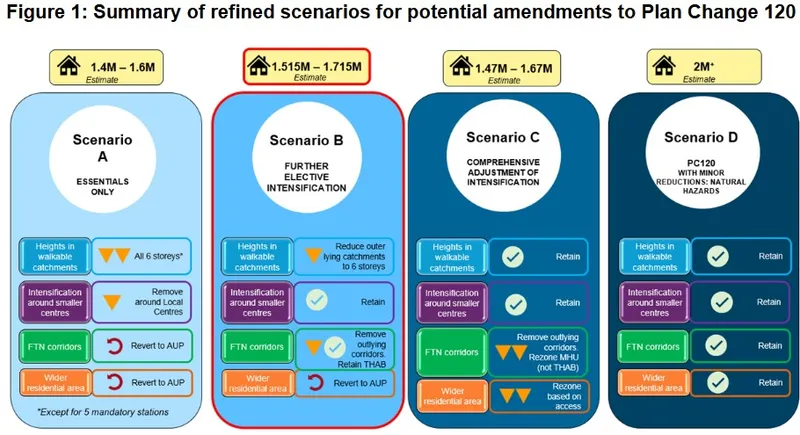
At each point, councillors have gleefully welcomed the opportunity to do less. They’re now obliged to zone for a minimum of 1.4 million homes, only 200,000 more than the existing Unitary Plan already allows. Many of them want to get as close to that number as possible. They’ll be backing an option, catchily dubbed “Scenario A”, which would restrict most new high-density apartment development to the city centre, larger town centres like Milford and around five City Rail Link stations where the government has mandated at least 10- to 15-storey apartments.
They’ll be fighting against a group, likely including mayor Wayne Brown, that will coalesce around “Scenario B”. It allows more apartments around local centres like Balmoral and along rapid bus routes such as Onewa Road on the North Shore and Sandringham Road in the central isthmus, all of which remain untouched under the first option. Just making those relatively minor changes increases housing capacity by 115,000 and adds $1bn in estimated economic benefits.
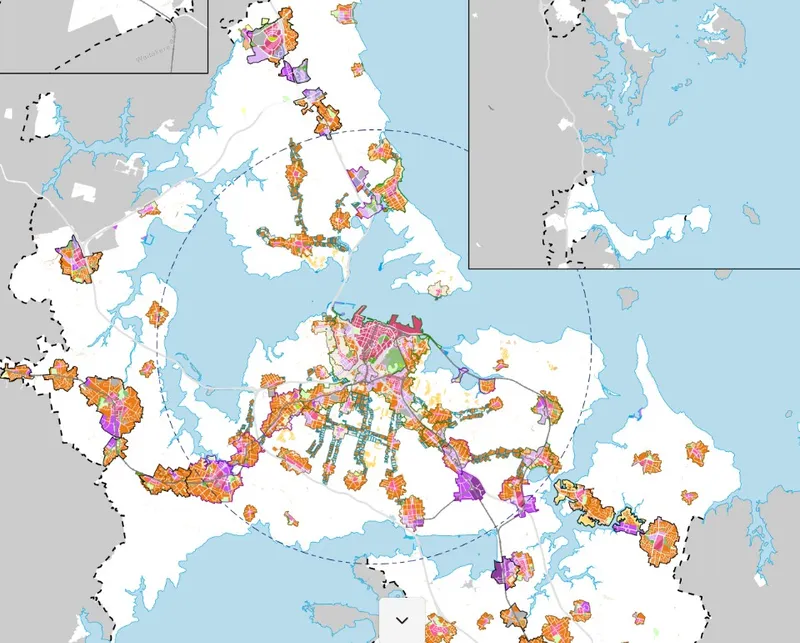
But under both scenarios, nearly all of Auckland’s suburbs will stay exactly as they are now. The council’s maps are startling. In white, they show the areas where zoning will remain as it is under the Unitary Plan. The areas are vast, with the white blanket covering most of the city, interrupted only by a comparatively sparse set of pockets where more density will be allowed.
As things stand, council sources say the numbers between Scenario A and B are close. The final count will be tight, with the result resting on a few key swing voters. Things are up in the air.
But we already know what won’t be happening. The two other options before council are called, you’ll never believe this, Scenario C and Scenario D. The former is a more comprehensive upzoning plan based on people’s access to amenities and public transport. The latter is just sticking with the original plan to allow for up to two million homes. Both would deliver economic benefits that exceed the two options that have ended up preferred. They’re also projected to suppress house prices more than Scenario A in particular. “It’s a committee of 23 and people have had that explained to them,” says planning committee chair Richard Hills. “They know that the move from 2 million to 1.4 million [zoned] houses will mean higher house prices over time.”
Those options will enter the meeting DOA, with only the mayor and a few councillors backing C. Shane Henderson will likely be the only one with any affection for Scenario D. The Waitākere councillor has argued for more housing through this multi-year plan change process, often as the sole voice hectoring to increase the upzoning in the council’s plans rather than haggling over the extent of its potential cuts. “I don’t know why the council doesn’t see more housing growth as an opportunity,” he says. “Economic evidence is clear we are all better off when we encourage growth, not to mention making our city a more vibrant and exciting place to live.”
Though he says he doesn’t know why his colleagues see dense housing as more of a necessary evil than an opportunity to enliven the city, he actually has a solid theory. “I think the perceived interests of existing property owners always win over future Aucklanders,” he says.
As Henderson sees it, more ambitious housing plans are always going to be controversial with the predominantly property-owning demographic that engages disproportionately in council affairs and mails in the bulk of the votes in local elections. Plans may come to the council table with all the economic reports in the world on their side, but with that baggage on their back, they never have a chance. The council vote on Scenario A or B will take place later this afternoon.

Hayden Donnell
Hayden Donnell is a senior writer for The Spinoff. He previously worked at RNZ, TVNZ and the New Zealand Herald, alongside other media companies that have since closed down or been renamed. His primary passions are local politics and the Big Fresh animatronic fruit and veggies.


