A not-so-wet but still quite whiny week on the campaign trail

The politicians witnessed by The Spinoff this week. (Photos: Getty, The Spinoff, supplied. Design: Tina Tiller)
Over five days, Hayden Donnell attends four political meetings and sees Christopher Luxon wrestling with a soundsystem, waning hope at a Chlöe Swarbrick meeting and Qiulae Wong and Helen White fighting for Mt Albert.
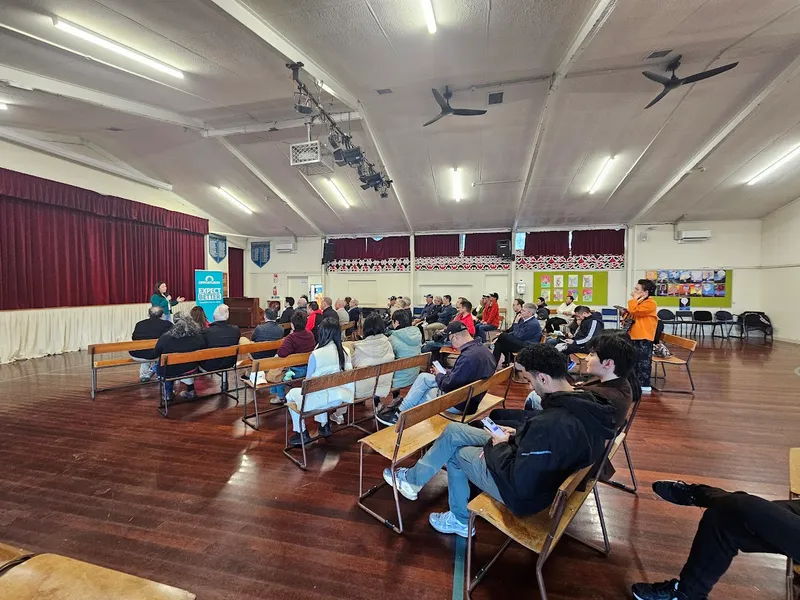
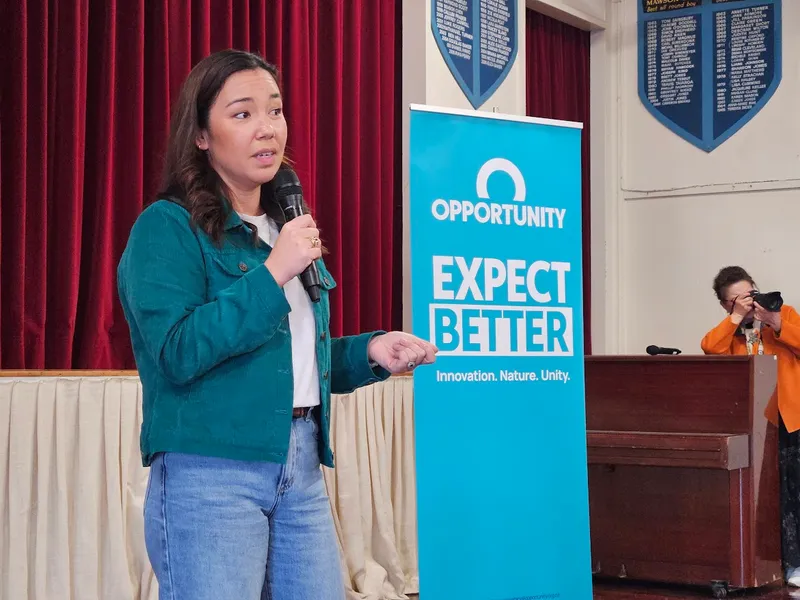
Qiulae Wong is on track to get to parliament but the road there runs through a sparsely attended school hall in Howick on a Sunday afternoon in August. The Opportunity Party leader is speaking to a group of 50 or so people at a public meeting put on by her party’s Pakuranga candidate Kevin Huang. “Thank you for coming,” she tells the assembly nestled on the wooden benches at Owairoa Primary. “I’m sure you all had better things to do on your sunny Sunday.”
Maybe, but they didn’t seem to mind. It’s a mark of Opportunity’s burgeoning popularity that these people are in the hall at all. The party would have struggled to pack out a toilet cubicle at such an inauspicious timeslot in the depths of east Auckland last election. But Wong has led a turnaround and this audience seems invested in the minutiae of her policies. They’re notably well-informed. One question touches on the infrastructure funding split between local and central government. Another covers the strategic ins and outs of how to communicate tax policy.
It’s not doing much to change Opportunity’s reputation as, to use the words of Winston Peters, a “party of consultants”, but it makes for illuminating listening. Wong is intelligent, articulate and, in what is being hailed as a radical departure from political norms, almost a regular human being. She’s willing to express self-doubt and give upfront answers to direct questions. Most of the time it works. Occasionally there are moments where you sense how new the party is to this “being taken seriously” business. In response to questions on how her party’s proposed land tax will work, Wong matter-of-factly admits she thinks her chances of getting tax concessions into a coalition deal this term are slim. “We’re not really pushing it as a coalition bottom line,” she says.
Generously, it’s refreshing realism. Less generously, it’s a defensive response to some land tax-themed attack ads that have come Opportunity’s way lately. But the party’s in the business of selling change. Many of its votes are coming from incumbent parties, propelled their way by dissatisfaction with a miserable status quo and a growing sense that the system needs a shakeup. If Wong is already making concessions to realpolitik and incrementalism before even getting into the room to negotiate with the major players, it could weaken a key marketing point.
Wong has to leave at 5.15pm. She has a busy schedule: an infrastructure announcement on Wednesday morning, a visit to a school debate club in Māngere on Thursday, a volunteer meetup on Friday. She’s Opportunity’s best asset and they need her to be as visible as possible.
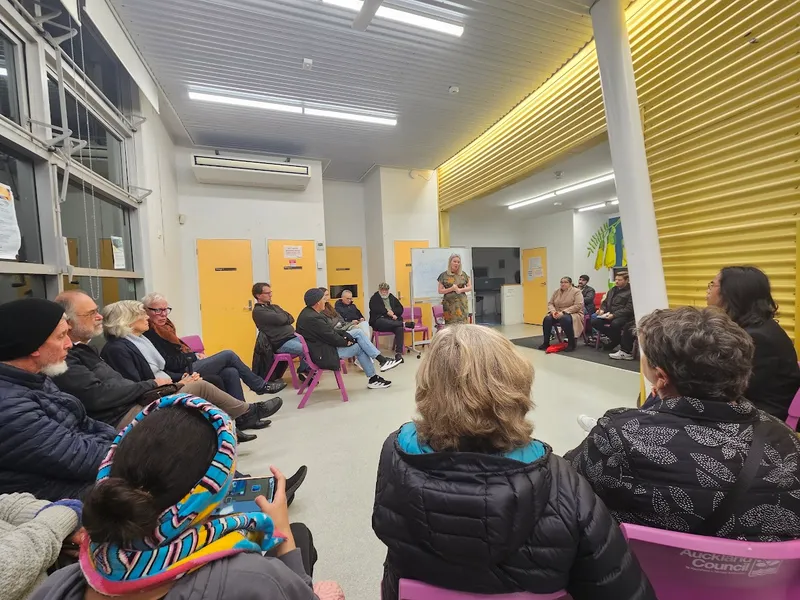
The extra profile could be an advantage in her Mt Albert electorate race, which the party is treating as a backup plan for entering parliament. But it also comes at the cost of time on the ground campaigning. Back in Mt Roskill the following night, one of her opponents for that seat is holding the latest of a flurry of public meetings. In a small room at Wesley Community Centre, the incumbent Labour MP Helen White is holding forth about the many and varied ailments that have befallen New Zealand. She talks about housing costs and grocery prices, but she’s most convincing when it comes to her specialist area, employment law, where she speaks powerfully about the gendered impact of recent reductions to leave entitlements for part-time workers. “When you take away the capacity of women to take time off, or parents to take off time with their children… you’ve taken away something really precious that keeps our families together.”
White winds up her introductory speech and opens the floor to a Q&A. This meeting is about the cost of living, and she runs it like a school teacher, listing potential price pressures on a whiteboard. “Power prices,” she says, underlining those two words. “Who’s struggling with power prices?” She gets a good response from the 30 or so people in the room, most of whom are doing it tough. This is a different demographic to the Opportunity meeting. One woman says she’s been served an eviction notice by Kāinga Ora. Another’s been told the rent’s going up.
White sympathises. Everyone is in agreement about the maladies afflicting our no-good economy. But there’s a question left hanging: and then what? The only Labour policy White mentions at length is its proposal to put a $20 cap on public transport. There’s a fundamental disconnect between the scale of the problems the people in this audience are facing and the scale of the solutions her party is proposing. That’s not necessarily White’s fault. She has actually split with her colleagues by calling for house prices to fall, in a statement perhaps partly motivated by recent travels around the poorer parts of her electorate. But it can give the impression of someone arriving at a burning building and suggesting a kitchen makeover.
A young woman called Rosa stands up and asks how you get tax off the people at the top of society. “I’m sorry, I don’t actually know anything about politics, but I’ve heard this word over and over since high school: Capital gains tax. Is that the mechanism?” she asks. White demurs. “It is, but it’s not a very big one,” she says, before insisting that Labour is limiting its ambitions to a small, ringfenced CGT and complaining that National is lying about the extent of its tax plans.
Rosa leaves straight after the meeting ends, looking a little nonplussed.
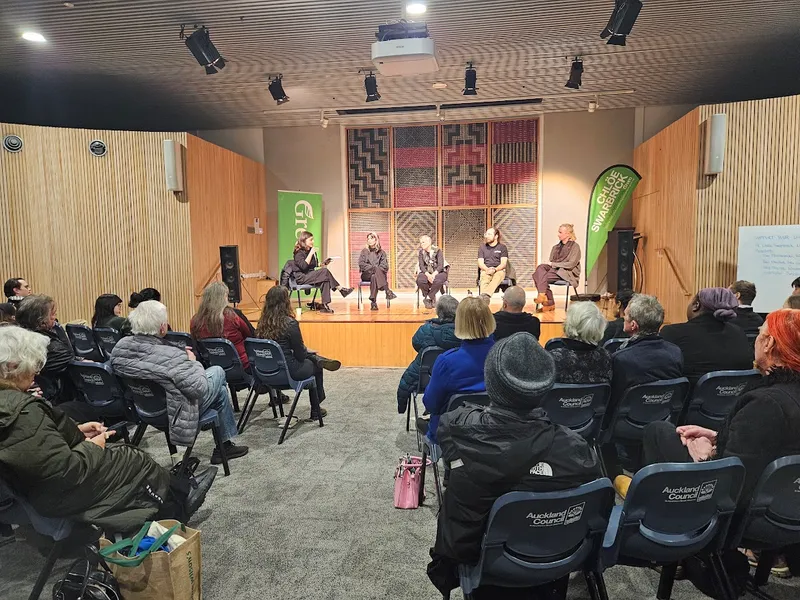
No one is sheepish about taxing the rich at the Greens’ meeting at Ellen Melville Hall in central Auckland the following night. “We just need to change the whole system,” says Ima Cuisine owner Yael Shochat as she laments the growing immiseration of the middle and working classes. The meeting, hosted by Green co-leader and Auckland Central MP Chlöe Swarbrick , is aimed at figuring out how to build a local economy that helps smaller operators survive and perhaps even thrive through the horrors. Its timing is fortuitous. Prime minister Christopher Luxon has just finished chiding Rotorua small business owners for being “negative” about the economic pressures they’re facing and failing to have an “adult” approach to the government.
Swarbrick doesn’t make those kinds of patronising admonishments. She speaks with respect. But the central question of how to reorient the economy isn’t fully answered in her hourlong discussion with a panel of small business operators, including Shochat, Whammy Bar co-owner Lucy Macrae, textile artist Chris Duncan and Kārearea construction co-owner Trav Mischewski.
On the other hand, the “problem definition”, as Swarbrick puts it, does get a thorough working over. There are acknowledgements that we need to stop the tax dodging and monopolistic behaviour that benefits multinationals at the expense of the little guys that keep society going. But how do we make that change? The task seems pretty overwhelming, even to Swarbrick. Once known as a young upstart, she’s now basically a grizzled political vet, and she’s seen how hard it can be to force anything approaching real change through the House of Representatives.
Honestly, the talk can feel depressing at times. “Are we doing hopeful tonight?” asks Mischewski at one point. To the extent the answer is yes, it’s when the panellists start focusing on the small stuff. Maybe you can’t overthrow capitalism, but you can go to a local restaurant or an independent gig, says Shochat. “We all have less money, but at least make it count,” she says.
At the end of the talk, there’s time for one question from the floor. It’s about the council cracking down on postering on Karangahape Road. Swarbrick promises to help get that sorted. Waitematā Local Board chair Alexandra Bonham stands up and says she’s willing to help out as well. Changing the system is daunting, but if there’s a message tonight it’s that change starts small.
Christopher Luxon probably wouldn’t have time for that kind of wishy-washy, namby-pamby, leftie hogwash. Our chief prime executive takes the stage at Lynfield Youth and Leisure Centre to loud applause from the true blue crowd and begins his speech extolling justice minister Paul Goldsmith for his tough on crime approach.
Luxon is here after a week that could euphemistically be described as apocalyptically awful. It began with him apologising to those aforementioned Rotorua business owners and went downhill from there. He’s fresh off promising a referendum on MMP, seemingly accidentally, in response to a listener’s question on Newstalk ZB. But tonight he’s on home turf, surrounded by a phalanx of loyal MPs. This is about hope. It’s about strength. It’s about unity. Unfortunately no one has told the sound guy, who kicks the evening off deafening the audience with a scream from the PA system. Luxon’s speech is set to a sickening background electronic whine. Mt Albert candidate Melissa Lee hurries over to the sound desk. “We can still hear it,” she hisses.
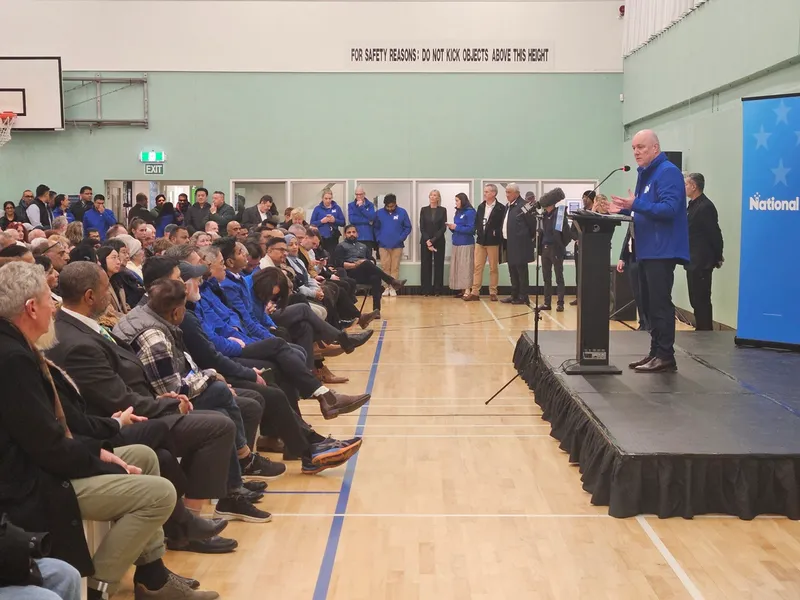
But the whine continues as Luxon launches into a familiar stanza about the world going from one governed by a rules-based order to one ruled by power. It’s the sound of a horrible week for the PM piercing through the supportive haze, reminding everyone about the flubs and flip-flops, the bad polling, the questions about his leadership, the editorials written under Matthew Hooton’s pen name, The Post editorial board, imploring his MPs to sack him while they still can.
Thankfully for him, it eventually fades. Luxon eases into some questions from the audience. A man sidles up to the microphone. “People have not realised fully how much good work your party has done and you’ve done under your leadership,” he begins. “How can you work to extend the [parliamentary] term to four or five years?” Luxon’s face lights up into a broad smile.
From there, he’s golden. He easily bats away a less supportive questioner who challenges him to name three things his party has done for anyone other than their wealthy donors, telling her rents have been flatlining, food inflation is down, interest rates are falling and they’ve hired around 2,100 nurses and 600 doctors. “Hold on a second, that’s five things,” says Goldsmith.
In parliament, critics could retort that the cost of living is still crippling for many and the health system is in crisis, but in this room, Luxon is on a roll. He doesn’t hesitate when a woman from China asks what she should say to someone who would tell her to “go home”, delivering a stirring defence of immigrants as vital contributors to New Zealand. He tells people about National’s achievements in education and justice and refuses to back down when faced with the occasional doubter.
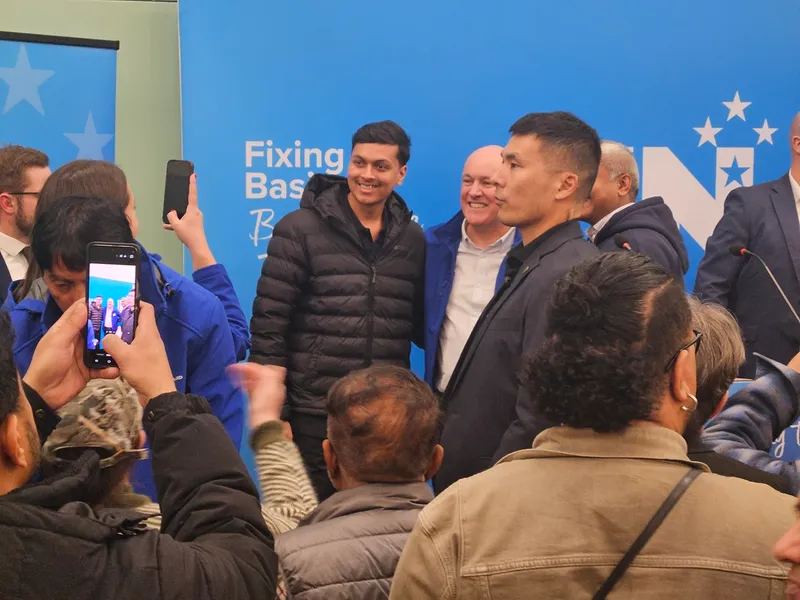
At the end of the session, hundreds of people queue up to take selfies. They want a picture with the prime minister who’s fixing the basics and building the future. They want to grin happily alongside the man who’s on track to take out the general election in three months. Luxon puts his arm around their shoulders and smiles toothily. After they’re done, he will step out into the frigid air at Margaret Griffen Park on what MetService says may be the coldest night of Auckland’s winter. It was a relief to spend a few hours in a bubble. Tomorrow is another day.

Hayden Donnell
Hayden Donnell is a senior writer for The Spinoff. He previously worked at RNZ, TVNZ and the New Zealand Herald, alongside other media companies that have since closed down or been renamed. His primary passions are local politics and the Big Fresh animatronic fruit and veggies.


