'Making it up as I go': Sam Duckor-Jones’ Gloria of Greymouth, reviewed

Made possible by


Sam Brooks reviews a new book by the artist behind the West Coast's famous pink church.
I always get a bit nervous reviewing autobiography. While I’m very comfortable – perhaps even too comfortable – putting my thoughts, feelings and opinions of someone’s artistic choices out there for public consumption, reviewing autobiography so often risks crossing the line of criticising artistic choices into criticising life choices. What’s bad storytelling and what’s bad living? One is my job to have opinions on. The other is absolutely not.
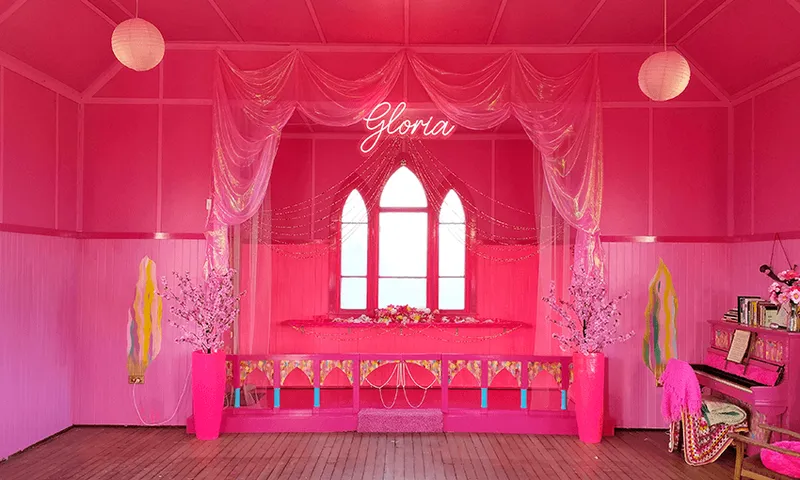
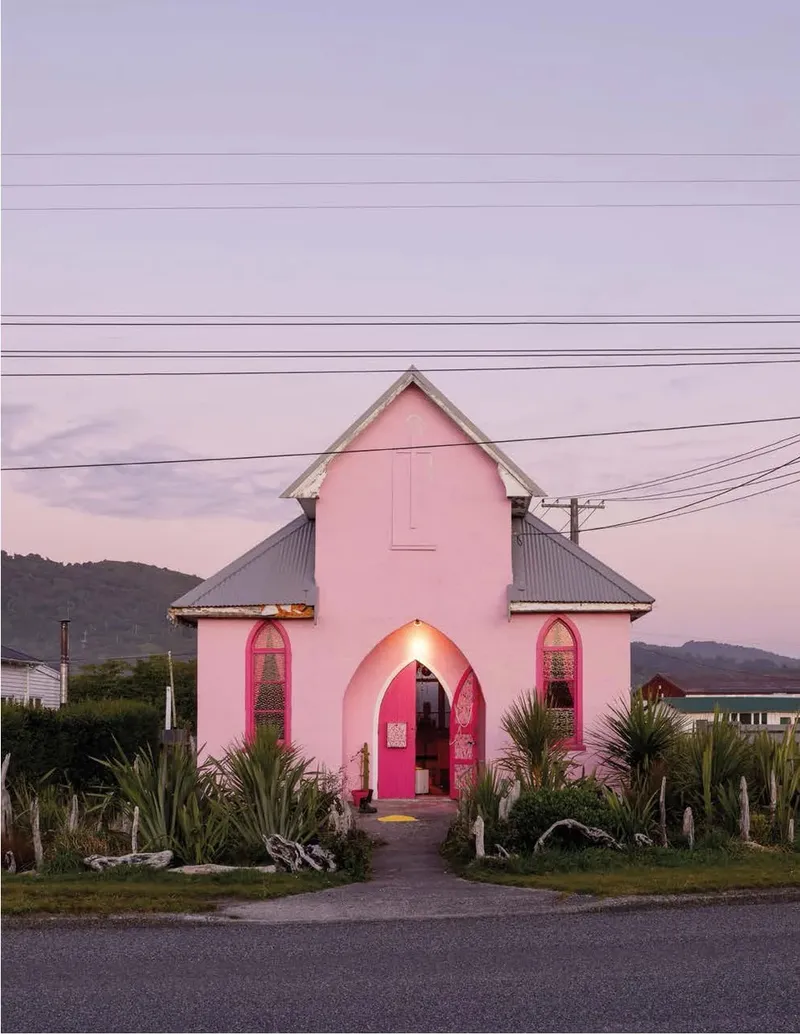
Thankfully, Gloria of Greymouth, Sam Duckor-Jones’ new book, doesn’t make me come even close to reflecting on that line. The book is a blend of memoir, essay, poetry, photography, and even biography through a certain lens, and tells the story of the first nine months of Duckor-Jones moving to the titular church in Greymouth and turning it into a sculpture, a haven, a refuge, and a home. It’s fitting that the book is a blend of genres and forms, because the church itself is the same. Since Duckor-Jones moved there, Gloria the church has had a presence far beyond Greymouth, becoming a social media – and genuine actual media – sensation. Gloria as a phenomenon is only lightly touched upon by Duckor-Jones, though – this is more about telling the story of Gloria from inside the pink walls, rather than outside of it.
The playful epigraphs for Gloria of Greymouth read: “This is the story of a former church that I turned into a sculpture. This is a made-up story. I’m telling the story of something I made. I’m making it up as I go.” It’s a fitting epigraph for the book, and also a declaration of Duckor-Jones uniquely playful voice, as if the bold pink of the book wasn’t enough of a hint. (Funnily enough, it shares a shade of pink with Branson Reese’s similarly cheeky collection of comics, Hell Was Full. Funny how colour can be such a clear indication of tone and intent.)
A little bit further on, Duckor-Jones outlines his particular brand of storytelling: “History is a set of agreed-upon myths. We chant them over & over. During periods of kindness we permit ourselves an edit here & there. One’s own story becomes a series of gently mythologised moments. With interchangeable tinted gels.”
Part of what makes the book so charming is that Duckor-Jones seems far more intent on actually living in the world that he’s made for himself than dwelling on it. You might expect more reflection from something that could really loosely be defined as memoir – and part of what makes Gloria of Greymouth so delightful is that it seems as eager to resist form and definition as its namesake – but rather than feeling shallow or lackadaisical, it actually ends up being refreshing. Again, much like its namesake.
The book moves back and forth between journal entries, stories about how Duckor-Jones made his way to Greymouth, photographs of sculptures inside Gloria, and poetry. The journal entries are hilariously matter-of-fact, comprised of short, sharp, sentences like “Didn’t have shower but didn’t matter” and “Woke 7am. Coffee, bread, butter, supermarket” pepper these entries.
Elsewhere, his writing turns inward and profound: “It’s an indulgent life I suppose, but so what? Making art is always a bit indulgent. If we want art we must allow for artists to be a bit indulgent. I have experimented with romance but it does butt into art making time & I just love the making more, not sorry.”
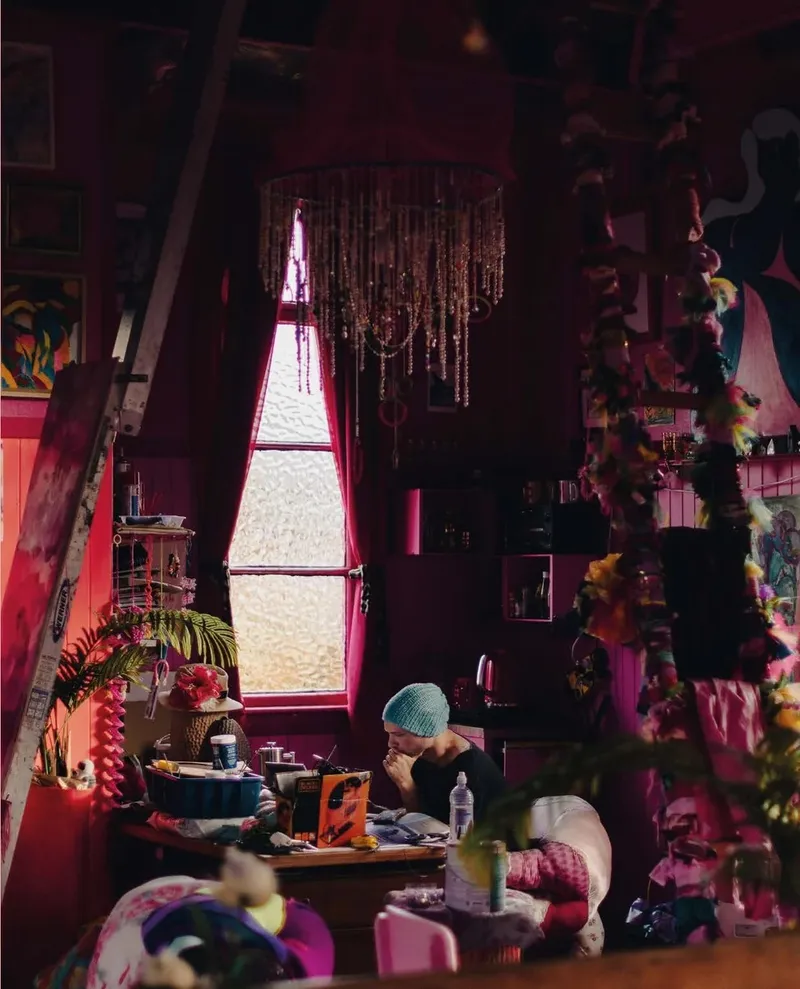
The shifts from simplicity to profundity are mirrored in the high-low quality of Gloria as an artwork, and as a community space. The artistry and craft that goes into making work that is of high quality, with clear intent and purpose, but remains accessible is remarkable, and Duckor-Jones makes it look easy. It is, again, something that the book mirrors about Gloria. The amount of effort it has taken him to turn Gloria into Gloria, not just in the physical acts of painting and repairing the building, but making it a space that is accessible and welcoming in a rural community that you would probably assume is not welcoming of a very pink building that was once a church, is no small feat. That Duckor-Jones renders its story so matter-of-factly is a similar achievement.
It’s also a credit to Duckor-Jones that the book doesn’t feel piecemeal or hodgepodge, but more like an all-encompassing scrapbook, a queerly gentle manifesto, of what Gloria currently is and what it can be. It makes his moments of introspection, less about Gloria, and more about himself as a man, an artist, a queer man. My favourite section of the book, where he more or less sums up his not-so-secret reason for creating Gloria in the way that he has had me wanting to read a more traditional memoir from Duckor-Jones:
“This is my radical queer participation, far away from the club and the scene, far away from the marches & the parties. A radical queer movement of a different colour that includes an enormous swatch of the OG (original gay) tint. A radical revelling in queer incongruity. Positive change & growth & enlightenment via radical encounters between communities. A wearing of pearls at the pub. These days when I reach for a pint my pinkie flutters proudly.
It’s funny tho. This is the story I tell, the story I insist upon. The story I share & write down & console myself with & choose to believe.”
Hilariously, and fittingly, he basically says this much earlier in the book, much more succinctly but no less profoundly: “I’m just an exhausted gay child of the 90s. I’m just tired of the act.”
Although seemingly light on reflection – or more accurately, light on navel-gazing – what Duckor-Jones has created in Gloria of Greymouth is actually no less beautiful or meaningful than the creation of Gloria itself. It exists in a multifaceted conversation with the church, the sculpture, the space of belonging, the icon. To quote somebody who would have surely delighted in the existence of both Gloria the space and Gloria the book, it’s a coat of many colours, woven with care, grace and, frankly, brilliance.
Gloria of Greymouth ($65, Te Herenga Waka University Press) is available for pre-order from Unity Books.
The Spinoff Books section is proudly brought to you by Unity Books and Creative New Zealand. Visit Unity Books online today.

Sam Brooks
Sam Brooks is a playwright and journalist who currently freelances and writes his own arts and culture newsletter Dramatic Pause.


