'I enjoy serendipitous finds in the community libraries': Richard Wolfe's rich reading life

Richard Wolfe is the author of new book, The Passing of the Forest (Image: The Spinoff)
Made possible by
Welcome to The Spinoff Books Confessional, in which we get to know the reading habits of Aotearoa writers, and guests. This week: author of The Passing of the Forest, Richard Wolfe.
The book I wish I'd written
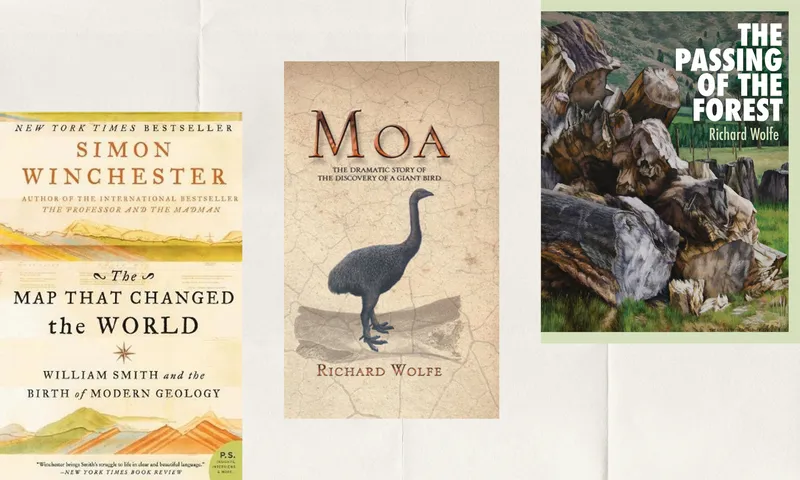
I wish I had been responsible for The Map that Changed the World, the 2001 book by Simon Winchester. The story of one man’s obsession, it tells how in the early 1800s Oxfordshire blacksmith William Smith developed a beautifully executed map that was the first to depict the geology of Britain. Smith faced numerous challenges, including plagiarism and illness, but his map both transformed the way in which the world was understood and represented the birth of a science.
The book everyone should read
At some stage everyone should read Charles Darwin’s The Origin of Species (1859), not least because it is one of the most influential and consequential books ever published. Further, its central concept, the theory of evolution by natural selection, has been described as the single best idea anyone has ever had. An understanding of its explanation for the common and lowly origins of all life might go some way towards diffusing humanity’s propensity for interminable conflict. In 1835 Darwin briefly visited New Zealand on the Beagle, and several aspects of this country’s natural history would later be mentioned in support of his argument in his great book.
The book I want to be buried with
I would like to be buried with a copy of my own 2003 book, Moa: The dramatic story of the discovery of a giant bird. Geoff Walker, then publisher at Penguin, asked me if, in the spirit of The Map that Changed the World, there was a single New Zealand-related topic that would lend itself to a book. I immediately suggested the story of the first moa bone – a small femur (thigh bone) fragment – that was taken to London in 1839 and how its identification as being from a giant flightless and extinct bird was the cause of much controversy, at a time of increasing debate on the age and origins of life on Earth. My research for Moa involved tracking down the bone’s various movements, from Poverty Bay to London, and inspecting it in storage in the Palaeontology Department at the Natural History Museum, where the famous fragment is now on permanent public exhibition.
The first book I remember reading by myself
The first book I remember reading unaided was one in Enid Blyton’s extensive Noddy series, which first appeared in 1949. I grew up in New Plymouth and had an aunt on the staff of the public library who was a regular source of battered and withdrawn books, and among them many by Blyton. For light relief, and after a break of some seven decades, I recently returned to that author and read one of the 2016 spoof Enid Blyton series (with text by Bruno Vincent), Five Go Gluten Free, about the Famous Five’s challenge of coping with an alternative diet.
The book I pretend I’ve read
Years ago a well-meaning friend gave me a copy of James Joyce’s 1922 novel Ulysses. Despite several valiant attempts I have yet to finish it, but do intend to do so at some point. In the meantime I can pretend I’m familiar with the story because I was a member of one of the over-18 gender-segregated audiences, as demanded by the Censor, who saw the film Ulysses by American producer Joseph Strick when it was screened in New Zealand in 1967.
Fiction or non-fiction
Most of my published books – 46 to date – have been non-fiction, covering aspects of New Zealand art, natural and social history, science and museology. As a result my reading preference is also for non-fiction, with much of it being essential research for writing. My publications include five children’s books, which are variously fictional and autobiographical, and include Midnight at the Museum (1997), illustrated by my wife Pamela and inspired by my time on the staff of the Auckland Museum.
It’s a crime against language to…
As a one-time curator at Auckland Museum, I grimace when I see what uses the word "curating" is put to nowadays, covering everything from hairdressing to home decorating. Similarly, the words "icon" and "unique" have been overused and abused to the point of becoming meaningless. To that end I suggest a neologism, "ichronic", that might be applied to those items that lack the essential uniqueness to qualify as "iconic".
The book that made me laugh
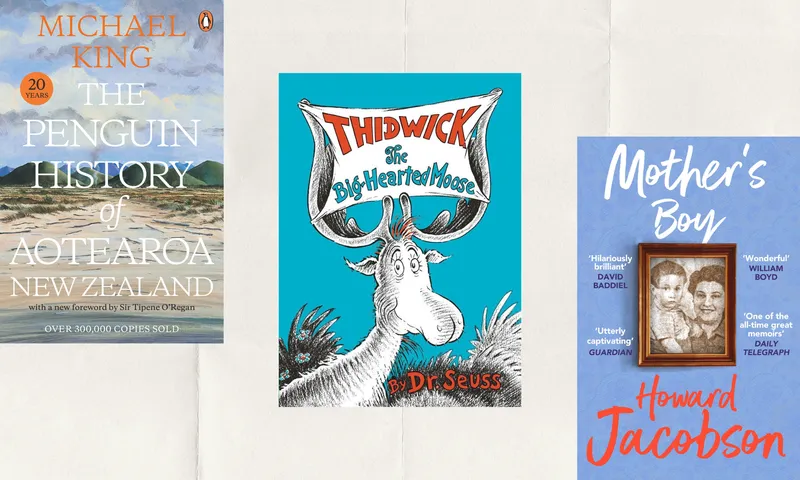
One of my earliest books, another withdrawn from the New Plymouth Public Library, was a well-worn 1948 edition of Thidwick: The Big-Hearted Moose, written and illustrated by Dr. Seuss. Held together largely by sellotape, this book introduced me to the highly imaginative and downright ridiculous, all expressed in rhyming couplets. I found the story and the illustrations hilarious, but the climax involved the unnecessary taxidermy of a number of birds and animals, which I didn’t consider a laughing matter.
Encounter with an author
When British artist and critic Matthew Collings gave a presentation at the 2007 Auckland Writers and Readers Festival, Pamela and I lined up for him to sign our copy of his 2001 book Art Crazy Nation: The Post Blimey Art World. As he opened it the spine came unstuck, but he pressed on undeterred, inscribing it: "To Pamela & Richard / Hope you finish it before it falls apart." We did, and so far it hasn’t.
Greatest New Zealand book
Surely this country’s greatest (non-fiction) book is Michael King’s Penguin History of New Zealand, which was first published in 2003 and has since sold over a phenomenal 300,000 copies. This highly-readable best-seller offers an accessible and well-rounded account of the nation’s history, since its first settlement by humans. King ends on a positive note, observing that most New Zealanders, irrespective of their cultural backgrounds, are "good-hearted, practical, commonsensical and tolerant", characteristics that he considers "as sound a basis as any for optimism about the country’s future."
What I'm reading right now
I recently read and reviewed a new edition of Vincent O’Malley’s 2012 book The Meeting Place: Māori and Pākeha Encounters, 1642-1840 for Waka Kuaka (Journal of the Polynesian Society) and have just finished Howard Jacobson’s autobiographical Mother’s Boy.
I usually have several books on the go at the same time, and right now they include The Value of Art: Money, Power, Beauty by American art dealer Michael Findlay, and Our Enemies Will Vanish, an account of Russia’s invasion of Ukraine by Yaroslav Trofimov. As well as borrowing from the rich resources of the Auckland Public Libraries, I enjoy serendipitous finds in the community libraries that have recently sprung up around Ponsonby.
The Passing of the Forest by Richard Wolfe ($75, Oratia Books) is available to purchase from Unity Books.
The Spinoff Books section is proudly brought to you by Unity Books and Creative New Zealand. Visit Unity Books online today.

The Spinoff Review of Books
A smorgasbord of books thoughts and formats by The Spinoff.


