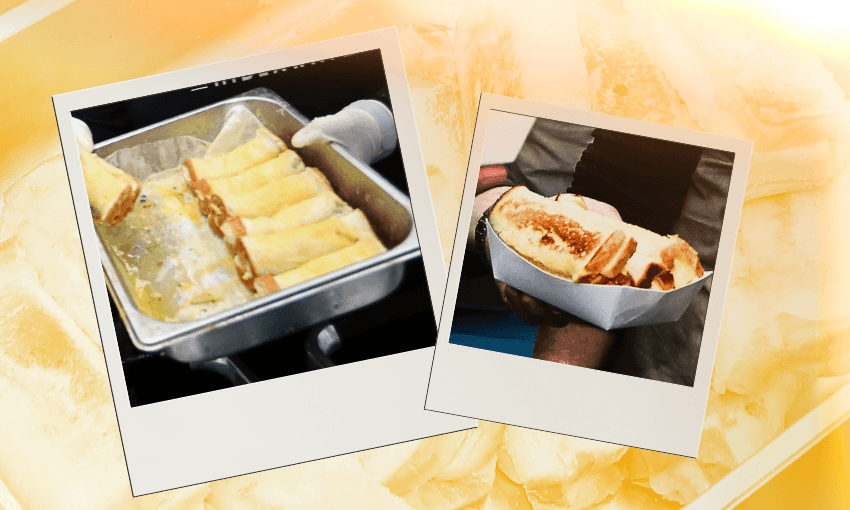



The mighty cheese roll did not arrive in this world fully formed. Joel MacManus journeys through its evolution, complete with taste tests.
There is an unwritten constitutional convention in New Zealand politics which requires any politician who touches down south of the Waitaki river to take a photo of themselves eating (or pretending to eat) a cheese roll.
The cheese roll – a rolled-up slice of white bread, filled with cheese sauce and toasted under a grill – is a culinary taonga of great cultural significance to the people of Otago and Southland. While they are virtually unknown in the North Island – and even the upper parts of the South Island – cheese rolls are ubiquitous in the deep south. They can be found at bakeries, cafes, and even at Michelin-starred restaurants. They’re also often sold frozen in bulk for school fundraisers.
For many years, visitors to Dunedin airport were greeted by a banner bearing a photo of a cheese roll and the words “even Japanese visitors are in awe of our Southern Sushi”. In Invercargill, the city council once installed a sign depicting the creation of the cheese roll among the top three most significant events in the region’s history, alongside the signing of Te Tiriti o Waitangi at Rakiura and the time Burt Munro broke the world land speed record.

Despite the vague name and humble appearance, cheese rolls are a deceptively complex dish. Every Dunedin aunty will tell you that the key is the filling, made with onion soup mix and evaporated milk (also known as unsweetened condensed milk) which, when combined with melted cheese and finely diced onion, creates a luxuriously creamy texture with a strong savoury kick.
Many online sources claim that the original recipe for cheese rolls appeared in a 1951 cookbook created by members of the Roslyn Presbyterian Church to celebrate the parish jubilee. However, after tracking down one of the few copies of that book still in existence, The Spinoff discovered something shocking: the cheese rolls the recipe described are a bastardisation that bear little resemblance to the cheese roll that southerners know and love today.

The recipe contains no onion, no milk or cream, and no onion soup mix. Instead, the cheese is mixed with sugar, worcestershire sauce, vinegar and mustard. The flavour profile is sweet and tangy rather than rich and savoury. Given these fundamental differences, it is hard to argue that this is the true origin of the cheese roll. And in any case, there are several earlier recipes bearing the name “cheese roll”, though these bear no closer resemblance to the modern dish.
In the words of the late Otago University food historian Helen Leach, the development of the cheese roll was not an invention but an example of “the evolutionary nature of culinary traditions”. The cheese roll did not arrive in this world fully formed. It emerged from the primordial soup as an an unformed idea, which eventually, after years of adaptation, crossed a developmental threshold, like homo sapiens separating from homo erectus. Finding the first cheese roll is an inherently subjective task, like finding the missing link in human development.

The evolutionary process
In the beginning, there were cheese rolls. But not the kind filled with creamy onion sauce. The kind that are filled with LIES. New Zealand newspapers from the early 20th century featured recipes for all sorts of nonsense under the name “cheese rolls”, including various bread rolls, scones, pastries, logs of cheesy based potatoes, and one particularly diabolical recipe involving deep-fried balls of mashed-up peas and cheese.
The shape of the cheese roll started to emerge in the early 1930s, when several newspapers from around New Zealand published recipes involving rolled up slices of bread filled with cheese and toasted under a grill. Most suggested a filling of plain cheese, sometimes seasoned with salt and pepper.
The first example of a cheese roll filled with a multi-ingredient savoury cheese sauce comes from 1932 in the Hawera Star. The mixture is made of cream cheese, Worcestershire sauce and tomato sauce, lightly mashed together until it resembles the consistency of softened butter.

When I tested this recipe, I found the flavour to be unusual but not unpleasant; the Worcestershire and tomato sauces provided a nice umami punch. However, many of my colleagues at The Spinoff disagreed. Designer Tina Tiller said they were “not very tasty at all”. Staff writer Emma Gleason’s feedback was “Ack! No thank you!” Resident Dunedinite Bec Murphy simply said “No. Dead.”
The next major step in cheese roll development came in the 1950s, when the availability of pre-sliced bread caused renewed interest in toasted bread snacks. The aforementioned 1952 recipe from the Roslyn Presbyterian church cookery book was a product of this time. According to Leach, the sweet, tangy taste of the sauce was mostly likely inspired by Rex Cheese, a widely available Australian brand of processed cheese sauce.
I found this recipe quite difficult. There isn’t quite enough liquid for the ingredients to blend together. The recipe’s author, C Finlayson, attempted to account for this by suggesting that the sauce be mixed gently above a basin of boiling water. The key is to combine the ingredients gently at a low enough heat that the cheese does not separate. Because I am a clumsy oaf I failed this task and produced a lumpy, curdled mess of radioactive yellow.
Deputy editor Alice Neville said it had a “disconcerting texture”. Emma Gleason criticised its “greasy mouthfeel”. Campaign specialist Ishal Eshna said she “didn’t hate it but was glad when it was over”. Calum Henderson declared that “we have strayed too far from paradise with this one”.
Another breakthrough came in 1964, when a recipe for cheese rolls written by M Metzger appeared in a recipe book published by the Bluff sub-branch of the Plunket Society. Metzger’s great contribution to the field of cheese roll filling was the addition of onion – today considered the second-most important ingredient after cheese.

Where this recipe differs from others is that it doesn’t call for the cheese sauce to be melted together before being spread on the slices of bread. Grated cheese and diced onion are mixed together with a beaten egg and laid out raw onto slices of bread.
This chunky mixture was a bit more difficult to spread and roll than the sauce-based versions, and some of the cheese leaked out the sides during the baking process. However, the sharp punch of the raw onion proved popular. “I detect onion and I like,” said editor Veronica Schmidt. Alice Neville commended the “good level of onioniness”. Calum Henderson said “onion has never tasted better”.
Ātea editor Liam Rātana produced the most salient criticism, noting that it was “good but tastes like a cheese and onion toastie”. A true cheese roll, in the eyes of many fans, is not merely made of cheese and onion. The creamy texture of the sauce is an essential characteristic.
In her research, Leach identified the first recipe for the modern “convenience food” version of a cheese roll as being published in a 1972 recipe book by the Wānaka Improvement Society. I didn’t manage to find a copy of the book, but Leach described the recipe as containing dried onion soup mix and evaporated milk, which sounds almost identical to the standard recipe published by Mainland cheese, so I used that recipe instead.
When presented with this fourth and final iteration of cheese rolls, The Spinoff’s taste testing department was highly complimentary. Henderson said it had a “delightful umami flavour with a sophisticated twist”. Schmidt said it was “so creamy! Just straight easy comfort food.” And Rātana said it was “the cheese roll I know. A creamy delicious classic.”
However, other Spinoffers found the flavour too subtle compared to the 1964 version. Softening the onion in the saucepan before adding other ingredients reduces its intensity, and evaporated milk can dilute the cheese flavour. Audience coordinator Sophie Albornett said it was “creamy but too bland for my liking”, and finance manager Cecile Brugnoli said it was “too squishy with not enough kick”.
The beauty of dishes developed through evolution is that they are inherently adaptable. Some people prefer their cheese sauce with raw onions. Others like to add parsley or a pinch of cayenne pepper. The world is your oyster (I would not recommend adding oysters).
For generations, southerners have iterated, adapted, shared recipes and compared notes. Through human ingenuity, compounded over time, they turned the cheese roll from a tomatoey, mustardy monstrosity into a hearty, luxurious comfort food that the entire region can take pride in. The creation of the cheese roll cannot be attributed to a single person or moment. It belongs to the south.