

Plan Change 120 is getting stick from both sides of the housing debate – while those stuck in the middle say it’s the most pragmatic way to address the government’s endlessly shifting goalposts.
TLDR: What is Plan Change 120?
It’s an overhaul of the Auckland Unitary Plan, which since 2016 has guided “the use of Auckland’s natural and physical resources, including land development”, or what can be built and where. Changes to the plan aren’t uncommon, but are usually smaller and more specific.
And right now, Aucklanders have another chance to have their say on the revised version.
Why is it happening?
It’s complex. But it starts about six years ago, when the previous government introduced the National Policy Statement – Urban Development (NPS-UD), which required councils to amend planning to “upzone” (that is, allow denser development, including taller buildings) around town centres and transport hubs. That was joined in 2021 by the Medium Density Residential Standards (MDRS), which essentially allowed property owners to build up to three homes of up to three storeys on a standard residential site, as of right, no resource consent needed, subject to various standards.
Did we do that?
Yes. That was Plan Change 78, in 2022. But in 2023, Auckland suffered devastating floods and it became clear that just upzoning the whole city to the MDRS was problematic. PC 78 would have allowed blanket intensification, including of areas that had been badly flooded or with high risks. The floods cost Auckland ratepayers $1.5 billion, and a significant part of that was buying out houses in those areas.
Richard Hills, chair of Auckland Council’s planning committee, recalls that “The mayor and I asked the government if we could put pause to Plan Change 78 to reassess our qualifying matters around stormwater. But also if we would be allowed to downzone in some of those areas, because with the plan change, we weren’t allowed to reduce any capacity anywhere. We could only go up.”
They got their pause – but couldn’t actually change or abandon PC78 without a law change from central government.
What happened next?
The government changed. The council asked again and, in August last year, legislation was changed to opt out of PC78 – or, to put it another way, it required council to come up with a plan that didn’t include the MDRS, but still allowed for the same theoretical additional two million new dwellings in the next 30 years. That’s PC120, which went out for consultation in November. Then the independent hearings panel jointly appointed by government and council began reading submissions on the new plan and preparing to hear submissions made in person.
Problem solved, then?
Not quite, says Hills. “Over Christmas, the prime minister and others got lobbied. They had been very clear they weren’t changing that [two million] capacity target, and then suddenly we heard early January that they were thinking of changing it, but that did require a law change again.”
The government’s future capacity requirement was reduced to 1.6 million, then 1.4 million. Council started again and PC120 emerged in very different form, pulling back some of the widespread intensification previously proposed across Auckland, while focusing more of it in well-connected areas where there is the infrastructure to go with it.
“So now 85% of Auckland’s urban area will remain unchanged from the zoning rules in the existing Unitary Plan, says Hills. “However, we’ve zoned more 15- and 10-storey areas than the government requires, so PC120 means more homes are built near public transport, jobs, infrastructure and amenities than before.”
The future capacity will actually be closer to around 1.5 to 1.7 million than the revised figure of 1.4 million from government – because council still has to comply with the NPS-UD and doing that takes it well past 1.4 million.
So where are these newly-zoned areas?
Put it this way: in the future, many more Aucklanders will be living in and around the city centre and major centres like Newmarket and Manukau, or near a railway or busway station and frequent bus routes.
That’s no accident. The plan deliberately channels more growth into the parts of Auckland that are best connected, while winding back some of the density that was previously proposed around smaller suburban centres.
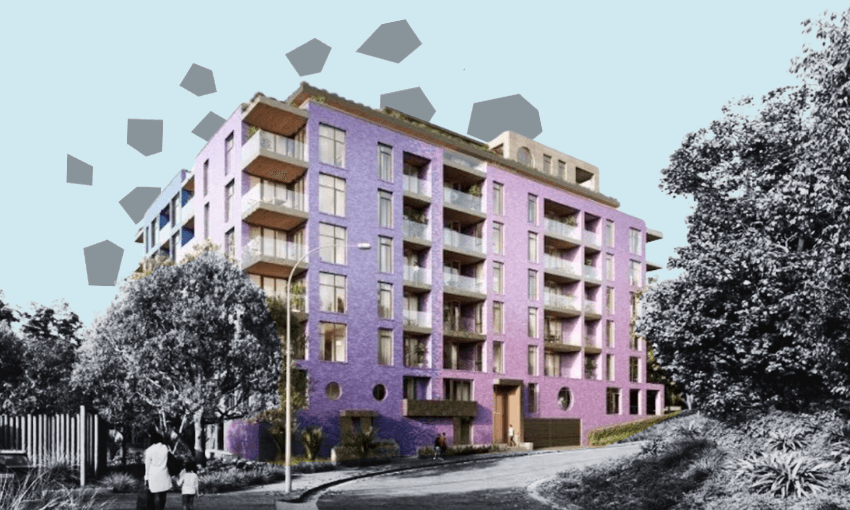
Much of this is driven by government rules that require more homes near major centres and rapid transit, and in some locations within 10km of the city centre, that could mean buildings reaching 10 or 15 storeys high.
That’s because those areas already have some of the best access to jobs, transport, infrastructure, and services – making them better suited to more housing as Auckland grows, like the City Rail Link and the Central Interceptor.
How do I find out whether my area has been rezoned?
It’s easy enough to check. Just go to akhaveyoursay.nz and drill down. Fun fact: your area may already permit more density than you realise. Some areas of Takapuna have had no building height limits since pre-super city days, and it still just has those two towers.

Wait, do we really need 1.7 million more houses in the next 30 years?
No. And we won’t be getting them.
“Those figures are the max capacity if every single property owner in Auckland increased or redeveloped their property to the maximum height and bulk allowed under the rules,” says Hills. “We know that’s never going to happen. Most people in the next 30 years won’t change their house. Some people will stay in their house forever, or add one dwelling and not 17 or whatever. Developers will see certain areas as places they don’t want to invest right now.”
Council modelling gives a sense of the difference, Roughly 140,000 homes could be built across Auckland over the next 10 years, just a fraction of the 1.5 to 1.7 million homes the planning rules have capacity for.
“I have heard people say ‘Why don’t we stage it?’ But if we just upzone, say, one station for now, the land around that station would be extremely expensive because that’s the only choice that developers and people have to build around a station.”
That’s a big change for somewhere like Baldwin Avenue, where the station is currently surrounded by single-storey houses. What guarantee can council give that these tall new buildings won’t suck?
“There are some setbacks and controls around things like outlook and sunlight, and buildings with four or more homes will go through a resource consent process, but the government’s requirements for PC120 limit what the council can do. And under the new RMA changes soon to be passed into law, it will become even more restrictive.”
That doesn’t mean developers can build whatever they like. Design rules and review processes still shape what gets built, but Hills argues the market provides another check: if a building is poorly designed, people simply won’t want to live there. He points to Simplicity’s build-to-rent developments as an example of what’s possible when good design and commercial incentives align.

But developers aren’t exactly rushing to build anything right now, are they?
No. After a boom, we’re in a property slump. But that won’t last forever.
“Our population went up 400,000 in five or six years after the Unitary Plan. So then we had the other problem, extremely unaffordable housing, nowhere for people to live. At the moment, yes, we’ve got an economic downturn, but the whole point of planning is you’re planning for the decades ahead and for the next big increase.”
So what does the new plan do about flooding?
Quite a lot. PC120 proposes much stronger rules to limit development in areas exposed to serious natural-hazard risks, including flooding, landslides and coastal erosion and it has reduced the amount of housing in some places. The idea is fairly straightforward: enable more housing in places that can support it, while making it harder to build homes where it puts more people and property in harm’s way.
Hang on, didn’t Aucklanders already submit on this?
They did – but the government changed the housing legislation again, leading to further changes to PC120. That’s why Aucklanders are being asked to have their say again.
So when do I get to have my say?
Right now. PC120 has been reworked by officials, councillors, local boards and mana whenua. Submissions are open again and you only have until 24 September to get yours in.
After that, about mid next year, the independent panel reports back to the council, which then decides whether or not to approve any changes it recommends.