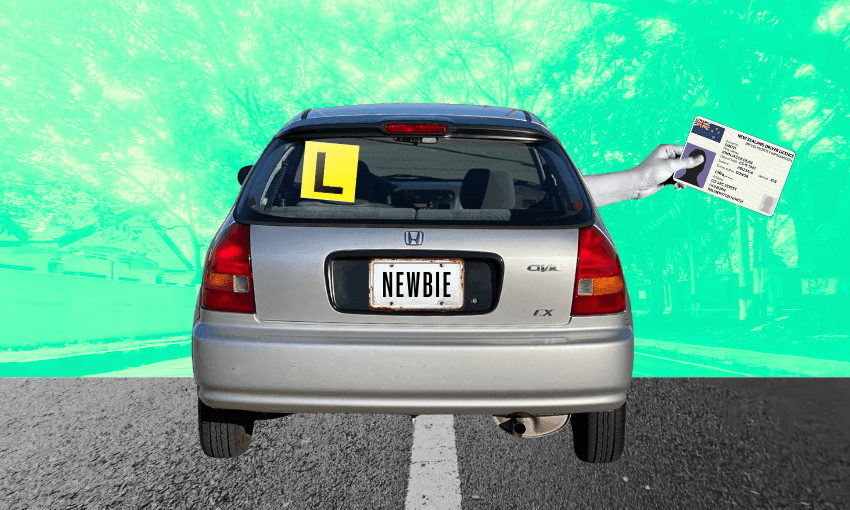

Getting a driver’s licence in New Zealand will soon look very different. Will the system’s biggest overhaul since 2011 actually make our roads safer?
When my grandmother turned 15 in the 1930s, there was no one available to drive her from the family farm to take a driving test with the local traffic officer. So she drove herself.
When she arrived, perhaps expecting a telling-off, the officer told her that if she had made it that far without running off the road, there was no need for a test. He wrote her a licence and sent her back home.
There is a similar story on my mother’s side. An officer told my grandfather not to worry about sitting the test, as they’d already seen him driving around Dannevirke.
Driving tests were a simple affair at the time. A traffic officer would ask a few questions about the road rules, then watch the applicant drive for about 10 minutes. Almost anyone who could change gears, perform a hill start and signal a right-hand turn would be issued a full licence, valid for life.
Things have become rather more complicated since then. Today’s would-be drivers must pass three tests over at least two years, at a total cost of $362. The bill rises if they fail a test or pay $245+ for an advanced-driving course to shorten the process.
Major changes
But the rules are about to change. From January 25, drivers will no longer need to pass a second practical test to gain a full licence. Instead, they will spend longer on a learner licence and be asked to identify hazards as part of the restricted practical test.
For drivers under 25, the learner period will increase from six months to a year, unless they complete an approved course or log supervised driving hours.
The restricted period will fall from 18-months to one year, although any demerit points incurred during that time will extend it by six months. Once the restricted period ends, drivers will automatically be eligible for a full licence without sitting a final test.
When announcing the reforms, transport minister Chris Bishop said the new rules would make it “cheaper and easier” to obtain a driver’s licence by removing one test and cutting the total cost by about $80.
Chris Rodley, head of driving regulation at NZTA, says another motivation was to update the licensing system. “There hadn’t been any major changes since 2011 and we wanted to align with things that have proved successful overseas,” he says.

Longer learners
“The theory behind the changes is that the most important time for a novice driver is in that learner phase, when they’re supervised,” Rodley says.
Under the current system, learners are supervised for only six months before being allowed to drive alone for the next 18 months. “The changes rebalance that and push the learning back into the learner phase.”
Getting licensing right can be literally a matter of life and death. Young drivers are overrepresented in crash statistics. According to NZTA, drivers aged 16 to 24 made up 12% of licensed drivers in 2024 but were responsible for 23% of fatal and serious crashes.
In Sweden, extending the learner period and increasing supervised driving reduced crashes among newly licensed drivers by 40%. More recent US research found that increasing the learner period from six to 12 months reduced fatal crashes among drivers aged 15 to 17 by 13%.

Young drivers
But the government must balance safety with accessibility. If getting a licence is too difficult or expensive, some people may be shut out – a potentially serious social and economic problem in a country with large rural areas and limited public transport.
“A driver’s licence is a ticket to independence and, in many respects, a ticket into the job market,” Rodley says.
Because younger drivers are statistically less safe, some jurisdictions impose much higher minimum ages for solo driving. In Victoria, drivers cannot drive alone until 18 or gain a full licence until 20.
New Zealand has an unusually low solo-driving age, at 16 and a half. The new system will still allow drivers to go solo at that age, but only if they first complete supervised hours or an approved learner course. Otherwise, they have to wait for a full licence at 18.
Shorter restricted period
Drivers who are already working towards their licence will be shifted into the new system on 25 January. Restricted drivers will be able to graduate onto a full licence after 12 months.
Some existing learner drivers will have to wait an additional six months before they can sit their restricted test, but they’ll have less time on their restricted licence if they keep a clean driving record and they won’t have to pass a full test.
Rodley says the agency is working to inform learner and restricted drivers who may be affected by the changes.
“We’re working on a smooth transition into the new system,” he says. That would be one measure of success, but the ultimate test will be whether the reforms reduce crashes.”