How to talk to strangers, and other things I learned drawing 1,462 New Zealanders

People Watching, the book (Image: Toby Morris)
Made possible by


Cartoonist Toby Morris looks back on two years of striking up conversations with strangers and asking if he can draw them for Sunday Magazine.
For the last two years I’ve been talking to strangers. Every week I met people from all around the country at markets, events, community clubs or workplaces, and drew portraits of them doing their thing for a weekly column in the Sunday Star Times’s Sunday Magazine. The goal was to show people being people, to build a collective national portrait from hundreds of individual ones. All up I drew 956 drawings of 1,462 different people from all walks of life.
Now the project has been collected into a book, and looking back over it the surprising thing is not just that I drew that many pictures – it’s that I managed to approach and chat to so many people I didn’t know. I’m an introvert, with a hearing impairment, and a lifetime of doubting that I’ve heard people properly means I’m often cautious about engaging verbally. Starting conversations with strangers has never been my thing.
So, to celebrate the book coming out I thought I’d look back over some memorable people I met and reflect on what two years of striking up conversations with random people around the country taught me.
Junior, Avondale Markets
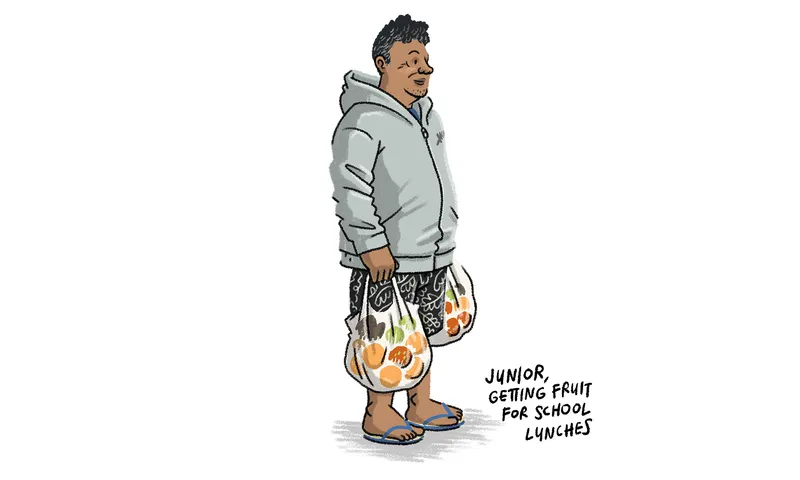
The very first week, having sold my editor on the idea in theory, I went to the Avondale Market on a Sunday morning. It was immediately clear I had underestimated the difficulty of the task. I had no idea what I was doing and made such a mess of the first few people I tried to approach that I considered just going home and forgetting the whole thing right then.
Starting up a conversation is hard enough, but then there’s all the explaining: I’m a cartoonist, I’d like to draw you (but not right now), it’s going to go in the newspaper, can I take a photo, what are you up to? Over time I developed a more natural way to sum it up, and made a business card that explained who I was, who I worked for and had some examples of the drawings which helped a lot too.
But that first week all I had was a few illustrations on a clipboard to show people and a bundle of nerves. Bad combo. I totally miscalculated how an anxious-looking middle-aged white guy with a clipboard comes across. Several stall holders thought I was the council checking on permits, one guy thought I was an undercover cop, and someone thought I was a government immigration official and aggressively told me to piss off.
So I quickly realised I just needed to relax and chat to people like a person, not an official. This guy, Junior, was one of the very first ones where I ditched the clipboard and just said something like “hey, how you going?” rather than launching into a sales pitch. I remember feeling so deeply relieved when he was very friendly and relaxed, and happy for me to take a photo. Thanks, Junior.
Dion, Paeroa
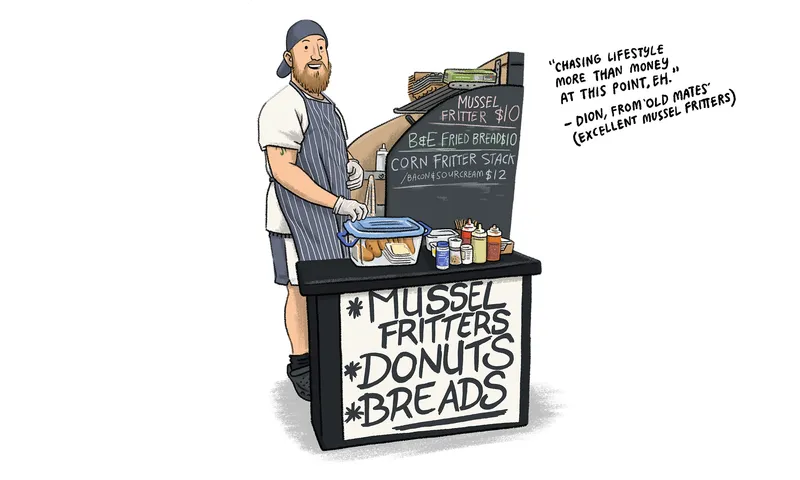
One thing I learned fairly quickly is that food was a reliable way to find people in a good space to chat. Eating is social – it’s something we all do, and it’s something that brings us together. Lots of places I was checking out would have food trucks or a café or bar area, and that’s where you find people who’ve ordered something and are waiting around for it, or choosing what they’re going to eat, or preparing food, like Dion here, and chatting away while they work. They’re usually not in a hurry, and you’ve got a pretty easy starting point for a conversation.
Dion from Paeroa was one of my favourite characters I met – an awesome guy who really does make a mean mussel fritter. He was so generous with his time and sharing his story, and generous with his food too. Stop and say hi if you’re passing through Paeroa.
(Incidentally, I think this is the full list of all the food and drink mentioned in the drawings: Bacon sandwich, macaroon, ribs, mussel fritter, hot chips, ice cream, milkshakes, ‘otai, Golden Circle lemon and lime, rice bubble slice, gözleme, bacon and whitebait butty, sausage sizzle, nachos, dumplings, several pies, Vietnamese fried chicken, crepes, fish’n’chips, bananas, cream donut and L&P, poffertjes, chips, mussel fritter (again), cheese scone and Fergburgers. There’s another portrait of New Zealand in 2026. Good times!)
Tou Hau, Tai Chi class
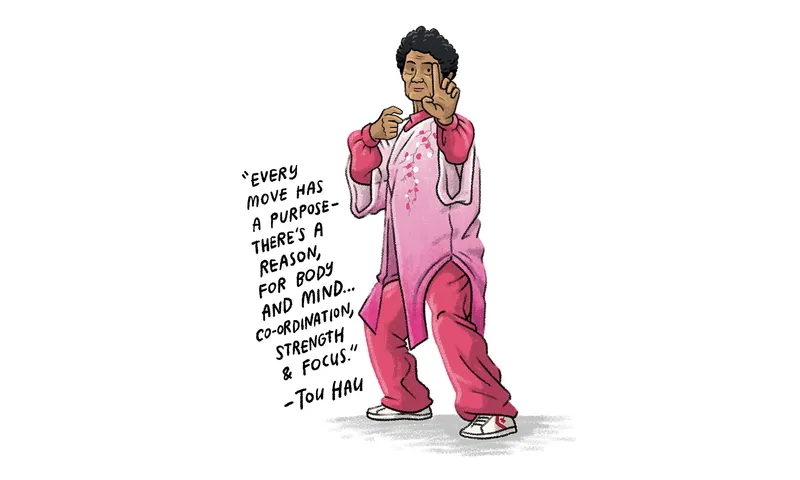
A couple of months in, I was starting to learn that my own body language and energy made a huge difference in how people responded to me. Basically, your mood is a mirror – people reflect your tone and general vibe back at you. When I was anxious, people would be anxious in response, so when I learned to approach people in a calm and relaxed way (even if I was acting a bit) I started to find the chats a bit easier.
The week I visited a Tai Chi class in Devonport was a lesson in picking up the tone from the subjects, though. I sat in on a whole class and it was weirdly intimate: the class was slow and thoughtful and personal, and the level of trust they showed me, a stranger, was huge, so I felt a sense of duty to show the same level of respect back to them when it came time to draw them. Afterwards, Tou Hau, one of the instructors, asked me how I was going to draw the group, highlighting that I had the power to make them look pretty silly if I chose mid-points of poses or unflattering moments. “Please show us doing the poses correctly” was essentially what she said, but I think she was also asking me to draw them with dignity.
And of course I did – but that conversation was a good reminder of something I was already thinking about: I was aware of wanting to look after the people I was drawing. To treat the people with care. I wasn’t trying to take the piss, or stitch anybody up – generally my feeling was “look at this awesome person”. Meeting Tou Hau was a good reminder to treat subjects respectfully and generously – they’re real people, and I wanted the experience of being depicted to be a positive one.
Natalie and Richie, Warriors fans
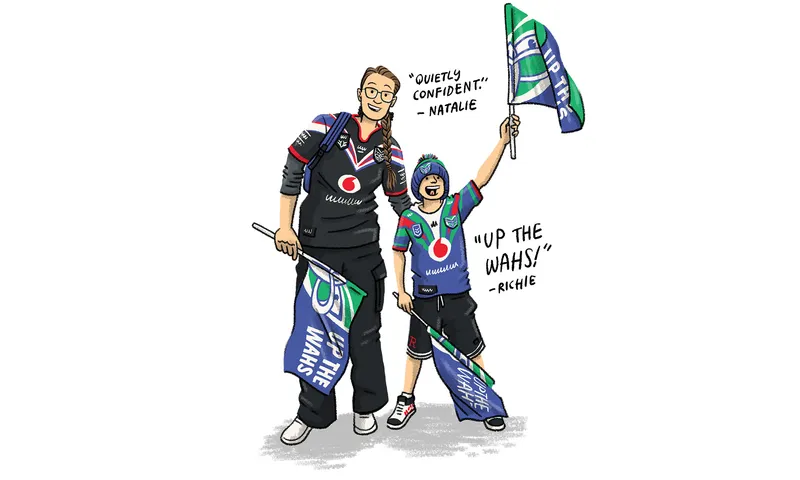
It was important to me to get some sports fandom into the project – not just because I’m a sports fan, but because I think it’s one of our greatest shared cultural touchstones – a magic way we publicly bond and share emotions together. I think public shared experiences are rare, especially ones that cross generations and cultures, so what the Wahs have built is really special. There’s a feeling of belonging and sharing something with other people – so this was one of the easiest places you could ever find to talk to strangers. Everyone is keen to talk about the game ahead when you feel like you’re all in the team together.
Tim, CRL worker
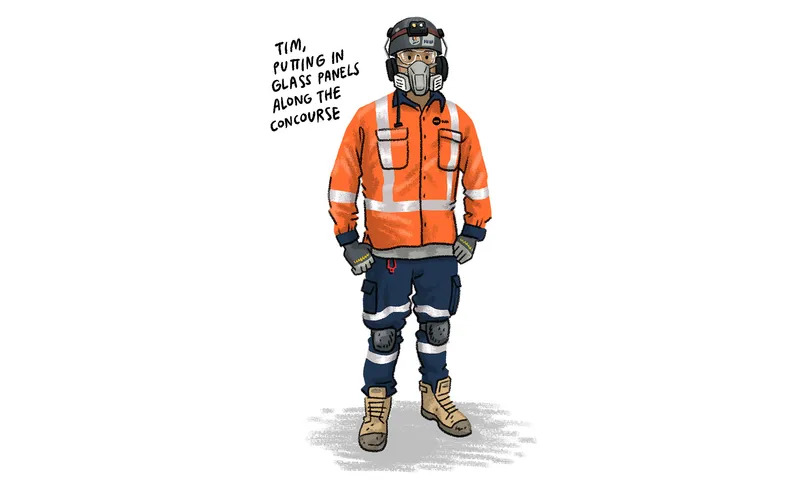
As a kid I found a copy of Ans Westra’s Notes on the Country I Live In and was obsessed with it. It’s a book of loose, candid, lively street photography from around Aotearoa in the early 70s that captured a sense of time and place so clearly it felt like being there. Part of the appeal of this project was to try and capture a moment in time like that – what we looked like, but also what we did and what we cared about too. I hope some kid will pick this up in 30 years time and feel the mid 2020s vibes – and I think visiting a CRL station under construction is one of the clearest markers of the specific time it was made. (See also: People wearing Palestine flag badges, meeting public servants who’d lost their jobs in Wellington, lots of Crocs covered in Jibbitz, and nurses, teachers and firefighters on strike.)
I was glad to capture this moment, going underground to talk to workers putting the finishing touches on Te Waihorotiu, the new CRL train station in central Auckland city. Weeks like this took a little bit of organising – you can’t just wander into a massive building site – so it required a few emails with communications teams and management, but it was worth it to be able to meet and honour some cool people who might not get recognised normally. There are thousands of people who work on these kinds of projects, but as a gesture I’m glad to have a reminder that it is the workers that build these things – the people who make this country work.
Yokr, Chinese New Year
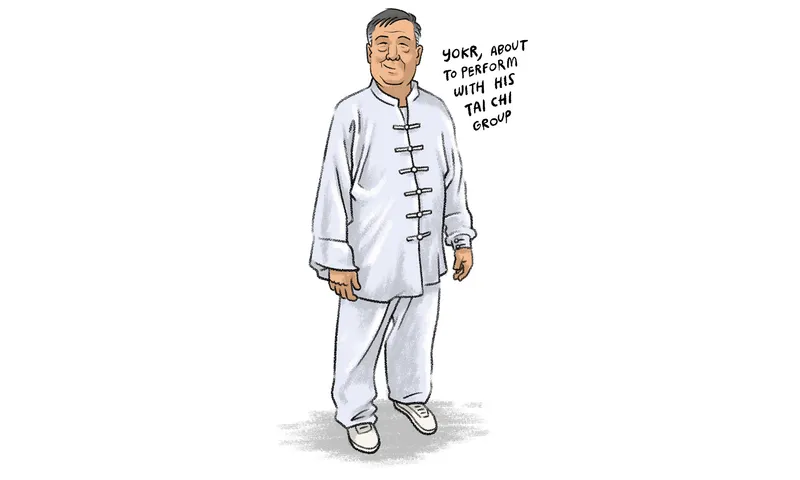
Given my hearing impairment, there were a few red flags I figured out quite quickly that could make approaching people and having a conversation difficult. One was language barriers when people’s English wasn’t great (and I only speak English), but the biggest one was anywhere with really loud noise or music playing. Lots of background noise made it really difficult not only to instigate a conversation, but also to understand and record what people said in reply.
This week, for example, at the Auckland Showgrounds celebrating Chinese New Year, ticked both of those boxes. There were several people I chatted to whose English wasn’t great, and at the same time there was extremely loud music playing the whole time which made me really worried I wasn’t hearing people’s answers correctly either.
For example: I’ll be honest, I’m still not 100% sure I spelled this awesome man’s name correctly. I wrote it out, showed him what I’d written out and he said it was right, which is the best I could do, but honestly, the music was so freaking loud he probably had no idea what I was talking about either.
Ellah (and Blondini), Southland
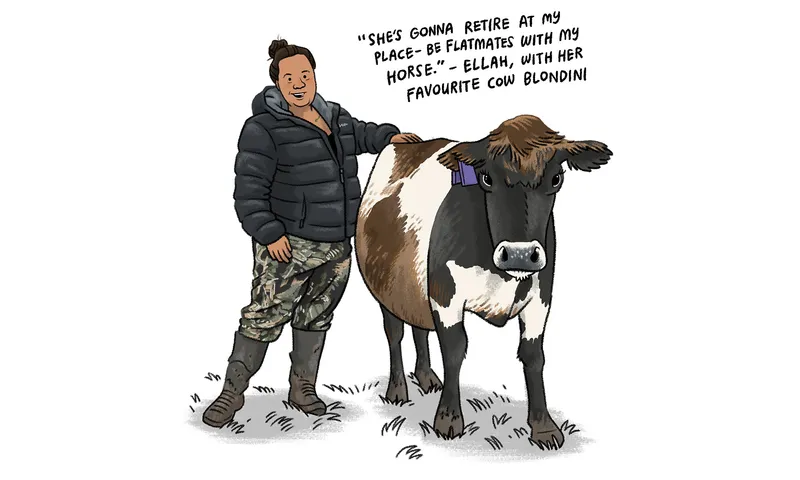
Something I began to realise that helped me get over my nerves is that most people are happy to be heard and to be seen, and happy to help someone. So it’s not about me, it’s about listening to them. More often than not, people are really generous with their time and energy because it feels nice to be seen and heard, feels nice to share and feels nice to help out.
Most of the chats in this book took moments, just a few sentences back and forth, but some spiralled into more. Meeting Ellah (and Blondini!) is a perfect example: I’d come all the way to Southland to draw workers on a dairy farm, which fell through at the last minute (they got too busy, basically) so I had to scramble to think of another plan. Suddenly someone at the original farm had rung a friend, who had rung around some other friends, and before I knew it I was at Ellah’s house, climbing into her ute and driving all around a farm in Lochiel to find her favourite cow. She didn’t know me and she had no reason to help me out, other than being friendly and wanting to show the world her beautiful cow. (It was a cool cow.)
Billy, All Black
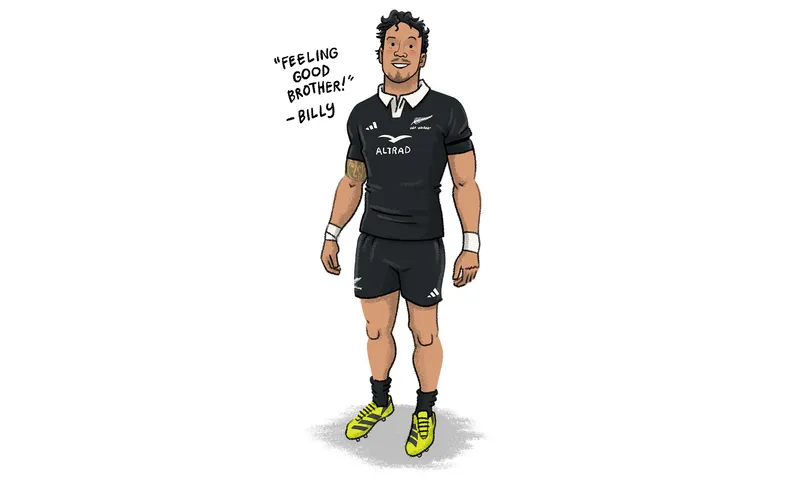
Getting up close to the All Blacks was a bit surreal. A cool bonus of this project was weeks like this, where I managed to hang out with the media pack at an awesome (and victorious) All Blacks v Springboks test at Eden Park.
A test like that is a slick operation, and it runs in a very set way. There are very specific organised opportunities for the pack of reporters to have contact with the players, but for what I needed, it was a bit of a scrum, no pun intended. I was looking for more human moments, so I was stoked when I literally bumped into Billy Proctor, one of my favourite players (go the Canes!), in a corridor straight after the game. He was still buzzing from the win, so I got a really natural and genuine reaction from him. The book is about people being people, so it was cool to capture the All Blacks being people too.
Tyla, LARPer
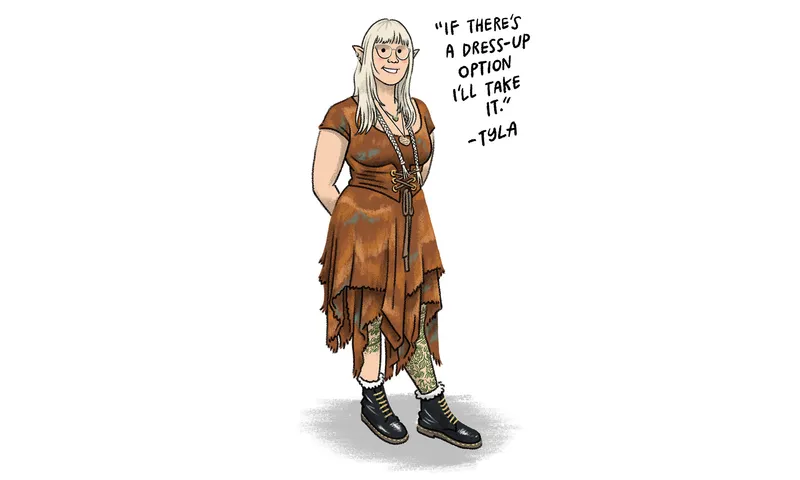
One of my favourite things about this project was having an excuse to briefly step into different worlds, in a way that taught me to be more open-minded about people living different lives to mine. New Zealand, like anywhere, is full of an endless amount of different communities doing their own thing, and from the outside it’s easy to make assumptions about different scenes or subcultures that might seem niche or weird to you. It’s easy to forget that what seems weird to one person is totally normal life to someone else.
For example: I admit that I’d always judged LARPing (live-action role playing) a bit harshly, assuming that within the tiers of nerdy subcultures LARPers were dug in pretty deep. So I probably did go along to the Auckland LARP Faire feeling a bit judgemental and maybe even a little patronising, assuming that the people would be nerdy, awkward or unfriendly.
But man, I was wrong. The thing I completely missed was that this is a community that is unabashedly about having fun (dressing up, imagining, playing) in a way that’s weirdly frowned up among adults, and as result, yes they were a bit nerdy but they were also really fun, friendly and crack-up to talk to. They were having a great time, so I had a great time. They ruled.
This kind of lesson happened a few times. Realising that some of my judgemental assumptions were wrong reminded me to question my assumptions more often.
Dr Richard, Homeground
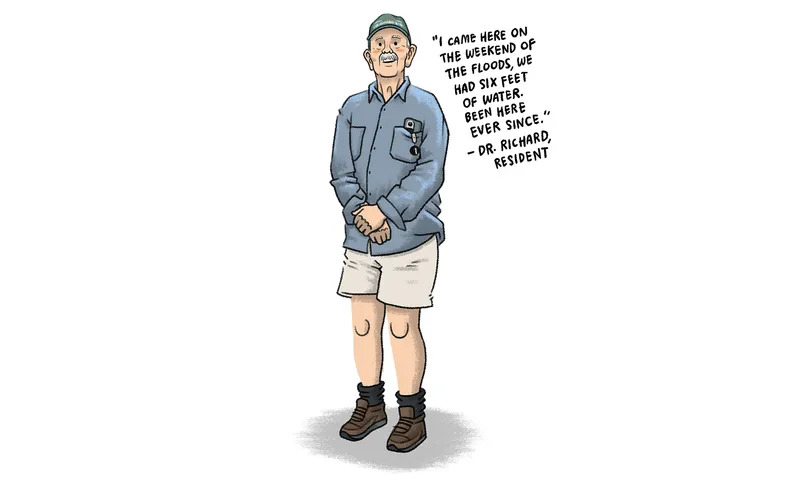
One of the very last places visited as I was winding down the project was HomeGround, Auckland City Mission’s central city base that features accommodation (long term and short term), detox, health care, community activities, a cheap grocery store and a community dining hall for some of the city’s most vulnerable people.
Meeting people at HomeGround put lots of the lessons I’d been learning into perspective: being open minded, listening to people, seeing the best in people. Here was an organisation that was living that kind of philosophy, and their successes felt like proof of the power of that kind of thinking. Meeting people where they are, engaging without judgement, treating vulnerable people with dignity and human-to-human respect is deeply built into the foundation of what they are doing. It was a fitting way to wrap up the project, and reinforced lots of things I’d been thinking about.
It might sound grandiose, but it’s simple really: the biggest lesson I learned was about empathy. Everyone has a story and a place and a role to play, and when we can be more open-minded and just stop and listen to people and really hear where they are coming from I think we can all get along a little easier, enjoy each other’s company a little more and maybe even find ways to work together that work for everyone.
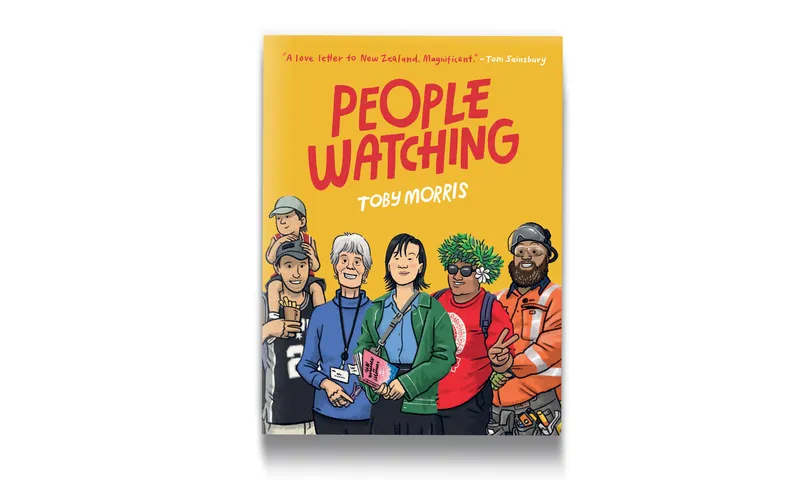
People Watching ($33, Allen & Unwin) is out November 3, and can be preordered at Unity Books.
The Spinoff Books section is proudly brought to you by Unity Books and Creative New Zealand. Visit Unity Books online today.

Toby Morris
Toby Morris is an Auckland based illustrator, comic artist and writer. He is the author of The Spinoff's non-fiction comic series The Side Eye, won the Voyager award for Cartoonist of the year for 2019 and in 2020 his Covid-19 collaborations with Dr Siouxsie were shared around the world.


