Wayne Brown digs out the last of the CAVEs

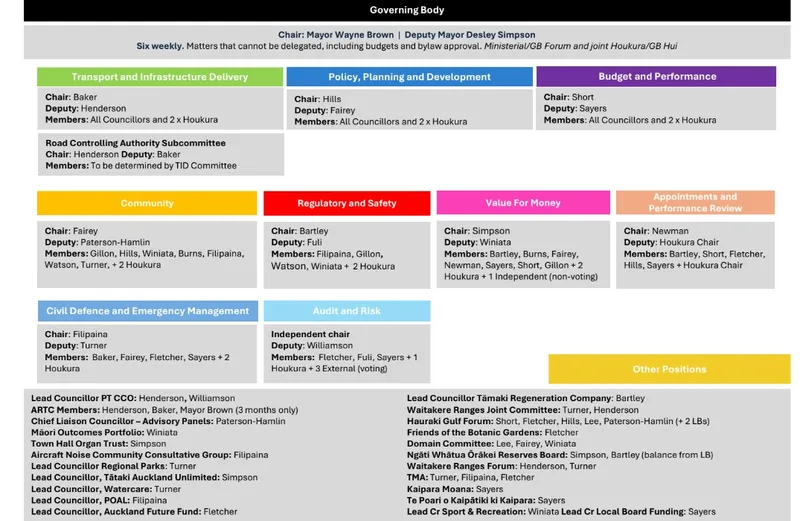
Wayne Brown will now have one of the youngest and most diverse leadership teams in supercity history. (Compilation design Tina Tiller)
The mayor is promoting collaborators and demoting those who have built a career saying no.
Wayne Brown has an acronym he likes to use for his most recalcitrant councillors. It’s borrowed from the All Blacks’ mental skills coach Gilbert Enoka: CAVEs, or Consistently Against Virtually Everything. Auckland’s mayor uses it to describe the elected members who he says have devoted years, or in some cases decades, to complaining, whining and generally saying no.
Though Brown isn’t known for being circumspect about sharing his feelings, he reserves his loudest and most vehement disdain for the CAVEs. The slightly awkward fact is that a lot of them started out as his natural allies. He arrived in the mayoralty singing “hit the road Goff” and initially aligned himself with a lot of the people who were his predecessor’s loudest critics. But he quickly found out their oppositional nature wasn’t mayor-specific. It was a way of political life.
Brown spent his first term ditching the grumpiest of the group. Waitematā councillor Mike Lee started out as an AT board member and now spends his time lobbing barbs at Brown in meetings and being told to go back to Waiheke in return. Albany’s John Watson was initially the transport committee chair and was ditched from that role in favour of Franklin councillor Andy Baker. Today Brown is getting rid of the last few CAVE-adjacent people he has left in leadership.
The headline move is the elevation of Albany’s Victoria Short to chair of the Budget and Performance Committee at the expense of Rodney councillor Greg Sayers, who will become her deputy. It’s one of a long list of changes. Labour-aligned Whau councillor Sarah Paterson-Hamlin will step in as deputy chair of the Community Committee. Howick councillor Maurice Williamson has moved from deputy chair of the Budget and Performance Committee to deputy chair of the less powerful Audit and Risk Committee. North Shore councillor John Gillon and Howick councillor Bo Burns have both lost deputy chair positions on the Regulatory and Safety and Community Committees respectively. Watson and Lee are nowhere to be seen in leadership, though the latter will serve on the Hauraki Gulf Forum.
There are two ways of looking at the reshuffle. One is positive. Short has only been in council for eight months but has already distinguished herself as competent and collaborative. She’s by all accounts used the financial acumen she built up in a career as an accountant to good effect on the Value for Money and Budget and Performance Committees, with deputy mayor Desley Simpson describing her as a leader in waiting. She’s also just 34, Auckland’s first Kiribati councillor and will now be the first Pacific person to serve as chair of one of the major committees attended by all councillors.
Manurewa-Papakura councillor Matt Winiata spent this term attending the Value for Money Committee even though he wasn’t a member. He’s been rewarded for his diligence with a role as its deputy chair. Paterson-Hamlin makes memorable contributions in debates, often going up against the likes of Watson. Her focus on people with disabilities will be a welcome addition to the Community Committee role, and there’s a chance she may take over from Brown on an AT advisory board which he is set to serve on as an interim observer for the next three months. The upshot of it all is that Brown, a mayor who swung to power on a wave of support from disgruntled, generally older voters from wealthy suburbs, has now instituted one of the youngest and most diverse leadership teams in Auckland Council’s history.
The other way of looking at it is as Wayne’s revenge. The mayor had to face down an effort to torpedo his budget at a May 26 council meeting. Gillon and Burns tried to pass an amendment they argued would bring a long-signalled rates rise down from 7.9% to 5.9%. But their proposal was flimsy in places. It was predicated on a delay to fully funding depreciation, which council finance staff said could trigger a costly credit downgrade. Several other proposed savings measures were questionable, with Simpson arguing many of them were already in motion.
Centre-right councillors who stuck by the mayor often seem livid at what they saw as a cynical and self-serving proposal from their colleagues. They’ve faced fierce criticism from their communities and the Auckland Ratepayers’ Alliance, which called them “gutless wonders”, for failing to back budget amendments that they still believe were unrigorous and unworkable.
Brown has rewarded right-leaning councillors like Short, Winiata and Baker who voted with him in the face of adversity. If Simpson could have got a promotion short of actually becoming mayor, she likely would have been given one too.
The demotees are among the group that tried to take his budget down. Sayers could feel a bit hard done by. Simpson and Brown have both gone out of their way to praise his demeanour as a chair, describing him as a calming presence. The Rodney councillor has voted with the mayor on housing intensification and hasn’t been as oppositional as some of his peers. But his position became untenable the moment he sided with his dissenting colleagues on their 5.9% rates increase at the Budget and Performance Committee he used to helm. Brown explains his decision bluntly. “Chris Luxon didn’t put Chlöe Swarbrick in as minister of finance,” he says.
Other decisions were more straightforward. Though Brown calls them “redeemable”, in contrast to what he sees as lost souls like Lee and Watson, Gillon and Burns have consistently voted against him this term on just about every important measure from housing to the annual plan.
The people who have replaced them in positions of power aren’t exactly sycophants. Short says she won’t be governed by what the mayor wants so much as “doing what’s right”. Winiata says his overarching concern is getting things done. “I might only be here for three years,” he says.
In Brown’s eyes, the thing that distinguished them from their predecessors is a willingness to compromise and collaborate. “It’s really easy to say no, right? It’s really hard to find an alternative,” he says. “I set a clear direction: fix Auckland. These people are helping me fix Auckland. I want to give them an ability to help even more. And those people who clearly don’t want to fix Auckland, well there’s no point in giving them more power to unfix Auckland.”
Local politics is unique in how people can get elected, and carve out long and successful careers on negativity alone. But as Brown has found out the hard way, governing on it is a different story. Now that he’s dug out the last of the CAVEs, his hope is that he can start to build.

Hayden Donnell
Hayden Donnell is a senior writer for The Spinoff. He previously worked at RNZ, TVNZ and the New Zealand Herald, alongside other media companies that have since closed down or been renamed. His primary passions are local politics and the Big Fresh animatronic fruit and veggies.


