Wellington North candidates face off on student issues in first debate

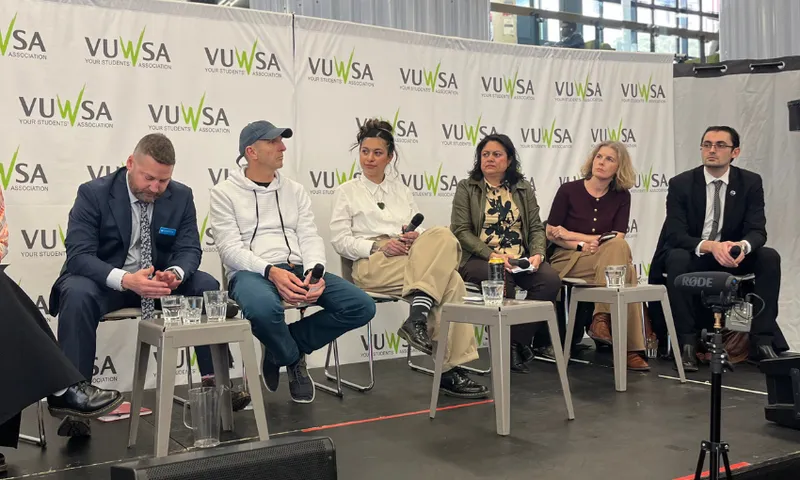
Johnathan Pitts, Nigel Elder (councillor, not candidate), Tamatha Paul, Ayesha Verrall, Jessica Hammond and Taylor Arneil. (Photo: Lyric Waiwiri-Smith)
The incumbent said she’d been ‘scrapping her ass off’ daily for her newly named electorate, but what could others offer?
If elections were won with applause, the hands in the air for Wellington North’s left-wing candidates at the electorate’s first debate this week would have convinced them it was all smooth sailing until November 7. It’s a new electorate, a merging of the former (reliably left-leaning) Wellington Central electorate and bits and pieces of the old Ōhāriu seat, including the traditionally more right-leaning suburbs of Khandallah, Ngaio and Wadestown. But with student-heavy suburbs like Te Aro, Aro Valley and Kelburn in the mix too, one issue looms large: is Wellington the kind of city where young people can build a future?
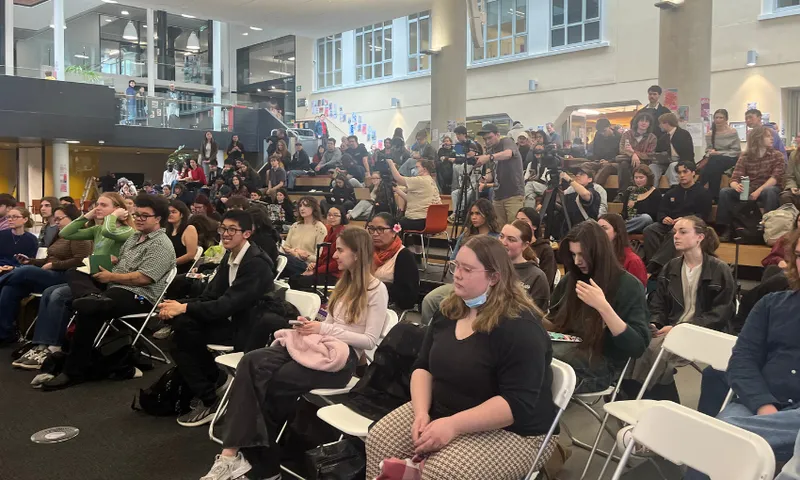
That question was at the heart of the electorate’s first debate, hosted by Victoria University of Wellington Student Association (VUWSA). This is familiar territory to current Wellington Central MP Tamatha Paul of the Greens, who’s a former VUWSA president. Alongside her on the panel were Ayesha Verrall (Labour), Jonathan Pitts (National), Jessica Hammond (Opportunity), Taylor Arneil (NZ First) and Nigel Elder (an Act-affiliated Wellington regional councillor who stood in for the party’s Wellington North candidate Matthew Hague).
First up, candidates were asked what they thought was the biggest issue for students in their electorate. For Pitts, it was dealing with the “draining” uncertainty of the job market while you’re trying to “enjoy [life] to the max”. Hammond reckoned it was the cost of living and the need for “radical reform” of the tax system. Arneil and Elder agreed that it was all about bills, bills, bills, but the latter had some advice for the crowd. The onus is on you to get through your studies, because “there’s no freebies in life”. “It’s going to be tough, I’m sorry,” Elder said, “but you can make it through.”
There was a change of tune when Paul picked up the microphone. She said she knew “life is shit for you at the moment”, but the Greens intended to “stand on business” and bring back the recently repealed fees free scheme. Verrall, a doctor, former health minister and current list MP, said if she was elected, she’d treat being a local MP the same way she treated her medical practice: by making sure to do the rounds every day to make sure constituents are thriving.
“I want to defend free stuff!” Verrall added, because “free stuff is so good”. It was a “public good” to be able to access free healthcare in Aotearoa, Verrall said, as she called out the government for reintroducing prescription fees. “Free stuff is good for you, and it is absolutely part of raising our productivity and everyone enjoying a good life.”
But how would these candidates juggle party policies with the needs of their constituents? Hammond, who is campaigning only for the party vote and is at number three on the Opportunity list, said the party needed to get into parliament first and “fix the fundamentals” – which looked like stopping the left and right from repealing each other’s legislation. Take it from somewhere who was born in the capital, studied at Victoria and worked as a public servant (“you can’t really get much more Wellington than that”), she said: moving away from political blocs was “going to make things better for all of us in Wellington and all around the motu”.
And Arneil, also eyeing up only the party vote, said he planned to be a strong voice for Wellington around the caucus table. Though NZ First is yet to release its tertiary education policy, Arneil hoped the party could resurrect policies from the 2023 election, like a universal allowance for full-time students, and a debt write-off scheme allowing employees in specific industries to pay off a year’s worth of student loan debt by spending two years working in Aotearoa.
Verrall, a former cabinet minister, had experience on her side. Party politics and local MP duties aren’t in contradiction, she said, and promised to make sure “the issues of Wellington North are being incorporated in the highest decision-making table in the country”.
Paul had already done the “actual real, gritty, complex mahi” needed from an electorate MP, she reckoned. She said “hundreds, if not thousands” of constituents had passed through the doors of her electorate office needing support, and she didn’t intend on “sitting in an ivory tower”. “I’ve been effective in opposition,” Paul declared, “and there are only two people on the stage committed to changing the government.”
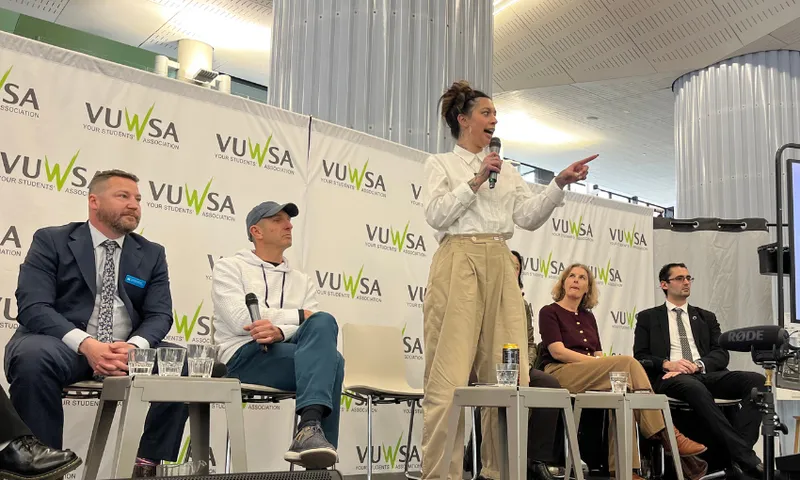
Elder, who was next up to answer, smiled. “I’ve got bad news for you: the government’s not changing,” he promised. “You’re going to get the same coalition back, it’s just going to look a little bit different this time.” The room was noticeably less enthusiastic about that.
When asked to envision the future of Wellington’s economy, the candidates couldn’t go past the job market. Hammond promised to get the “mojo” levels back up by investing in research science jobs. Arneil said the current government had already helped Wellington’s job market by relaxing film industry regulations. Elder imagined a city dependent on industry rather than the public sector.
Both Pitts and Verrall said they wanted students to be able to see the city as their forever home. And Paul just wanted to make sure the next government “stops having a go” at Wellington. “We have been the punching bag of this government because we’re not dumb enough to fall for their policies, their economic insanity,” Paul said.
Final round: a 90-second pitch to round things off. Arneil wanted in so he could “push” NZ First on its previous student loan and allowance policies. Hammond wanted in because someone needs to stop the “backsliding” between the left and right. Elder wanted you to party vote Act for “equality for all”. Verrall wanted in because a track record of delivering “life-changing health services” should translate into some decent delivery for Wellington. And Paul, “battle-worn” after “scrapping my ass off every day”, just wanted another term.
And finally, Pitts. The single dad, lawyer and self-described “corporate guru” is the kind of guy who just “likes to help people”, he said. He’s got the contact book to help his constituents get connected with services and industry leaders, and he didn’t want to see the good people of Wellington “walk down Courtenay Place and get assaulted by some random”. And Pitts said he knew what it was like to clean up someone else’s mess. “I’ve supported Green MPs and mayors when they’ve got into trouble or they’ve got some bad publicity,” Pitts said, eliciting a small frown from Paul. “I’ve always helped people out.”

Lyric Waiwiri-Smith
Lyric is an award-nominated politics reporter at The Spinoff. She covers parliament from the press gallery, pens the weekly column One MP, One Pint and is endlessly curious about what makes our decision-makers tick. Off the clock, Lyric loves a live gig, a cold brew, and being a Wellingtonian (on a good day).


