The calls on the right to ‘rort’ MMP by engineering a National Party overhang

The seat squeeze. (Image: Tina Tiller)
Advocates for a version of the Te Pāti Māori approach include a former National leader, a high-profile NZ First candidate and a billionaire donor.
Please don’t vote for us, was the message from Te Pāti Māori (TPM) at its campaign launch last month. Or, rather, do vote for our candidates in the Māori electorates, but give your party vote to Labour or the Greens, and thereby increase the chances of changing the government.
The tactic – which neither Labour nor the Greens support – is at least in part designed to create an “overhang”. Under the MMP system, any party that wins a tally of electorate seats that is greater than the number it would get based the party vote does not have to surrender those seats. It instead creates an overhang. As has happened variously over the years, the total number of seats in parliament simply ticks up a little from the 120 default. Right now, for example, there are 123 seats in the chamber.
The TPM announcement prompted discussion around whether what appeared to be deliberate efforts to engineer an overhang would be considered legitimate; some thought it could even imperil the Māori seats, or the MMP system itself.
Others countered that the rules of MMP have been gamed since Mark Thomas was kneecapped by his own National Party in 1996 – TPM are just saying it out loud. Some opponents of the current government say that the imperative of change outweighs other concerns.
Interest in the overhang doesn’t end with TPM, however. It can also be found on the other side of the spectrum.
Here, it centres on an unusual situation faced by National: on present polling, it is plausible the party could win more electorate seats than its allotment based on the party vote. That would be miserable for anyone relying on a list seat, but were Act or NZ First to fare sufficiently well in the party vote, it could be the difference between the coalition holding power or getting turfed out.
A research paper published by the NZ Initiative think tank last month modelled overhang possibilities, finding, as Oliver Hartwitch wrote, “if one National party vote in nine moved to a coalition partner, the government would gain a parliamentary majority even if the opposition wins more votes in total”. That wasn’t presented as a recommendation, mind you – the warning was instead that “tactical voting could sink MMP”.
All of this might be dismissed as fanciful were it not for the fact that it has been championed by a group of intelligent and influential figures on the right.
Don Brash, who founded the Hobson’s Pledge lobby group, responded to Te Pāti Māori’s approach by urging voters on the right to draw inspiration. “The right would be unstoppable,” said Brash, who led the National Party for three years from 2003, on The Platform. Voting for National electorate candidates while backing Act or NZ First on party was a way of “guaranteeing a centre-right government”.
Michael Laws has by his own account been “hammering” since February the case for the “overhang ruse or rort”. One of several high-profile candidates for New Zealand First, Laws is a former MP for National and NZ First, and hosts a daily show on The Platform. He told listeners last week: “Labour, National, New Zealand First, the Greens and Act cannot admit this particular strategy. To do so would be to essentially have one of the major political parties of this country signing up for what is essentially a rort or a ruse, or the misuse of MMP for political purposes. But the rest of us aren’t bound.”
And yet, he said, “sotto voce… it’s a bloody good idea”. If TPM was “going to screw the scrum and the referee is not going to pick them up, then stuff it,” he said. “We’re going to screw the scrum as well.” He offered the analogy of the 1990 cricket match, during which New Zealand responded to Pakistan’s flagrant ball tampering by, well, flagrantly ball tampering.
Ashley Church, a former chief executive of the Property Institute of NZ, joined the chorus in a recent appearance on the Leighton Smith Podcast for Newstalk ZB. In light of the “Marxist” ideas that would come with a coalition on the left, the overhang strategy was “an idea I’ve been promoting over the last three or four weeks,” he said, adding: “This is extreme stuff, but we’re at an extreme point in the election cycle”. Smith, godfather of ZB talkback, interjected: “I wouldn’t call it extreme, I’d call it tactical.”
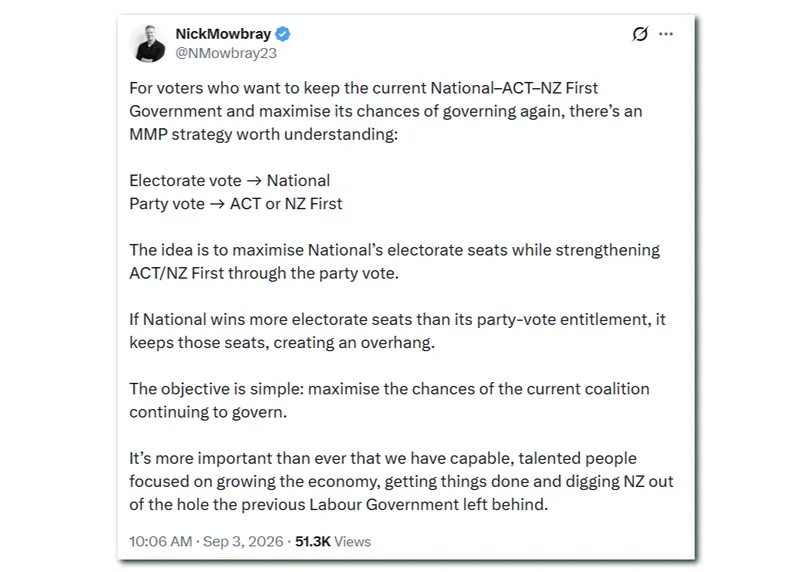
Nick Mowbray, the billionaire co-founder of Zuru, has this year donated $250,000 to National and $200,000 to Act. On Thursday, he laid out his thinking for “voters who want to keep the current National-ACT-NZ First government and maximise its chances of governing again”, he laid out the overhang strategy as something “worth understanding”.
He wrote on X: “If National wins more electorate seats than its party-vote entitlement, it keeps those seats, creating an overhang. The objective is simple: maximise the chances of the current coalition continuing to govern. It’s more important than ever that we have capable, talented people focused on growing the economy, getting things done and digging NZ out of the hole the previous Labour government left behind.”
No sitting MP from the incumbent coalition has come out in support of the tactic. “I think voters would punish that kind of game-playing,” senior National MP Chris Bishop told media last week. “We’ve got no intention of doing that.”
Act candidate Paul Henry did appear to flirt with the idea during his ongoing “Unlocked” roadshow, however. According to a Herald report, he told a Lower Hutt audience that a National overhang would mean a “much better chance of securing a right government win”.
Henry said he’d seen calculations that an overhang could reach as high as 10 seats. “There are a lot of people who don’t like to be told what to do and because I think there are more and more people who are wise to the way MMP works, people like yourself and you’ve worked it out and you’ll talk to other people and maybe that’s the best way this news should filter around,” he said.
“But you’ve got to be so careful saying these things and there are members of the media here, but there is a school of thought that says actually, party voting National is actually a wasted vote because they will get so many constituency votes that they require many, many, many more party votes to… get an extra member of parliament as opposed to Act.”
The NZ Herald was sufficiently moved by Henry’s remarks to devote an editorial to the subject. It contended that “the use of these strategies, particularly by the minor parties, is not deceptive or an attempt to rig the system. It’s just smart politics.” It concluded: “If you don’t like it, hate the game, not the players. And you might consider a referendum on MMP – as Christopher Luxon suggested – is worth supporting.”
So would seeking to engineer an overhang be a good idea for the parties of the right? “This is a very, very, very bad idea,” came the answer from David Farrar, the pollster and commentator whose clients include the National Party. He laid out his reasons for rejecting a “stupid plan” on Kiwiblog.
First, it would mean “National has no list MPs at all”, said Farrar, a longstanding National member and former staffer. That would mean farewelling Nicola Willis and Paul Goldsmith, and possibly Chris Bishop, in favour of “whoever is ranked No 17 or 15 on the NZ First or Act party list. If you think that will make for a stronger centre-right government, you’re out of your mind”. Were National to become, in effect, an electorate-only party, “its ability to bring talented people such as Tim Groser, Steven Joyce, etc, in is gone.”
What is more, it would be “profoundly undemocratic”, he said. “The public will have a revulsion to any government that gets formed despite winning fewer votes than the opposition. It creates an arms race, where all parties will then try to manipulate the system – Labour could try the same with Greens and Top. You’ll end up with absolute chaos.”
Such an approach also imagined the three coalition parties to be “interchangeable”, he said. “The fewer seats National has, and the more NZ First has, then the fewer policies National will get to implement – so expect lots more money for horse racing and MFAT, and no chance of plugging the deficit to get out of debt.”
Farrar urged anyone seeking a centre-right government to simply give their party vote to whichever of the three parties they supported. “If you want more National Party policies and ministers, then choose National. If you want more ACT Party policies and ministers, choose ACT. If you want more NZ First Party policies and ministers, choose NZ First. But do not vote for ACT and NZ First if you actually want National Party policies and ministers, on the basis of a cunning overhang plan. It won’t work, and will only damage National.”
In other parts of the world – from Lesotho to Italy to South Korea – mixed systems similar to MMP have been gamed through what is sometimes called “decoy lists”, whereby a party offers two versions of itself, one for electorates and one for the list. It tends not to end well, typically leading to reform of the voting system. Many believe this is the path the overhang strategy would lead us down.
That is not a new thought. Forty years ago, the Royal Commission on electoral reform, which recommended MMP, acknowledged the “remote possibility” of “deliberate manipulation of the system” to deliver an overhang. It was confident, however, that “any attempt to deliberately manipulate the system would be both difficult to implement and likely to attract an electoral backlash”.

Toby Manhire
Toby Manhire is editor-at-large at The Spinoff. He loves to cast a pod, whether it's Gone By Lunchtime, At Large or Juggernaut. He is a former editor of The Spinoff and has worked as a journalist in NZ and the UK since the last millennium.


