Why the world thinks New Zealand solved the housing crisis

New York mayor Zohran Mamdani (right), one of many international politicians looking to NZ for answers to the housing crisis, and housing minister Chris Bishop. (Photos: Getty Images. Composite image: The Spinoff)
From Zohran Mamdani to the Financial Times, international politicians and media seem to think Aotearoa has fixed its housing affordability problem. Um… what?
“Let the lessons other cities have learned guide our future,” New York mayor Zohran Mamdani said while announcing a new affordable housing programme in Queens earlier this year. Then, as an example of a city he wanted to learn from, he cited Auckland, New Zealand.
Mamdani isn’t alone. Chris Minns, the premier of New South Wales, has pointed to New Zealand as an example of housing policy he’d like to emulate. So too has David Eby, the premier of British Columbia.
New Zealand has become something of a cause celebre among housing activists, academics, journalists and politicians seeking a solution to the crisis of housing affordability. In 2023, Business Insider ran the headline “America, take note: New Zealand has figured out a simple way to bring down home prices”. The following year The Atlantic wanted to know “What the United States can learn from the Pacific nation”.
A more recent story in the Financial Times featured the particularly eyebrow-raising headline “How New Zealand’s biggest city solved its housing crisis”. When it was posted to the /r/newzealand subreddit, the top comment read: “Today I learned that the Auckland housing crisis has been solved! Good work to everyone involved!”
Despite all that international praise, the Ipsos housing monitor survey shows that 54% of New Zealanders think the country is on the wrong track when it comes to housing and 62% of renters don’t believe they will ever be able to afford to buy a home.
What’s going on? Why does the world seem to think New Zealand has solved the housing crisis while New Zealanders on the ground report a completely different story?
The short answer is zoning reform. Over the past decade, subsequent Labour and National governments have introduced a series of rule changes aimed at increasing housing supply, each with boring names and forgettable acronyms such AUP, NPS-UD, MDRS, PC78 and PC120.
The reforms have been wide-ranging, covering everything from granny flats to parking mandates. The most obvious impact has been a boom in townhouse construction. Since 2022, townhouses have overtaken standalone houses as the most common form of new building construction in the country.
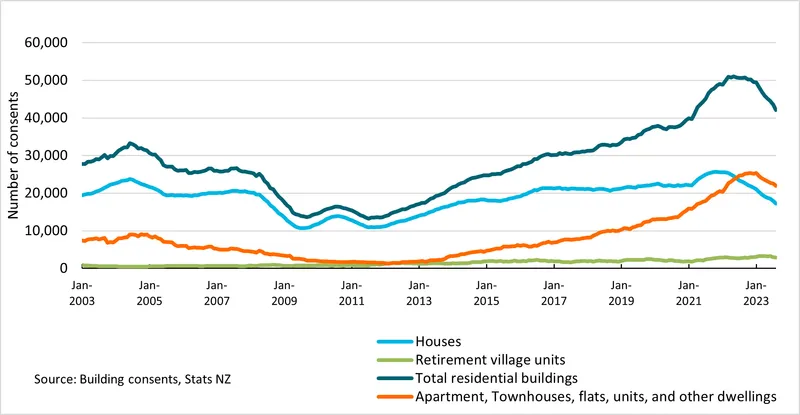
But building more townhouses is a far cry from solving the housing crisis. The median Auckland house is worth 6.9 times the annual median household income, which ranks the city as “severely unaffordable” according to Demographia’s International Housing Affordability criteria. That’s a slight improvement from the peak of 9.6 in 2022, which was considered “impossibly unaffordable”.
Economists agree that the idea that the housing crisis has been “solved” is far too optimistic: both Stuart Donovan of Motu Research and Eric Crampton of the New Zealand Initiative say the reforms increased housing supply, but New Zealand is still a long way from anything that could be considered a solution.
“We’ve made progress from a very bad position. The job isn’t done,” Crampton says. “There is credible economic evidence that supply-side reforms increased supply and reduced costs in Auckland and Lower Hutt,” adds Donovan. “For the rest of the country, which has adopted variants of these reforms more recently, I would say it’s too soon to know what the effects are.”
Michael Andersen is a Portland-based housing advocate who has based an entire podcast on the New Zealand housing experience. In Yimby Country, he interviews New Zealand activists, politicians and academics to see what US campaigners can learn.“There is no better example that I know of in the world than Auckland for a city that set out to make big changes to its zoning with the goal of managing housing prices and increasing housing choice, and unquestionably succeeded,” he says.

New Zealand’s reforms have attracted further attention within nerdy policy circles because they have been unusually rigorously studied. The man primarily responsible for that is Ryan Greenaway-McGrevy, an associate professor of economics at Auckland University who has published an ongoing series of papers analysing the impact on New Zealand’s housing market.
Greenaway-McGrevy says the Auckland Unitary Plan was “a very unique policy and it took me a while to realise that. Internationally, very few cities have taken such a broad zoning change all at once.” It created what he describes as a “natural experiment”.
By comparing Auckland’s rate of new housing construction to other New Zealand cities, and comparing areas that were upzoned to those that weren’t, Greenaway-McGrevy estimated that 21,800 new homes consented from 2016 to 2021 were a direct result of the Auckland Unitary Plan, and that rents in Auckland were 23% lower than they would have been without the changes. He says several people from US state governments have approached him to discuss his research further.
Aside from the numbers, Andersen says he has picked up tactics from New Zealand campaigners. “I was really persuaded by an argument I heard [New Zealand housing policy expert Eleanor West] making on a podcast appearance… It’s easier to say that we want to allow housing in the city so that we don’t have to pave over the country. That’s a fundamentally simpler argument than saying we need to allow this home so that this rich person can move into that home so they don’t move into this other home, so that drives down the aggregate price of housing for this other person. It may be true, but it’s way too complicated to tell to normal people,” he says.
Andersen also sees parallels in the way New Zealand housing campaigners focused on reforms at a central government level rather than piecemeal changes at a council level. “What really caught my attention was the fact that this had all happened in quick succession, and maybe most importantly, that it happened from the central government; that it was the nation’s government setting a baseline standard for zoning. That was just becoming the key strategy in the United States at the time – getting state governments to set a baseline zoning standard. That’s been the key to a lot of changes. I do almost all my work now at the state level, and I have various peers around the country doing the same thing.”

Throughout the process of making the podcast and learning more about New Zealand, Andersen says he’s been particularly struck by the narrow power distance between political leaders and individuals who want to influence policy. “A bunch of people I talked to were like, “yeah, [Labour MP and former housing minister Phil] Twyford DMed me on Twitter all the time to ask for my opinion. That was something that’s hard to imagine happening much in the States.”
The current housing minister, Chris Bishop, is the most vocal champion of planning reform in the National-led coalition government and has become something of a hot ticket at international housing and urbanism symposiums. Last year he gave a keynote presentation about New Zealand’s reforms at the prestigious New York Urban Design Forum and spoke at the Centre for Independent Studies in Sydney alongside NSW premier Chris Mimms.
When asked why he thinks the world has taken such interest in New Zealand’s reforms, Bishop points to the speed and scale of the legislative changes. “It’s kind of like New Zealand is at the vanguard, as we were in the 1980s, in terms of big substantive bold reforms that are world leading. That’s what we’re trying to do. I’m trying to continue that and take it forward,” he says.
Much like the Rogernomics era of rapid and controversial economic reforms, many of Bishop’s moves have been possible only because of New Zealand’s uniquely powerful parliament, with no upper house and no ability for the supreme court to overturn legislation. “In New York and Sydney they couldn’t believe how we can just pass a law through parliament and it happens,” he says.
As leader of the house this parliamentary term until a caucus reshuffle earlier this year, Bishop pushed the pace even further. He generated controversy for his record-setting use of parliamentary urgency to rush through legislation with less scrutiny. “I, in particular, and New Zealand broadly get a bit of stick for our unicameral legislature,” he says. “There are good, fair-minded objections to that. However it also means that, in the same way as in the 1980s, if you want to act boldly you can act, especially when there is a bipartisan consensus.”
Although Labour and National have seen eye-to-eye on many of the changes, that doesn’t mean they’ve been without controversy. The latest proposal for further upzoning in Auckland, Plan Change 120, generated backlash in some inner suburbs that are currently exempt from high-density rules. And Auckland Council has taken umbrage at proposed fast-tracked greenfield developments on the outskirts of the city, which could reportedly require as much as $5 billion worth of new infrastructure to service.
Mark Todd, the co-founder and development manager of Ockham Residential, one of the largest apartment builders in Auckland, says what he considers to be the government’s laissez-faire approach to zoning has essentially enabled even further sprawl because townhouse developments on the outskirts of the city have become more lucrative for developers, as they can fit more homes onto the same plot of land.

While townhouse construction has boomed in the past decade, there is little sign of an uptick in apartment building. “No one will build anything. That’s a clear failure. We’ve spent a billion dollars making our downtown one of the prettiest in the world and there’s no one living there,” he says. “It’s just not good enough to be agnostic about where they go. We’ve got to have priorities. We need to incentivise housing that we want and disincentivise low-value or unwanted housing.”
He wants the government to take a more hands-on approach to encourage more apartment developments. “My personal view is that for the monopoly service providers – power, water and fibre – the government should make sure those connections are free if the city has designated those areas as a priority for housing.”
There are other downsides too. The proliferation of townhouses on the outer edges of Auckland without equivalent development in inner suburbs has caused worsening traffic issues. And the decision in 2020 to ban councils from imposing car parking requirements on new developments has raised hackles too. The changes were celebrated by international urbanists for reducing cost barriers, but have frustrated some neighbours who find it harder to get street parking.
The parking issue is Andersen’s biggest critique of New Zealand’s approach. “It’s really tickled me how terrible New Zealand has been at making progress on parking management. I love that y’all were able to remove parking mandates… but the next step needs to be that you actually manage the parking on the street with permits or meters or time limits or something,” he says.
When asked about these controversies, Bishop says “the last two or three years have been interesting. There has been a backlash among some parts of Auckland but I wouldn’t want to overstate that.
“I suppose my take-home point is change is difficult, and I get that, but if we want to be a property-owning democracy and get people to stay in the country, with an economy that’s not based on endless house price speculation, then this is the difference. The 1980s economic reforms were not an easy time for the country either, but we came out of it wealthier and better off.”

Joel MacManus
Joel MacManus is a senior writer for The Spinoff. He previously worked at RNZ and Stuff, and began his career at Critic Te Ārohi. His writing explores the political, economic and cultural systems that underpin modern New Zealand. He won the 2025 Voyager Media Award for Best Columnist, Opinion or Critique.


