Needling for change: the surprisingly political history of knitting

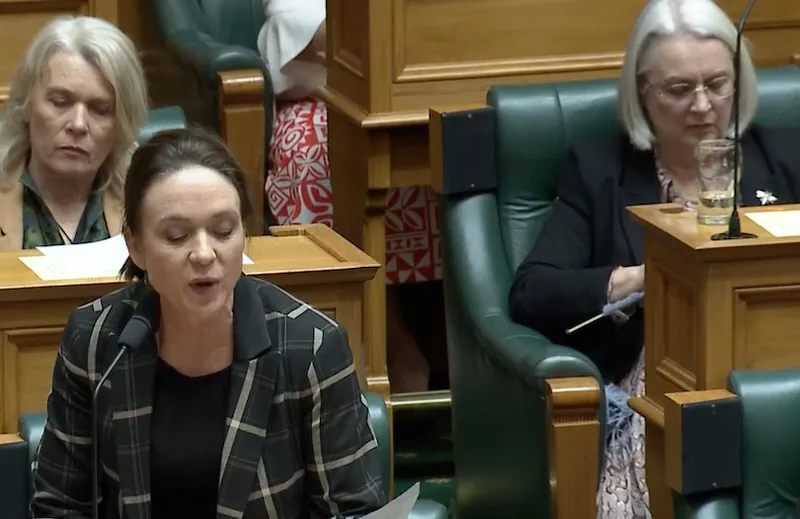
Deborah Russell knitting in the debating chamber on September 2 (Image: The Spinoff)
When Labour MP Deborah Russell was spotted knitting during parliament’s question time last week, she was joining a rich and meaningful political tradition. Stephen John Taylor explains.
From fistfights in the corridors to tractors driven up its front steps, New Zealand’s parliament has seen plenty of odd and unruly behaviour by sitting MPs.
But a few other controversies have involved something slightly less rowdy: knitting.
In the latest instance, Labour MP Deborah Russell was spotted stitching together a woollen vest during parliament’s question time last week. Around half of more than 43,000 respondents to a Stuff poll thought it unacceptable.
Russell’s defence? It helps her stay calm and focused. She also described it as a way of signalling displeasure with the debate happening in the chamber.
In suggesting a political element, Russell wasn’t pulling the wool. Knitting happens to have a long and storied place in political protest in New Zealand and around the world.
A history of needling
Knitting is often seen as a quiet hobby for the home and hearth. And for good reason: research suggests it can be calming, aid concentration and create social connections.
But its quiet nature has also made knitting an unlikely tool for protest.
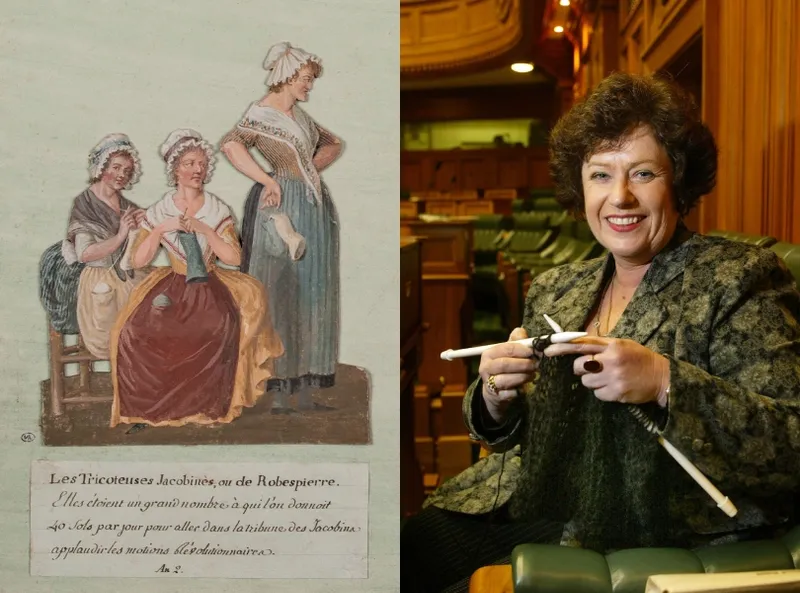
During the French Revolution, women known as tricoteuses famously knitted while watching public executions. During World War I, Belgian women reportedly used knitting to record the movements of German troops and artillery.
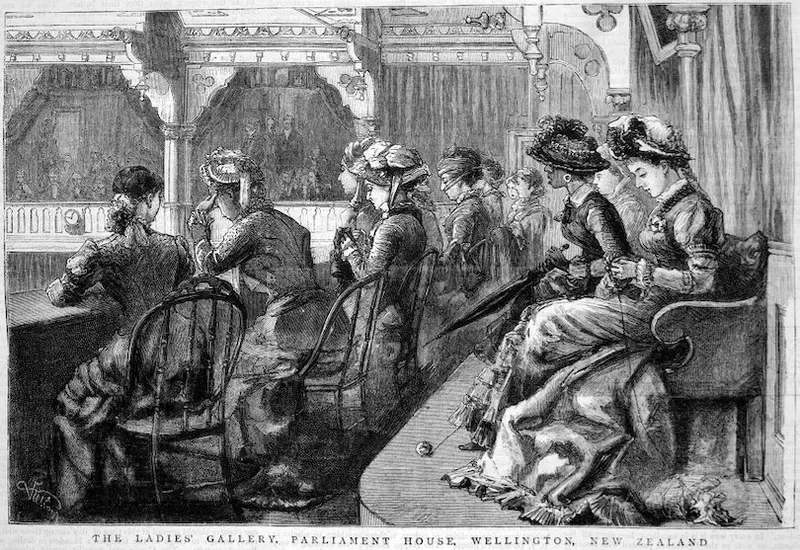
New Zealand has its own history of knitting rubbing up against politics. An 1880 illustration depicts women knitting as they watched proceedings from parliament’s ladies’ gallery.
Heather Nicholson’s history of New Zealand knitting, The Loving Stitch, contains a colourful anecdote from the women’s suffrage debate of this period: “a ball of wool rolled right up the speaker’s chair”, while “a half-finished camisole fluttered down to the feet of a scandalised legislator”.
Whether this was simply a knitting mishap or a political gesture is unclear.
There was less ambiguity about Marilyn Waring. The renowned feminist and former National MP, who was the first woman to knit on parliament’s floor, later described her own knitting as a political act.
More recently, former National leader Bill English accused Labour’s Judith Tizard of showing “contempt and arrogance” by knitting in 2002. And in 2021, then Labour MP Stuart Nash objected when Act’s Nicole McKee knitted during a tribute to the Duke of Edinburgh.
Away from the halls of power, New Zealand has plenty of other examples of disruptive stitching. In 1955, women staged a “knit-in” on railway tracks to protest the closure of the Nelson railway line, continuing for ten days before being arrested.
Overseas, the pink “Pussyhat” became a symbol of the 2017 Women’s March in Washington DC, where hundreds of thousands of protesters gathered following Donald Trump’s inauguration.
Knitting has also been a source of cultural innovation. Māori women unravelled wool from imported knitted garments and reworked it into korowai – an example of one culture’s materials being adapted for another.
A common thread
These examples show how something associated with quiet domesticity can carry a very public message. Knitting offers a form of protest that does not need to be loud or confrontational to make a point.
There’s also a clever term for this: craftivism. In 2009, British activist Sarah Corbett founded the Craftivist Collective to promote what she called “the art of gentle protest”.
To better understand this phenomenon, I interviewed 50 women in four countries involved in knitting for social change.
In Australia, Christian social justice organisation Common Grace invited people to knit “climate scarves” for politicians, using coloured stripes to depict changes in average global temperatures over the previous century.
For some of the women I interviewed, the project offered a way to participate in politics when they might otherwise have felt powerless. As one grandmother told me: “I’ve never spoken to a politician… I’m a little ordinary person. I’m sitting here watching the world get hotter. [Knitting] gave me some agency.”
Another described the scarves as a gentler way of communicating the urgency of climate change.
In England, knitting was used to show solidarity with survivors of church abuse.
Survivors in the Diocese of Newcastle had adopted the strawberry as a symbol of resilience and change, prompting church knitting groups to make more than 600 red and green knitted strawberries.
Many carried handwritten messages of support and were displayed inside the cathedral. One participant described the result as “exuberant defiance” – a particularly potent description given how abuse within religious settings can involve the silencing of survivors. Here, their voices were being made visible at the heart of the church.
Across these projects, I found knitting could give people a sense of agency, connect those who might otherwise feel isolated and make overlooked voices more visible.
As amusing or irksome as it may have seemed to many of us, Deborah Russell’s knitting was part of a rich and meaningful tradition.
For generations, women have taken an activity often regarded as quaint and homely and carried it into public life – sometimes for comfort, sometimes for community and sometimes to make a political point.
Perhaps that’s why, after all these years, a harmless pair of knitting needles can still get parliament in a tangle.
This article is republished from The Conversation under a Creative Commons licence. Read the original article.

Stephen John Taylor
Stephen John Taylor is a research affiliate at the Centre for Theology and Public Issues at the University of Otago.


