Just how big was the ‘change’ vote, and how many mayors hate Three Waters?

(Image: Archi Banal)
Analysis: Almost half of NZ mayoral offices have new occupants. But most of those didn’t defeat the incumbent. Plus: where the elected mayors stand on Three Waters.
The name is on the tin. Local elections are local. They are not a referendum on the performance of central government. But nor do they exist in a vacuum. Whether or not you go along with the idea that the weekend’s results were “a spanking for the Labour Party and the prime minister”, there’s no doubt they send a message.
Auckland, Wellington, Christchurch and Dunedin all have new mayors. In Wellington, centre-right incumbent Andy Foster was defeated by the Green-backed Tory Whanau, but the other three cities have gone from left-inclined mayors (former Labour ministers Phil Goff and Lianne Dalziel stood down; Dunedin Green mayor Aaron Hawkins was unseated) to centre-right leaders in Wayne Brown, Phil Mauger and Jules Radich. In the super city, home to a third of the country’s population, and in the capital, Labour-endorsed candidates were defeated.
The traffic wasn’t all one way. As well as Whanau’s victory – which came on the back of a formidable year-long ground campaign – Campbell Barry held on in Hutt City, Anita Baker was comfortably re-elected in Porirua. Based on the preliminary count, Moko Tepania will be mayor of the Far North. In Hamilton – the fourth biggest mayoralty by population – Paula Southgate’s centrist approach won her re-election.
The low turnout – likely to end up at 40% or so across the country – makes it slightly trickier to read any tea leaves in terms of next year’s general election, but it does reveal the mood of those who are exercised enough to vote. And the mood, in very general terms, appears to be one of broiling frustration with The Way Things Are Going. Donald Trump used to be called a deranged comments thread made human. Wayne Brown is not that at all. But he does sometimes seem like the personification of a Herald letters page. Harrumph.
Brown is not, however, straightforwardly blue or red. He claimed during the campaign to have voted for both main parties, and to have been getting texts of advice from both John Key and Helen Clark. Across the country, affiliation to a parliamentary party is rare.
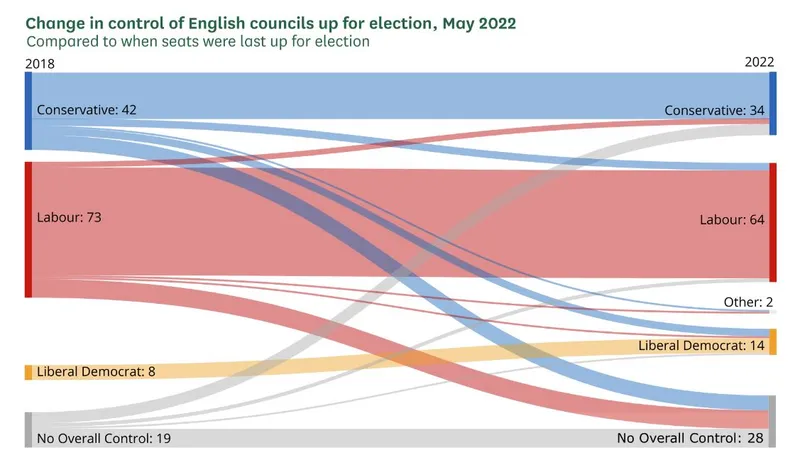
In Britain, the turnout is even more dismal than Aotearoa, but the party alignments make it easier to (cautiously) detect a shift in party-political mood. We can’t, for example, produce a lush visualisation like this:
Incumbency and churn
Of 66 mayors set to be sworn in in the coming days (Tauranga has commissioners for now), 31 are new to the role – or, such as in the case of returning mayor and celebrant of Ruapehu District, Weston Kirton, weren’t in the role last term. Perhaps the post-Covid great resignation is to blame, but a historically high number of mayors, 20 of them, decided to call it a day before these latest elections. Eleven new mayors are there because they beat the incumbent. That’s up, too, but hardly a wipeout. It’s one more than at the last election.
Thirty-five sitting mayors are returning. Of those, six were re-elected unopposed; nobody stood against them. In a seventh uncontested mayoral election, Kawerau deputy mayor Faylene Tunui stood unopposed.
(All of that is based on preliminary results, with four– Far North, Matamata-Piako, Southland and Gore – still looking too close to call.)
Watery graves
The central-local fault line has become increasingly pronounced. There’s the health system, polytechs, and housing intensification edicts, but the issue that loomed above them all through campaigns around the country, the lightning rod for frustration with the Beehive, was by some distance Three Waters.
The upset among many sitting mayors and councillors and candidates covered a range of grievances, most centering on a belief that a critical part of the local authority sphere is being seized. Some reject the approach entirely; others reject the design and the drawing of the “entity” maps. Many began their criticisms, it’s worth noting, with words to the effect of “clearly things need to change but”.
Some argue they’ve been managing water infrastructure well and shouldn’t be punished because of other councils’ neglect. Many say the consultation process was insufficient and that alternatives have not been properly considered. Still others attack, expressly or by way of insinuation, the co-governance model.
On RNZ yesterday, Jacinda Ardern responded to questions about the message sent on Three Waters by local elections by saying that the infrastructure overhaul required was costly, and if left to local authorities that would entail hikes in rates.
“While there are many who have expressed a view on Three Waters, you haven't had anyone arguing the counterfactual – that is, if we stick with the status quo that they would support rate rises, which is the inevitable outcome,” she said. "The alternative to Three Waters is rate rises in the thousands because of the additional water infrastructure that is required, no one's out campaigning on that."
One candidate for the Nelson mayoralty told me during the campaign that councils could no more vote down Three Waters than they could stop GST. That may be literally true, but there is no doubt they can send a thunderous message – as indeed did the man who was elected mayor, Nick Smith, who said there was “real anger around the government on Three Waters. Unless the government has a deathwish they do need to revisit that”.
Mayors do not necessarily represent the broader position of their councils, but they're as useful a sample as any. Across the group of 66 preparing to chuck on the chains, we’ve looked at their stated positions on Three Waters and assessed their position across a range from strongly against to strongly in favour of the reforms, drawing on statements on (a) Policy.nz, (b) candidate blurbs and (c) media reports.
That analysis suggests 43 mayors opposed to the Three Waters reforms and nine in support. There were 14 that were ambivalent, unsure or where it was too ambiguous to be sure. The broad sentiment, however, is clear enough.
The three mayors we’ve gingerly classified as strongly in support of Three Waters are Tory Whanau in Wellington, Monique Croon in the Chatham Islands, and Anita Baker in Porirua.
Only three of the successful mayors who took part in Policy.nz listed opposition to Three Waters among their three priorities: Vince Cocurullo in Whangarei, Andrew Tripe in Whanganui, who both placed it at #1, and Nobby Clark in Invercargill.
Ardern went on to say on Monday that “we've been open to changes, to try and make these the most effective changes that we can”. To win over the local politicians are not dead set against the reform, those changes will need to be substantial.
Full list of New Zealand mayors
Based on preliminary results, 2022
Far North District Mayor
Moko Tepania*
Whangarei District Mayor
Vince Cocurullo
Kaipara District Mayor
Craig Jepson
Auckland Mayor
Wayne Brown
Thames-Coromandel District Mayor
Len Salt
Hauraki District Mayor
Toby Adams
Waikato District Mayor
Jacqui Church
Matamata-Piako District Mayor
Adrienne Wilcock*
Hamilton Mayor
Paula Southgate
Waipa Mayor
Susan O'Regan
Ōtorohanga Mayor
Max Baxter
South Waikato Mayor
Gary “Puku” Petley
Waitomo Mayor
John Robertson
Taupō Mayor
David Trewvas
Western Bay of Plenty District Mayor
James Denyer
Tauranga City Mayor
n/a
Rotorua Mayor
Tania Tapsell
Whakatāne Mayor
Victor Luca
Kawerau District Mayor
Faylene Tunui
Ōpōtiki District Mayor
David Moore
Gisborne District Mayor
Rehette Stoltz
Wairoa District Mayor
Craig Little
Hastings District Mayor
Sandra Hazlehurst
Napier City Mayor
Kirsten Wise
Central Hawke's Bay District Mayor
Alex Walker
New Plymouth District Mayor
Neil Holdom
Stratford District Mayor
Neil Volzke
South Taranaki District Mayor
Phil Nixon
Ruapehu District Mayor
Weston Kirton
Whanganui District Mayor
Andrew Tripe
Rangitikei District Mayor
Andy Watson
Manawatu District Mayor
Helen Worboys
Palmerston North City Mayor
Grant Smith
Tararua District Mayor
Tracey Collis
Horowhenua District Mayor
Bernie Wanden
Kapiti Coast District Mayor
Janet Holborow
Porirua City Mayor
Anita Baker
Upper Hutt City Mayor
Wayne Guppy
Lower Hutt City Mayor
Campbell Barry
Wellington Mayor
Tory Whanau
Masterton Mayor
Gary Caffell
Carterton Mayor
Ron Mark
South Wairarapa Mayor
Martin Connelly
Tasman Mayor
Tim King
Nelson City Mayor
Nick Smith
Marlborough District Mayor
Nadine Taylor
Buller District Mayor
Jamie Cleine
Grey District Mayor
Tania Gibson
Westland District Mayor
Helen Lash
Kaikōura Mayor
Craig Mackle
Hurunui Mayor
Marie Black
Waimakariri Mayor
Dan Gordon
Christchurch Mayor
Phil Mauger
Selwyn Mayor
Sam Broughton
Ashburton Mayor
Neil Brown
Timaru Mayor
Nigel Bowen
Mackenzie Mayor
Anne Munro
Waimate Mayor
Craig Rowley
Chatham Islands Mayor
Monique Croon
Waitaki Mayor
Gary Kircher
Central Otago Mayor
Tim Cadogan
Queenstown-Lakes Mayor
Glyn Lewers
Dunedin Mayor
Jules Radich
Clutha Mayor
Bryan Cadogan
Southland Mayor
Rob Scott*
Gore Mayor
Ben Bell*
Invercargill Mayor
Nobby Clark
* TBC

Toby Manhire
Toby Manhire is editor-at-large at The Spinoff. He loves to cast a pod, whether it's Gone By Lunchtime, At Large or Juggernaut. He is a former editor of The Spinoff and has worked as a journalist in NZ and the UK since the last millennium.


