Why does National keep reannouncing the same road?

National leader Christopher Luxon announcing stage one of the Mill Road project at Totara Park last week, flanked by colleagues. (Photo by Phil Walter/Getty Images)
The controversial saga of Mill Road, explained.
“National, quite frankly, is the party of delivery. We build infrastructure and we get things done,” said prime minister Christopher Luxon last week as he announced that a re-elected National government would spend $1.75 billion building a 7km, four-lane road south of Auckland from Manukau to Alfriston.
It would be the first of three sections of the Mill Road corridor project, which run a total 21km from Manukau to Drury, parallel to the existing State Highway 1. National has not released costings for the second and third sections.
This is not the first time National has promised to build Mill Road. It’s the fourth consecutive election where the project has featured in National’s manifesto.
In 2017, under leader Bill English, National committed to building the whole route for $955m. In 2020, after the Labour government included the Mill Road project in its grab-bag of Covid stimulus spending, National leader Judith Collins said she would continue it at the estimated cost of $1.3bn. The following year, Labour transport minister Michael Wood cancelled the project because estimates had blown out to $3.5bn.
In 2023, National scaled down its ambitions to just building the first 7km section, though it still wanted to pursue the further sections at a later date. Leader Christopher Luxon and transport spokesperson Simeon Brown said construction would begin within 1-3 years for a cost of $1.3bn. It has been at least 1-3 years since 2023, and the road continues to get more expensive and remains just as non-existent.
The cost estimates promoted by Brown were outdated and hadn’t accounted for the rapid inflation in the construction industry. Labour’s David Parker criticised the numbers as “wildly misleading” at the time, which turned out to be true.
An updated analysis by NTZA in 2025 put the cost of the first stage at $1.75bn to $2.05bn. At this election, National’s policy focuses on the lower end of that estimate, and the funding wouldn’t be committed until Budget 2028, so there’s every chance the cost could blow out again.
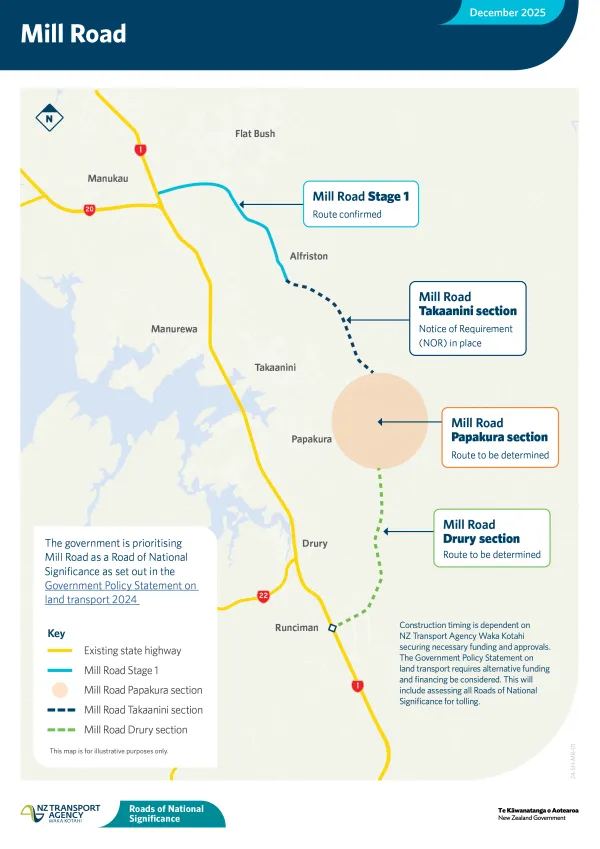
The existing Mill Road is a two-lane rural road about 30km from the Auckland city centre. It was named for the timber and flax mills which once surrounded Papakura Stream. As the forestry ran out, it became a productive farming region. In recent years, the area has been gradually invaded by the gradual march of Auckland’s sprawl, with new residential and industrial developments popping up among the empty green fields.
Residents in the area have grown frustrated with the increased traffic on the road. In a recent social media post, Luxon posed with two locals who claimed the traffic was so bad it took them 30 minutes to get out of their driveway. However, the Infrastructure Commission doesn’t expect the current road to exceed capacity until after 2065, making it one of the lowest priorities in the long term infrastructure pipeline.
Safety has been another point of contention. NZTA analysis found that in the span of five years there were 283 reported crashes on Mill Road, with 89 of those resulting in injuries.
During a recent interview with Newstalk ZB’s Heather Du Plessis-Allan, transport minister Chris Bishop suggested the parallel road would remove congestion on State Highway 1. However, any benefits from spreading traffic out wouldn’t be realised until the entire corridor was completed. The NZTA business case found the new road would make it three minutes faster to get from Alfriston to SH1 during the morning peak. For those driving on SH1 there would be "minimal impact on journey times".
The Mill Road upgrade is popular with locals in the area and has been championed as populist policy by local councillors and MPs. But if assuaging the concerns of existing residents was the only reason to build a multi-billion-dollar road to nowhere, it would be an extraordinarily expensive piece to win a few votes in electorates that are already safe National seats.
The real game here is about housing. Every empty paddock adjacent to the road would suddenly become much more valuable and attractive to property developers and home buyers.
There is one property developer in particular that would benefit enormously from the road: Winton Property, which owns 215 hectares of land surrounding the proposed Mill Road route, where it is planning the 3,800-home Sunfield development.
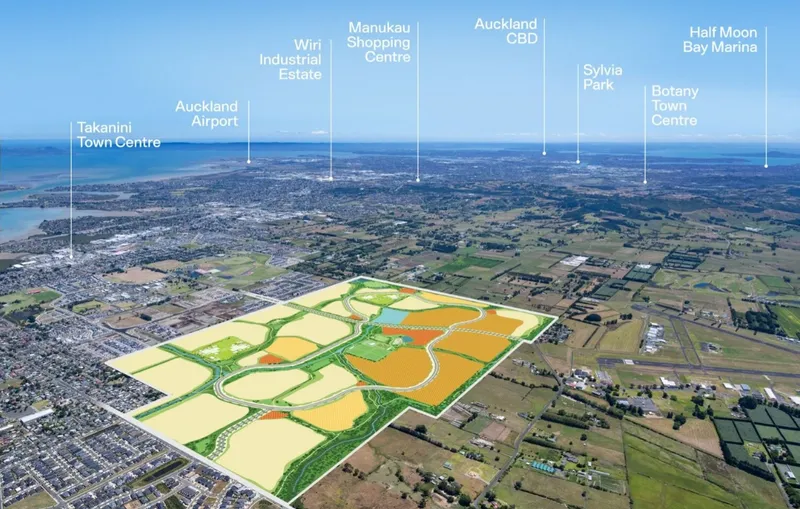
Chris Meehan, who owns 55% of the company, has donated $156,154 to the National Party since 2022, $50,000 to Act, and recently hosted a fundraiser for New Zealand First deputy leader Shane Jones at his Queenstown home. New Zealand First threw its support behind Mill Road in August.
Sunfield was granted conditional approval in March under the Fast Track approvals scheme, but it has been challenged in court by Auckland Council over concerns that it would remove highly productive farmland and place greater infrastructure costs on the council.
Mill Road and Sunfield have become the latest battleground in the housing battle of up vs out. Bishop wants to “flood the market” with new housing, no matter where it is built. Auckland mayor Wayne Brown wants “development in the right places, near good transport links, and not just on any bit of rural land a developer buys”.
There is little doubt that Mill Road would enable more housing south of Auckland. The question for voters is: is it the right place? And does the government really need to spend billions of dollars on a new road just to make it happen?

Joel MacManus
Joel MacManus is a senior writer for The Spinoff. He previously worked at RNZ and Stuff, and began his career at Critic Te Ārohi. His writing explores the political, economic and cultural systems that underpin modern New Zealand. He won the 2025 Voyager Media Award for Best Columnist, Opinion or Critique.
Sign up to Two Ticks, delivered straight to your inbox.


