Why fisheries policy is such a hot issue this election

National leader Christopher Luxon and senior MPs announced their fisheries policy with a dip in the Hauraki Gulf on Saturday. (Photo: Supplied)
Fisheries minister Shane Jones tried to push through controversial pro-industry reforms. Instead, he inspired a wave of conservation policy.
National Party leader Christopher Luxon made quite a splash when he announced his party’s fisheries policy on Auckland's Takapuna Beach on Saturday. Surrounded by senior MPs, he took a hoon around the Hauraki Gulf on Mark Mitchell’s boat and squeezed into a wetsuit for a photoshoot with a speargun.
The policy document he revealed was full of promises to protect fish stocks, establish marine reserves and restrict harmful commercial fishing practices. It was a dramatic turnaround from the 2023 election, when fishing barely warranted a mention in National’s platform except for a couple of passing references in a policy document focused on hunting.
National isn’t the only party with a particular focus on fisheries policy this election. Act released a six-point policy in August with proposals to limit scallop dredging, create new fisheries management areas and impose harsher penalties on those who take more fish than they are allowed. Last election, Act didn’t have any fisheries policy.
And Opportunity, which polling suggests could find itself in a position to decide the next government, has made phasing out bottom trawling one of its bottom lines for coalition negotiations.
Fisheries policy has traditionally been a niche issue filled with complex minutiae fought over by environmental groups, industry bodies and iwi representatives. This election, for the first time in a long time, it has been dragged up to the surface.
Why are so many parties – particularly on the right – suddenly so concerned about marine conservation? The short answer is two words: Shane Jones.
As the minister for oceans and fisheries for the last three years, Jones has been a proud and vocal ally of the commercial fishing industry. It’s an area he knows well, previously serving as the chair of Sealord, the largest fishing company in the country. His party, New Zealand First, has received large donations from several companies and individuals in the fishing industry including Talley’s, Sanford and Westfleed Seafoods. Peter Vela, the founder of Vela Fishing, gave $150,000 to New Zealand First in May, the largest single donation it has received this year.
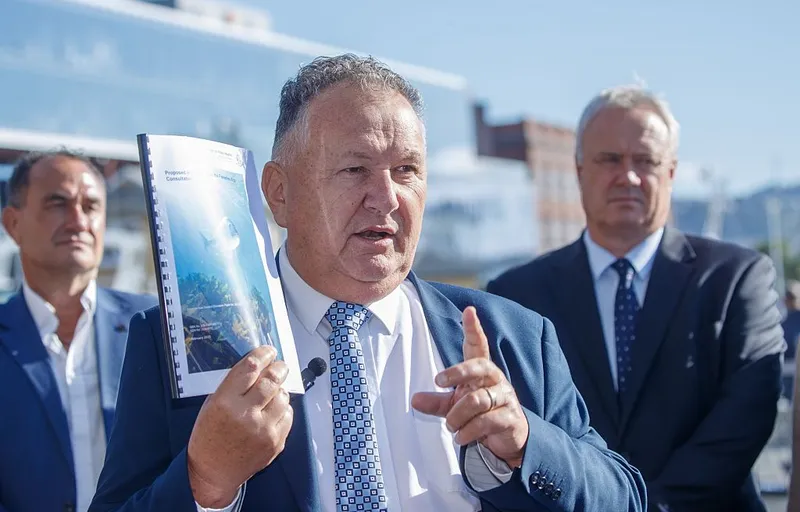
As minister, Jones pursued a series of pro-industry reforms aimed at boosting productivity in the sector. Most notable was the controversial Fisheries Amendment Bill, which proposed a suite of changes including: allowing commercial fishers to catch and sell undersized snapper, trevally and tarakihi, allowing commercial fishers to sell marlin and 19 species of reef fish if they were caught as bycatch, reducing the penalties for commercial fishers who go over their quota, and restricting the ability for the public to access footage from monitoring cameras on boats or challenge the minister’s decisions.
The bill was strongly opposed by environmental groups including Greenpeace and the Live Ocean Foundation. But it became a particularly salient political issue due to the intense backlash from recreational fishers, who were concerned about the impact on fish stocks.
LegaSea, a lobby group set up by the Sports Fishing Council, ran a strong campaign against the bill and Matt Watson, the host of the ITM Fishing Show, became a vocal opponent. There are an estimated one million recreational fishers in New Zealand, many of whom are male, older and wealthy enough to own boats – a demographic that tends to skew conservative.
Sensing the fallout, National and Act pulled their support for the bill. In June, Jones told a parliamentary select committee that the bill was being paused, though New Zealand First has not dropped the bill entirely.
It seems Jones overplayed his hand, and in doing so seems to have caused the tide to shift away from deregulation. While National and Act still aren’t going as far as some parties on the left, their recent policy announcements show they are trying to win back the support of recreational fishers by promising greater protection of the marine environment.
The key policies
Marine sanctuaries
National has proposed to establish a new 23.5km2 marine reserve off Waiheke Island and to expand the existing Goat Island reserve. Act hasn’t proposed any new protected areas, but would make the Hauraki Gulf its own fisheries management area so catch limits reflect local fish stocks.
The Greens want to expand the protected areas of the Hauraki Gulf from 18% to 30% by 2030 as part of a wider goal of protecting 30% of New Zealand’s ocean territory. Opportunity has the same 30% protection target, which it wants to reach by 2035.
Labour, the Greens, Opportunity and Te Pāti Māori all support the creation of a Tasman Sea Sanctuary in the international waters between New Zealand and Australia. National has not specifically supported it, but has committed to ratifying the High Seas Treaty, which is critical to enabling the sanctuary.
New Zealand First hasn’t taken a firm stance on the Tasman Sea Sanctuary. In one of his first moves as fisheries minister, Jones scrapped the proposed Kermadec Ocean Sanctuary.
Bottom trawling
Bottom trawling is the act of dragging heavy, weighted nets across the sea floor. It is a highly destructive technique that rips up coral forests and other delicate ecosystems and has high rates of bycatch. It accounts for about two-thirds of New Zealand’s commercial catch.
Opportunity would ban it immediately in the Hauraki Gulf and other inshore waters and expand the ban to deep sea areas within five years. The Greens and Te Pāti Maori have largely similar approaches, with slight differences in target dates and priority order.
Labour committed to ban bottom trawling in the Hauraki Gulf. In the first TVNZ leaders' debate last week, Chris Hipkins said he supported phasing in a ban in other areas, though Labour seems to prefer a more gradual approach compared to its allies on the left.
National’s policy would “review” the rules around bottom trawling in the Hauraki Gulf but doesn’t commit to a decision. Act hasn’t called for a ban on bottom trawling but would ban the similar practice of scallop dredging in currently closed North Island scallop fisheries.
As fisheries minister, Jones scrapped a plan to confine bottom trawling in the Hauraki Gulf to set corridors.
Ring net fishing
Ring-netting is a commercial fishing technique where a boat surrounds and catches a school of fish with a net. It isn’t as environmentally destructive as bottom trawling but can remove large quantities of fish and can have high rates of bycatch.
It became a political flashpoint this term when conservation minister Tama Potaka, against the advice of officials, included an exemption in the law that allowed a handful of commercial fishers to continue the practice in highly protected areas of the Hauraki Gulf where commercial and recreational fishing is otherwise banned.
National is now campaigning against Potaka’s carve-outs and promising to ban all commercial fishing in the protected areas. Labour and the Greens support the same ban.
Everything else
Fisheries policy is an incredibly broad area and parties have put forward many other proposals. Act wants to set a combined daily take limit of 10 shellfish for species that don’t already have limits. National would create a $20m "fish tech innovation fund and hire 20 additional honorary fisheries officers. Labour, the Greens, Opportunity and Te Pāti Māori want to ban seabed mining. Several parties have suggested the Quota Management System, which determines how many fish can be commercially caught each year, needs to be reformed. And New Zealand First still hasn’t completely given up on the Fisheries Amendment Bill. Whether or not any of those policies survive will depend on coalition negotiations and whoever ends up in the role of fisheries minister.

Joel MacManus
Joel MacManus is a senior writer for The Spinoff. He previously worked at RNZ and Stuff, and began his career at Critic Te Ārohi. His writing explores the political, economic and cultural systems that underpin modern New Zealand. He won the 2025 Voyager Media Award for Best Columnist, Opinion or Critique.
Sign up to Two Ticks, delivered straight to your inbox.


