The secret life of election hoardings

Hoarding season. (Photos: The Spinoff. Design: Emily Wong/The Spinoff)
From pallet-ply reinforcements to midnight torch-lit installs: the builders, rules, collaborations and rivalries behind New Zealand’s election hoardings.
As the coming of spring is signalled by the bloom of daffodils, so too is the coming of an election signalled by the blooming of election hoardings. And much like those much anticipated flowers, hoardings appear at different times in different parts of the country. There’s no fixed date in the Electoral Act for when hoardings can go up – that’s up to local councils, who set their own timing and size rules. Most, including Auckland and Wellington, land on nine weeks out (in the present case, September 5), but the Electoral Act prescribes a size limit (3m²) that kicks in nationwide for that final nine-week stretch, overriding whatever the local council would otherwise allow.
Almost as competitive as the election itself is the competition for the best spots. Some eager campaigners have been known to put up fortuitously timed public meeting signs in the weeks before the official date to effectively bags a good spot (Chris Bishop, the attorney general no less, was made to take down his gun-jumping signs last month). While Bishop caught flak for it, multiple sources told me it was a common tactic, as was putting up the wooden framing in advance so when the clock strikes 12, all that’s needed is to staple in the sign.
Those following the letter of the law “set out at one minute past midnight and put them up in the dark with big torches”, says Labour’s campaign manager Beth Houston, who, for the record, made no mention of her party partaking in any rule-breaking or -bending behaviour.
The big build
Act’s Cameron Luxton was a builder before entering parliament (his middle name just happens to be Gib), so when he got involved with politics, joining the Act Party in 2018, putting up hoardings was a natural place for him to pitch in. While, for the other parties I talked to (Labour and the Greens), hoarding construction is an art passed down by hand, generation-to-generation in some sort of ancient apprenticeship system, Luxton just got out there and did it. “I’ve seen a lot of ways that different people put up hoardings, and I’m pretty confident mine’s the best way.”
“For the vast majority it’s local men with a ute who’ve maybe been a retired builder, or are just handy,” says Houston. “On the day they can go live, we have a small army of volunteers all over the country putting them up. It’s not a one-person job – you usually have someone who’s been in charge of it for a long time, and they’ll have a couple of apprentices they’re bringing up through the ranks.”
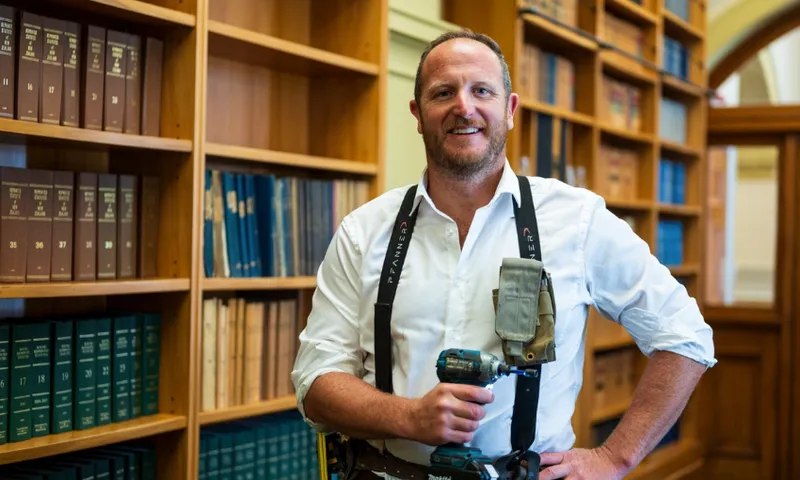
Leroy Beckett, the Greens’ campaign manager, says the party has “really great, diverse people all over the country doing it”, but he too admits “often it’s an old fellow”.
In Luxton’s region (he’s contesting the new Mt Maunganui electorate this election), he’s one of those guys. And in the eight years he’s been putting them up he’s seen some “absolute shocker[s]”. In particular, he calls out hoardings without a backing so when the sun hits it from behind, you can’t read it easily. Or frames put together with nails instead of screws. “Part of the whole process is you’ve got to take them all down in one big flurry – they can’t be up on election day. If you’re pulling out nails for the next week, you’d be pretty gutted with your behaviour three months before.”
Others just don’t strengthen them sufficiently. “You might be putting it up on a nice day, but it’s going to be up for a couple of months – you’ve got to be prepared for the weather,” he says. “I remember in 2020, when the election got extended during Covid, a big storm came through and no matter how much bracing you did, we were all getting damaged. Having strong bracing is key.”
Natural threats
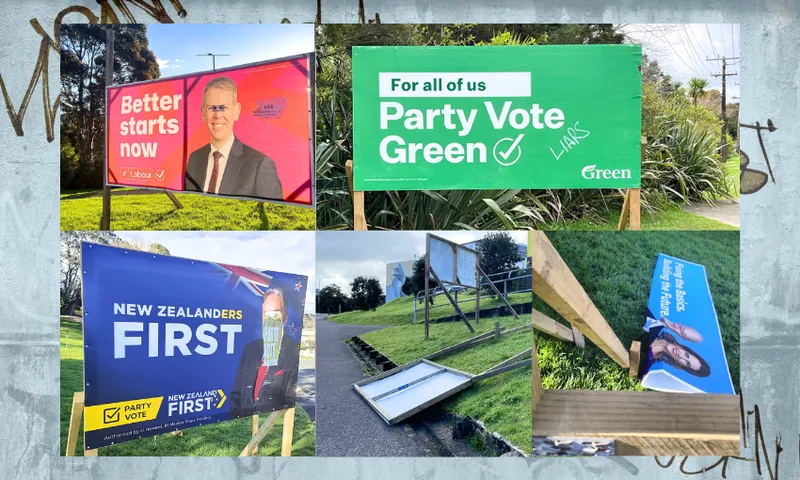
Then there’s another more human threat to hoardings – vandalism. That tends to take two forms: structural damage or image alteration. The latter usually takes the form of devil horns or a moustache, or, increasingly, just the word “liar” or something about vaccines. “They think they’re being clever with some inarticulate one-word term of abuse,” Luxton says, “but everyone driving past just knows that’s a person who hasn’t used their ability to communicate and engage in politics properly.”
Labour’s Houston tells me how Jacinda Ardern had one of her hoardings graffitied with the horns and a pirate patch and when she put it on her Facebook page it got a lot of engagement which no doubt helped her digital campaign. Houston also enjoyed a more recent example from the current campaign where someone stickered over two letters to change the party’s slogan to “Better farts now”. “There was a really good one for Andrew Little a few years ago where they made him into Stuart Little,” she remembers.
But it’s the physical damage that’s worse. The plastic front bit with the words and pictures on it (corflute, I’m told) is easily replaced. But the framing takes more work, and is more expensive to replace. “Smashing the wood is the worst – the most egregious sin,” says Houston, “because then you’ve actually broken their stuff. I think there’s mutual respect, and none of us like it, across the political spectrum.”
“I had a hoarding site that was constantly getting smashed down last election,” says Luxton. “I ended up building it out of pallet ply … I thought, you can’t give an inch. It’s standing, that one.”
So how do they know their one has been defaced or smashed? Each party has a network of volunteers and makeshift whisper networks, so news travels fast. Beckett says the local Greens offices have spreadsheets of the sites, linked with maps, and damage gets reported through those. Luxton says Act has Whatsapp groups. Often parties will tell each other, or just fix it if they can. Like other ancient guilds, there’s a camaraderie to hoarding people (“hoardingsmiths”?). “In the main, people try not to be a dick about it,” Houston says. “They try to leave space for others, and if they see someone else’s hoardings being smashed while they’re fixing their own, they’ll lend a hand and fix the other ones too.”
Luxton agrees. “It’s not just a one-party thing. In Tauranga and the Bay of Plenty, all parties sort of look out for each other and let each other know about damage. I probably shouldn’t admit this, but I’ve repaired a few signs for other parties in previous elections … you’ve got to look out for each other. Not everybody’s got a builder on their team – I’m lucky to have one on mine.”
The comedown
All official political advertising is banned on election day, so around midnight on election-eve, they all come down in a hurry. The timber gets sorted and put into storage to hibernate for three years. “It’s a bit of a perpetual stew,” says Beckett. “You add, replace stuff you need, add a little bit each time, and throw some out, but you try and carry it over because a good amount of wood is very expensive.”
“My timber has certainly been through a few cycles,” says Luxton. “Being a carpenter, I love looking after timber. If something breaks, I usually cut it up into pegs – a broken stick of timber becomes pegs or a short sign.”
The corflute is difficult to recycle – Beckett tells me it has to be clean, have all the staples removed and be cut into particular sizes – so it’s usually reused. Parties give it to schools, construction companies, nurseries and conservation groups who use it to wrap around trees that need shelter or support. But, according to a report on The Spinoff last election, some of it still ends up in the landfill. Beckett tells me that the Green party has been experimenting with printing onto plywood for party vote hoardings so they can be reused next election, but it’s far from widespread.
Not everyone wanted to talk about hoardings. “Hi Henry, sorry, we won’t be commenting,” said National’s campaign communications adviser Ethan Foster via iMessage. “National will keep talking about the issues that matter to Kiwis and let them know about our plan to fix the basics and build the future, with no new taxes!” begging the question whether he typed that out or has it handy to cut-and-paste into texts whenever possible. Fair enough. Daffodils don’t give interviews either.

Henry Oliver
Henry Oliver writes The Bulletin. He was previously The Spinoff's music editor, the editor of Metro, a bar owner, intellectual property lawyer, and bass player.


