New Zealand is being held hostage by the business case industrial complex

New Zealand, a nation ruled by business cases. (Image: Tina Tiller)
The Waitematā crossing is one of a long list of projects to get locked up in a prison of infinite planning.
Chris Bishop was defiant as he stood before reporters last Wednesday to announce that, after three years of studying the options for an additional Waitematā harbour crossing, the government was committed to further studying the options for an additional Waitematā harbour crossing. The media assembly was slightly befuddled, wondering what we’d spent this entire term of government doing if not getting the project to a place where construction might begin at some point this century.
But the transport minister said officials had only managed to find the crossing’s “why”. A detailed business case was still needed to establish its “how”. “You would say ‘well, how are you going to pay for it?’ And then you’d say, ‘how much is it going to cost?’ And then you’d say, ‘when’s it going to start?’ And then you’d say, ‘how’s it going to be delivered?’”
Those do seem like important questions, so it’s a bit surprising none of them appear have been answered by, gird your loins, the Waitematā Harbour Crossing Study (1988), the Waitematā Crossing Study (1997), the Auckland Waitematā Harbour Crossing Study (2008), the Additional Waitematā Harbour Crossing form assessment and preliminary business case (2010), the North Shore Rapid Transit investigations and strategic case (2016), the North Shore Rapid Transit programme business case (2018), the Additional Waitematā Harbour Connections preliminary business case (2020), the Northern Pathway business case (2021), the Northern Busway Enhancements detailed business case (2021), the Waitematā Harbour Connections draft indicative business case (2023) or the detailed options assessment phase (2024).
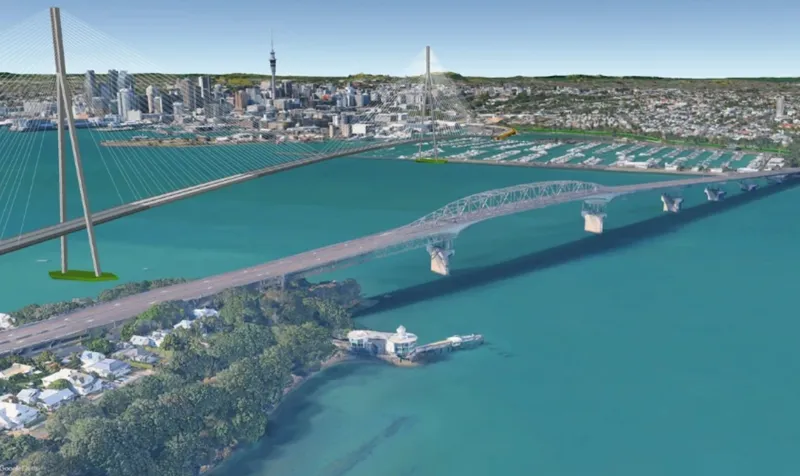
All up the government had already spent $106 million on consultants and contractors before announcing the 10th attempt at coming up with a harbour crossing plan in 38 years on Wednesday. There may be good reasons for pushing the study count into double digits. NZTA had developed tunnel vision, literally, when it came to the project, focusing entirely on an eye-wateringly expensive tube under the sea as its preferred option. The new process will take things out of its hands. Bishop may also be trying to extricate himself from the decisions of his predecessor Simeon Brown, who ordered NZTA to literally repeat the mistakes of the past and exclude cycling and light rail from its new design.
But the result is that after nearly 40 years of planning, we’re set for several more years of planning, at the end of which it’s highly possible the government will announce some more planning. The additional harbour crossing is hardly the only project stuck in a prison of infinite business cases. Labour’s light rail project famously generated $229 million of reports from 200 consultants and companies over six years without laying down a single metre of track. Let’s Get Wellington Moving generated similarly gargantuan amounts of paperwork while only physically producing a pedestrian crossing and a roundabout over its four and a half years. In Auckland, the Connected Communities scheme managed to produce literally nothing over five years, though tens of millions went to consultants to produce reports on improving 12 road corridors.
Road projects like the Mill Road highway and the East-West Link have also gone through years of business cases without anything being built. Both were recently put on the backburner by the government and NZTA is in the process of removing protections on the East-West Link route.
This is by no means an exhaustive list. Dozens of planning-rich and physical reality-poor projects criss-cross the country, from moving Auckland’s port to the Lake Onslow power scheme. Why? Economist Shamubeel Eaqub suspects the answer has more to do with political convenience than planning necessity. “We use the need for a business case as an excuse when we don’t want to do something, when we don’t want to make a decision,” he says.
In essence, Eaqub thinks ordering a business case grants politicians all the benefits of appearing to take action without the political cost of messy construction periods or the controversy that comes with paying for a project. Greater Auckland’s Matt Lowrie agrees they can be a delaying tactic. “They’ll do a business case or a study, come up with a solution, and the solution is to do another business case because they don’t want to make a decision,” he says.
But he thinks the processes themselves are also fundamentally flawed. Our business cases don’t always come with a project budget or a properly defined scope, he says. Urban designer Emma McInnes says that can often lead to officials getting disconnected from economic reality and suggesting stuff that’s not feasible or achievable. “They do the business case, then they realise they can’t afford the thing, and so therefore they can’t do anything with it,” she says.

There’s also what Lowrie thinks of as the Harbour Bridge myth. You still hear it all the time, including from public officials. It goes something like: the Auckland Harbour Bridge was built with only four lanes. We had to widen it later and we don’t want to repeat that mistake. Though there were problems with the bridge’s design, most notably the exclusion of walking and cycling, Lowrie thinks that’s the wrong message to take. It’s led to officials and politicians trying to future-proof projects for 50 or 100 years, which only leads to the kind of scope blowout that stops anything getting built at all. “We get this paralysis of ‘we can’t do an appropriate size solution because what if it’s not big enough?’, and it stems from the Harbour Bridge,” he says.
Lowrie says we’d actually be better off if we emulated the Harbour Bridge process in many cases: starting small and adding as we go along. He thinks about light rail. If we’d built a surface level track from the city centre to Dominion Road, we might be talking about how to extend it by now, rather than still wondering if it will ever happen. Eaqub agrees. “We want a once-and-for-all solution to the problem. I don’t think that works. Because you have to take your community with you,” he says.

How do we fix the problem though? The Treasury is trying to improve the quality of our planning with its Better Business Cases programme. NZ First’s Winston Peters has called for the government to forgo another business case on an additional harbour crossing and just put the project out for tender, essentially outsourcing the job of finding the most efficient solution to bidders.
Ultimately though, there’s still a huge consultancy industry that wants to be fed and a gargantuan business case industrial complex to reform if we want to see real change. We may have gone some way to establishing the why of our broken planning system. Now it’s time to ask PricewaterhouseCoopers, KPMG or another consultancy to work out the “how”. Its business case should come back in a few years. It’s more than likely to recommend another business case.

Hayden Donnell
Hayden Donnell is a senior writer for The Spinoff. He previously worked at RNZ, TVNZ and the New Zealand Herald, alongside other media companies that have since closed down or been renamed. His primary passions are local politics and the Big Fresh animatronic fruit and veggies.


