‘It’s always a joy’: Harry Sinclair on Kiri and Lou Go Raaa!

Harry Sinclair with some of his stop-motion mates. (Photo: Robert Sarkies; design by The Spinoff).
He’s written for adults and found himself depressed. Now Harry Sinclair is focused on Kiri and Lou and has discovered a new, playful relationship with the world.
A few years back, when I was wondering about the when and the what of introducing my small son to a spot of screen time, I came upon a homegrown TV series called Kiri and Lou. The TVNZ promo picture promised a lush forest with claymation figures – a cute yellow lizard and a purple elephantine creature – with floating eyebrows. I clicked the play button and ushered in a cacophony of buoyant percussion, bright-coloured birds, a fluttering yellow butterfly, singing kiwi, and a huge green dinosaur emerging from between thick, leafy fronds.
Kiri turned out to be a feisty, fierce but loyal little friend to gentle, sleepy and sneakily greedy Lou. Each episode included sensational songs with never sickly, often quirky emotionally rich lyrics underscored with hefty musicianship. As the credits on the first episode rolled I saw the show was created by Harry Sinclair, a name I knew from a favourite New Zealand movie, The Price of Milk, and the music was from the genius of The Front Lawn, made up of Sinclair with Don McGlashan. “This’ll do nicely,” I thought.
My son’s screen-virgin eyes nearly popped out of his head with awe, and I considered it a gift that a locally made show set in a richly artistic world was his first ever experience of TV. And now, the dynamic dino pair and their vast array of prehistoric friends are going to be playing on the big screen in Kiri and Lou Go Raaa!, New Zealand’s first ever stop-motion feature premiering at the New Zealand International Film Festival.
“I’d never really thought about making kids’ TV before Kiri and Lou,” Sinclair tells me over a video call from his home. He frequently beams as we discuss favourite characters and the joy that comes from creating for children. It was Sinclair’s daughter that inspired him to pay closer attention to what was available to kids on the small screen. “I started watching TV with her and had an idea to do something that was a bit more calm, more gentle. I thought of the calm of being in the New Zealand forest and it went from there.”
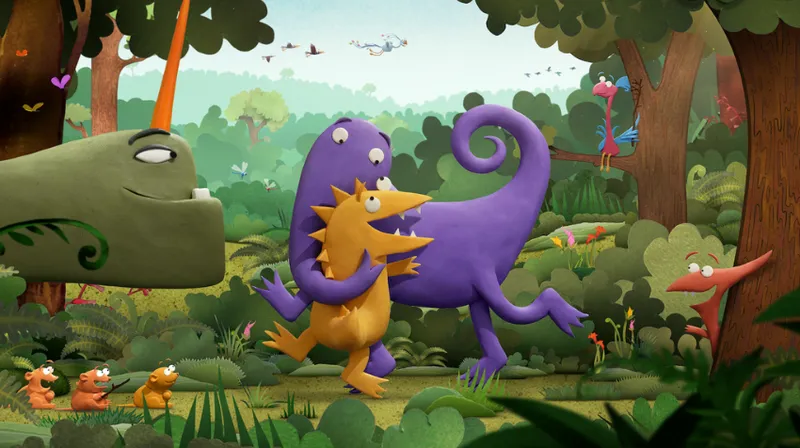
The engine of the show is Kiri and Lou’s friendship and how it is sustained through a series of knocks and catastrophes, emotional meltdowns, interactions with others and moments of truly beautiful epiphanies. “Kiri [voiced by Liv Tennet] sprang to life as this extremely emotionally raw character who has to deal with big feelings and doesn’t cope very well with that, which felt authentic,” says Sinclair. Lou [voiced by Jemaine Clement] on the other hand is “sleepy and generous” and it’s that dynamic that generated the fundamental heart of the world: two very different characters who adore each other all the same. The film takes us back to where it all began: to the dramatic events that seal Kiri and Lou’s relationship. It’s a wondrous 61 minutes for children, but it’s also a real ride for adults. Like the series, the dialogue is sparky, the storytelling layered and the worldbuilding magical and surprising.
Sinclair always knew he wanted it this way. His mantra was “what would parents like to watch?” Alongside that he was committed to a world in which the characters are cute, the world is rich and the stories are beautiful. Sinclair and the Kiri and Lou team frequently receive messages from adults who watch the show without kids, which Sinclair is thrilled about. Adults, he says, find the show calming; an antidote to the dystopian elements of our world, and the often frantic and violent, cynical and terrifying shows on TV. “There is a place for entertaining adults that’s extremely gentle and sweet,” says Sinclair. “It’s a very liberating space to work in to tell stories, both for the kids and the grown-ups.”
One of the most appealing aspects of Kiri and Lou is the sheer artistry. You can see the fingerprints on the dinosaur’s bellies and backs, the torn edges of paper on the verdant foliage. It was animation director Antony Elworthy who led Sinclair and producer Fiona Copland down the path of stop-motion. Sinclair quickly realised he loved the handmade feel: “It has a visceral reality to it which is very unusual in our world where everything is made on the computer, especially now AI is here. It feels like you’re looking at a beautiful quilt that your grandmother has made.”
On the big screen the beauty of the hand-made world is amplified. Kiri and Lou Go Raaa! is a riot of colour and texture with the direction making the most of sweeping shots across the rich, pre-human landscape complete with active volcanoes (“smoky mountain”), vast rivers, and, new to Kiri and Lou’s universe, a wide ocean teeming with strange and startling creatures.
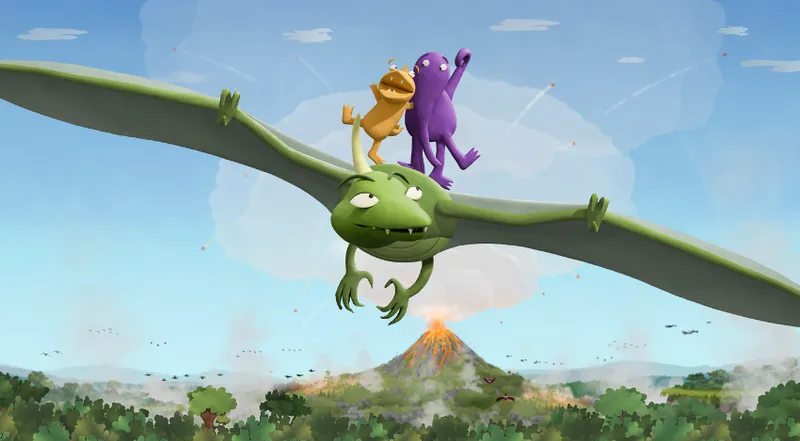
The stop-motion artistry of Kiri and Lou is one of the reasons the show is considered niche. Even though it’s on TV around the world (US, UK, Canada, Latvia, Sweden and Finland among others) and has been translated into multiple languages, it’s not a mainstream product in the way that Bluey or Peppa Pig are. But Sinclair is fine with this: “I think we’ve made something that has lasting value.”
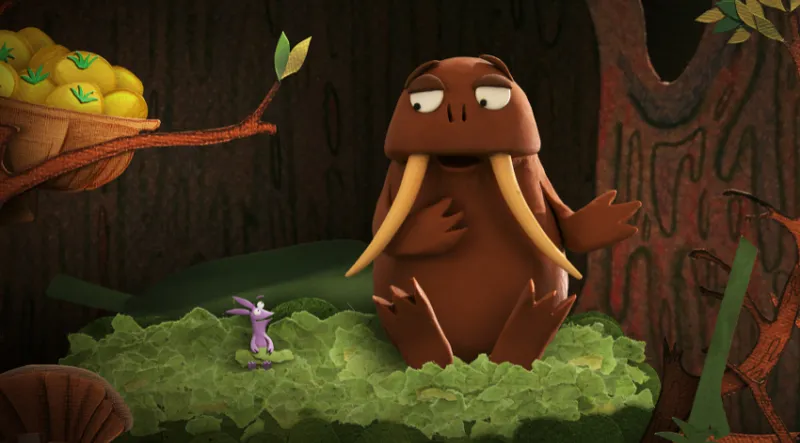
Kiri and Lou is not only artistic in aesthetics but in vision and substance, too. Kiri, Lou and friends are always making music and telling stories; there’s a character called That’s-Ok-Don’t-Worry-About-It who holds poetry readings. But the artistic star of the show is the scene-stealing Small, voiced by Rima Te Wiata. Small is a tiny walrus-like creature who lives in a tree apartment and is focussed on her artistic life. She’s a painter and a storyteller and it’s Small who frames Kiri and Lou Go Raaa! by telling the origin story to an even tinier creature called Pants, also voiced by Liv Tennet. In a world that seems, at times, to be hell bent on de-valuing art, it is nourishing and deeply optimistic to embed art-making into a TV show intended for growing brains and fresh personalities.
“I’d love to do a spinoff about Small and Pants,” says Sinclair, the light in his eyes dialling up a notch. “I love the idea of Small: this artist who is insecure. I suppose there is something autobiographical about it,” he laughs. “But I love it when her grandparents tell her to paint every day. It’s so touching. Encouragement means so much. Don and I wrote this very bizarre song called ‘What’s Art For?’ for Small to sing, because we wanted to explore the meaning of being an artist, and introduce those ideas to kids. The idea that you can make stuff up is very dear to me. Kids should feel that they can write a little song, do a little painting. It’s not something only specialists can do. It’s something everybody should do.”
It’s hard to think of a more specialised pair than Sinclair and McGlashan who have been making little songs together for 40 years “on and off”. For Kiri and Lou, Sinclair will send McGlashan the episode story and the lyrics, and “occasionally I even think of a little tune as I’m walking (which he sometimes uses or discards [laughter])” and McGlashan will send back ideas and questions and from there the back and forth begins. “It’s such a joy to work together. It’s just part of our ongoing process that we’ve had since 1985.”
The music in the film will delight both fans of the series and newbies to the Kiri and Lou world. There are sweeping ballads like ‘When You Find A Friend’ and a brilliant working song called ‘Digging Up The Roots’ that Lou’s herd of Palorchecies sing as they’re harvesting kūmara. In one scene a trio of Ruru warble backing vocals so beautiful I hunted for the credits: Anika Moa, Anna Coddington and Sandy Mill. The TV series is stuffed with phenomenal talent: Marlon Williams, Julia Deans, Paul Kelly and many others. The film holds fast to its musical roots, ensuring that emotions and ideas are conveyed seamlessly between dialogue and song.
But what was it like adapting a five-minute episode structure to a feature length film? For Sinclair it was challenging but exciting. “I really wanted to see where it could go, how big the stories could get, and create something with a real arc where you’re really heading somewhere. I was excited to get Kiri to the most intense place she can go. It was actually a relief in a way to give them a big story: to go crazy and do all of the things that you can never do in a five minute episode. It was a wonderful feeling.”
Sinclair and team also needed the story to be one the whole family could watch; a real adventure with the kind of excitement that could hook older kids and adults. To combat tension overwhelm for the smallest audiences, Sinclair came up with an idea for storyteller Small and audience Pants (who is essentially a stand in for the littlest kids) to call out and halt the action before it gets too scary. It’s a brilliant device that offers relief to stressed children for whom this film might well be their first cinema experience; and a device that leads into comedic moments where Kiri and Lou are suspended mid-dramatic moments wondering why the world has suddenly frozen.
It’s a luxury of storytelling to offer reminders that everything is going to be OK. For most artists, their own stories are white-knuckle rides, that lurch from one funding application to another. For Sinclair it’s always been a struggle. “You’re doing a thing for say six months, then nothing and endlessly getting ‘no’ for answers. You go through moments of terrible panic feeling like you’re never going to work again and that your ideas are terrible and there’s a lot of doubting yourself. It’s kind of a stressful way to live.” Kiri and Lou changed everything for Sinclair: it was the first time in a long time he had steady work which was a “great relief”. “It’s more calm making ongoing TV. And I needed life to be more calm.”
Which is not to say that making Kiri and Lou Go Raaa! has been easy, or that creating children’s TV is getting any smoother. “We’re a tiny company competing with very, very big companies. There’s Fiona Copland [producer] and me. We don’t even have an office. Everything happens on Fiona’s kitchen table. We don’t have a marketing budget to go out and tell everybody about our work. So we’re really hoping the movie will help spread the word and then maybe we’ll have more money to make more of the TV series.”
Since first starting on Kiri and Lou it’s become harder to raise funds for TV, and especially stop-motion animation. “It’s very, very, very difficult now to get money for kids’ shows in general. There are less shows being commissioned because the industry is in a massive downturn globally. I don’t know all the reasons why, but it’s harder.”
Would Sinclair ever go back to making work for adults? “Kids’ shows are the right spot for me now because it seems to work well for my personality. I’m not sure I have anything to say to adults anyway. It’s disturbingly easy for me to access my inner child. It helps maintain a kind of playful relationship with your world. I’ve written some adult things and got quite depressed and grumpy writing them, and that’s never happened writing Kiri and Lou. It’s always a joy to go to that world and then to see little kids watching something you’ve made with a whole bunch of people. It’s the best feeling in the world when you see their faces and see they love it. There’s nothing better.”
Kiri and Lou Go Raaa! premieres in Auckland on August 8 and in Wellington on August 15 after which it will be in cinemas nationwide. Auckland Philharmonia is presenting Kiri and Lou Live in Concert on August 22; and Orchestra Wellington on August 29 in Wellington.

Claire Mabey
Claire Mabey is a children's author of The Raven's Eye Runaways, The Raven's Eye Rebellion, and a picture book Cass and the Beast illustrated by Jill Calder. For a long time Claire worked on literary festivals and is the founder of Verb Wellington. She lives in Te Whanganui-a-Tara with her partner and son.


