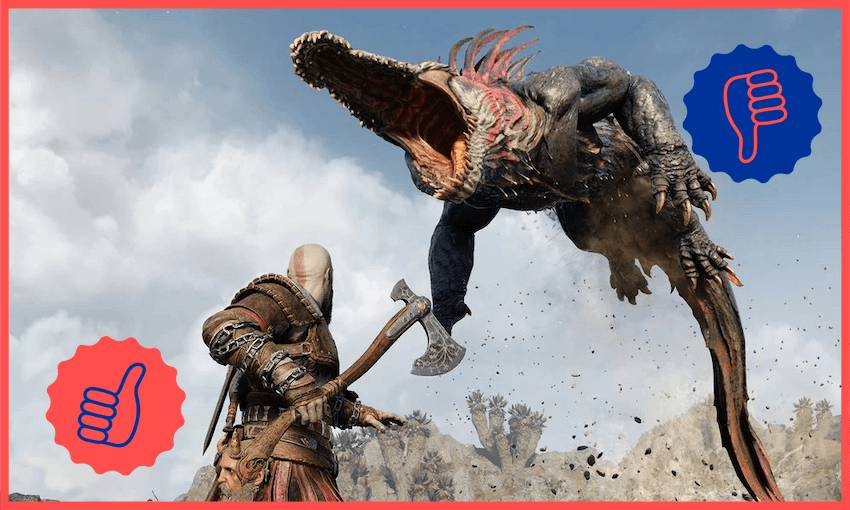


It’s the year’s most anticipated blockbuster game, but will it meet fans’ mammoth expectations? Sam Brooks reviews God of War Ragnarök.
The lowdown
God of War was, hands down, the biggest game of 2018. Not only did developer Santa Monica rerail a franchise completely written off as hyper violent edgelord escapism, it was a big signal to mainstream media that, once again, games could be about something. In this case, they could be about fatherhood. It was a mournful, almost existential, tale of the onetime Greek god of war Kratos, as he and his son Atreus carried his late wife’s ashes to their final resting place – with a lot of Nordic monsters, creatures and supernaturals perishing at the bloody end of Kratos’ axe along the way. It walked away with millions in sales, universal acclaim, countless game of the year awards, and a heavy dose of audience anticipation for the sequel.
Nearly half a decade later, God of War Ragnarök not only has to meet the lofty heights of the first game, it has to provide a satisfying conclusion to it, while also meeting the extremely nebulous expectations of its fanbase. And? It mostly succeeds.

The good
Ragnarök picks up a few years after the ending to the first game, with Fimbulwinter (basically a cold, everlasting winter) in full swing. Atreus, a preteen in the first game, is now a teenager, and a more than capable battle companion for his father Kratos, and in teenage fashion, even more capable of defying him. The story follows the pair as they try to avoid Ragnarök, essentially the apocalypse in Norse myth. The king of the gods, Odin, is stubbornly scheming in their way, alongside other parts of the Nordic pantheon, including a memorably thicc Thor and, after the endgame of the first game, a vengeance-stricken Freya.
For the most part, Ragnarök is more of the same. If you enjoyed the first game, you’ll enjoy this. There’s hacking, slashing, collectables and exploration. The combat has a little more variation, including a third weapon that opens up battles in a thrilling way, the graphics are excellent (though not notably improved from the first game) and it’s paced in a way that stops it from feeling dull over its 20-plus hours.
Most impressively, Ragnarök manages to significantly improve on the writing of its predecessor. The God of War franchise has, like many video games before it, struggled between allowing a player to commit acts of violence en masse and critiquing that violence. For the most part, the God of War reboot has managed to balance these two, with it being extremely clear that Kratos is atoning for the violence on his part, and ultimately trying to prevent more violence. That this game manages to mostly successfully interrogate the role of violence, the cost of vengeance and ultimately, the restorative power of forgiveness, is a massive achievement and not one to be overlooked.

While the game continues to detail a nuanced relationship between Kratos and Atreus – arguably one of the deeper parental relationships seen in gaming – where it most surprisingly succeeds is in the vivid, nuanced portrayal of the supporting cast. While this extends to pretty much everybody who appears onscreen, it’s most impressive with the characters of Freya and Odin. In the previous game, Freya was reduced to a mother figure, an overbearing nag who led to her own son’s demise. Here, more time is given to Freya to explore her motives, her thinking process, and who she was before the trauma that appears to be visited on every character in this game was inflicted on her. It’s deep in a way that feels almost like atonement, an apology for how she (and the other women) in God of War were treated.
On the other hand, Odin is a sharp, slanted take on the all-knowing villain. He’s written more like a mob boss than a megalomaniacal god. It’s a refreshing take in the series, where gods are known for striking first and asking questions later, and it makes for a villain that is even creepier, more unknowable than he would’ve been otherwise.
As expected from a triple-A Sony game at this point, the game includes over 60 accessibility options, including high contrast settings, subtitle size, and just about every option that enables a differently abled person to engage with the game and have as enjoyable an experience as anybody else.

The not-so good
Something about God of War Ragnarök feels a bit too familiar – like it could be an (admittedly rich and deep) expansion pack to the first game. It also feels tonally similar to many other triple-A games – the humour a bit too quirky, the drama a bit too self-important, with proper nouns filling in for actual stakes. It’s never really clear what Odin wants, or what Ragnarök actually is, so when characters are extremely aggrieved over either, it’s hard to understand why it matters so much.
The storytelling for the first fifteen hours is nuanced, thematically dense, and psychologically rich, but it doesn’t land the ending. The lessons about the cost of vengeance, or the rippling waves of inherited trauma are not just resolved easily, but resolved in ways that betray the complexity of the character’s and the world that the developers have set up.
It’s sad that the way the game feels most familiar is how it stumbles across the finish line. There are clear signs that the game, once intended to be the middle entry in a trilogy, feels like it has to resolve and give its character a clear ending, be it a happy one or otherwise. Without spoiling, the finale of the game feels akin to many other franchises which find themselves having to frantically tie up loose ends because they’re not getting another game. When the game should be kicking into fifth gear, it insteads idles, pulling the keys out of the ignition and throwing important plot development out of the window while it goes. Indeed, it’s telling that the best writing actually takes place not in the main game, but in the plentiful incidental conversations between travelling companions, and in completely optional sidequests, almost like the writers were exploring sideroads when they saw the end of the highway fast approaching.
The game always keeps the player invested, but there’s definitely a sense that there was more that could be explored. Instead, we bid farewell to these characters when the journey doesn’t even feel done yet.
The verdict
God of War Ragnarök is a great game. Sometimes, it’s even an excellent game. But as we fully enter the high noon of gaming’s ninth generation, it already feels a bit yesterday. The God of War reboot was one of the defining games of the eighth generation, and a lot of the hallmarks of that game – the constant over-the-shoulder camera, the cinematic setpieces, the brooding, nearly self-serious tone – feel like familiar comforts now. Whether intentionally or not, the game is a farewell to that era of gaming. Even the subject material, a father trying to be a good parent, feels very much like a trend of the last decade. But there was only ever so much room for this game to reinvent the wheel, when what was needed was just to finish the story.
We might say goodbye to these characters, and this story, but I’m glad that the studio can move onto whatever this generation brings for it. Santa Monica’s version of God of War was always, within the games and outside them, an endeavour in looking back, in reflecting and rehabilitating. The studio can be happy that this is the iteration that will be remembered, for its heights and not its lows. I won’t remember the ending, or even the last five hours – I’ll remember a moment where a son, after a moment of defiant rebellion, hugs his dad, who slowly, surely hugs him back.
God of War Ragnarök is available for PlayStation 4 and PlayStation 5 from November 9.