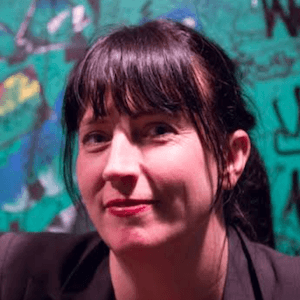


Lorin Clarke, director of Not Only Fred Dagg, tells Alex Casey about being raised by a comedy icon and bringing his story to the big screen.
John Clarke always hated pass the parcel. Before the politically correct days where every layer revealed a treat, he couldn’t stand to watch his daughter Lorin and her friends unwrap empty layer after empty layer, their frenzied anticipation plummeting to crushing disappointment with every turn. “His way of dealing with this was that he had this character whose job was to collect all the wrapping paper,” says Lorin. “And then he would do everything he could to fail to pick up that wrapper – throw it up in the air, miss it, try to catch it again and double back.”
Photos from her birthday parties show children squealing with delight, tears of laughter streaming down their face as The Wrapper Collector pratfalls around the circle. “By the end of the game you didn’t care about that present, because everyone just wanted a visit from The Wrapper Collector,” laughs Lorin. When she looks back now at those photos, she realises what was really motivating that character. “It was such a lovely instinct from him to turn the focus away from the disappointed kid to this idiot,” she says.
“It was so slapstick, and it was so Fred Dagg.”
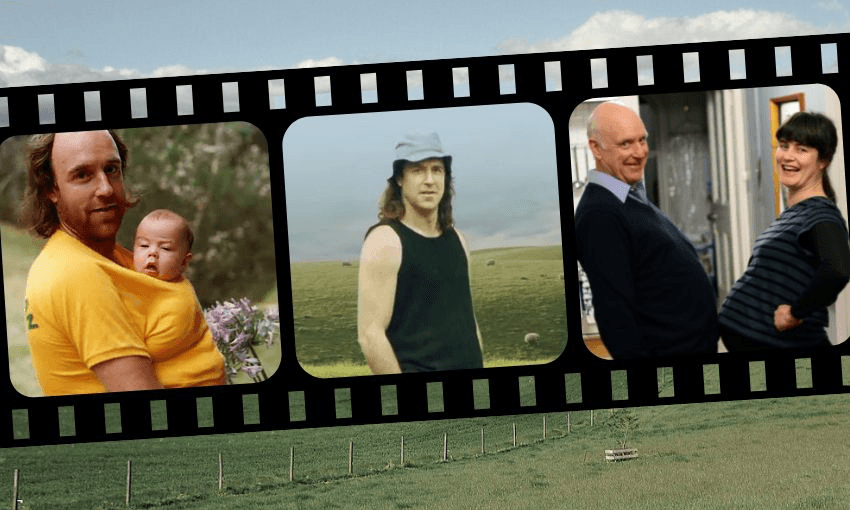
Remembered following his death in 2017 as “one of the sharpest wits this country has ever produced“, John Clarke will be best known to New Zealanders as the singlet-wearing, sheep-shearing Fred Dagg. Rising to fame in satirical segments on Gallery and Tonight at Nine in the mid 70s, the “confident idiot” farmer Fred Dagg quickly became a pop culture phenomenon. While Clarke would eventually cross the ditch and carve out a decades-long career as a political satirist and actor, it is that black singlet, tatty hat and stubbies that sit in Te Papa today.
For his daughter Lorin, the Fred Dagg look is more closely associated with home maintenance than comedy royalty. “He really did mow the lawns in the Fred Dagg outfit at our suburban house where we grew up,” she laughs. In fact, when the curator from Te Papa flew to Melbourne to acquire the Fred Dagg gumboots and clothing for their collection, she got stopped at Customs and had to wash some mud off the boots in the bathroom. “He’d been mowing the lawn in them the week before,” says Lorin.
These kinds of fascinating personal insights behind a true pop culture icon are peppered through Not Only Fred Dagg, the documentary directed by Lorin Clarke. Drawing from extensive home video and archive footage, as well as interviews with friends and colleagues like Sam Neill, Rhys Darby, Ben Elton and Stephen Fry, it provides a deeply personal look at the real man behind the stubbies. “People probably imagine him one way, and they’re not wrong,” says Lorin. “Even in the private version of him, you can still see that glint in his eye.”

Lorin knew from an early age that her dad was different. “We always felt like we shared him,” she says. “You would go to the corner shop, and there would be all these people talking to him that he didn’t know, but they would know him.” Despite the attention, she says the children were always sheltered from the media. “When he was Fred Dagg in New Zealand, he was sort of public property,” she says. “When he came to Australia he got to start again, start a whole new career, and he made the decision to protect his privacy quite a lot.”
Clarke was a scholar of comedy, and did his best to educate his children on the form. “I reckon there’s not a Marx Brothers movie we haven’t seen 17 times,” says Lorin. “If we ever had a sick day, he’d sit us in front of the TV, and he’d go, ‘what do you want? We’ve got Marx Brothers, Blues Brothers, or Withnail and I.” At times, his one-eyed devotion to comedy grated on his teenage daughters. “We loved Party of Five, and watched it religiously… Dad would always walk in and out of the lounge and stand behind us making snide comments,” she recalls.
But being raised by a comedy savant had also sharpened their young wits to defend even the most syrupy American teen sitcom. “My sister was brilliant, she would just say ‘oh sorry Dad, should we watch something intellectual like the Bledisloe Cup instead?’” Equally infuriating for Lorin slightly later in life was her dad’s total refusal to buy a mobile phone. “He didn’t want to be in the system, so he just wouldn’t do it,” she says. “You’d have to meet him on the corner of a certain street at a certain time like it was the 1940s again.”

Other times, modern technology proved itself crucial in the Clarke story. In 2016, Lorin had a new baby and was making a podcast in her home when her colleague suggested she start recording some of her conversations with her dad. “He would come over, hold the baby, have a cup of tea and we would chat,” she says. The pair talked about his parents’ fascinating and tragic wartime relationship, his childhood spent in Palmerston North, his university years at Victoria. “That’s about where we got up to in 2017,” she says. “Then he died.”
There’s a quote from Laurie Anderson – “when my father died, it felt like a library had burned to the ground” – which acts as a mission statement for the film Lorin would make nearly a decade later. Piecing together his life from their conversations, as well as a 70-page document they found on his computer after his passing, Lorin wanted to go beyond a misty-eyed hagiography. “What makes his story interesting isn’t that he was funny or famous, but the decisions he made through his life that were sometimes a little bit bonkers.”
That includes Clarke’s choice to move to Australia in 1977, just four years after Fred Dagg made his first appearance on New Zealand television, two years after his Fred Dagg album released to gold status, and one year after he won television personality of the year. In the documentary the character is described as a “gilded trap” that grew too big, too fast – “it gets blunted when you start having to tap dance and do commercials.” Eventually, he took the advice of a higher-up at TV1 who gave told him, “you’re really good: get out.”

He would go on to earn comedy icon status across the ditch too, whipping the country into a frenzy over an absurd fake sport called “farnarkeling”, staging satirical political interviews in The Gillies Report and Clarke and Dawe, and making an award-winning comedy mockumentary, The Games. But all the while, he never forgot where he came from. “He always had a real sense of himself as a Kiwi,” says Lorin. “If you ever went overseas and emailed him pictures, he’d say ‘that’s very beautiful. It looks a little bit like just outside of Taranaki’.”
While his relationship with New Zealand was “mourned, but never burned”, Lorin hopes local audiences will still enjoy a fresh perspective on one of our most pioneering comedy talents. “One of the undercurrents in the film is that moment where he decides ‘I’m just gonna do what I’m good at’,” she says. “The concept of authenticity is so overused on social media, but it is true that it is something that you can’t manufacture and you can’t buy it in a shop. It’s something that he protected fiercely, which is also why he knew he couldn’t do Fred Dagg for ever.”
There are plenty of lessons in creativity and life to be gleaned from Not Only Fred Dagg, but for Lorin it is her attempt at rebuilding even a small nook of that rich library of knowledge that was lost in 2017. She describes the moment her editor cracked the opening montage of the film, a flurry of archive and home video including Clarke filming his own daughter in the style of a nature documentary, referring to her as the “lesser-spotted smartarse” in the backyard. “He played it back for me and I couldn’t speak,” she recalls.
“The only thing I could say was ‘hi Dad’.”
Not Only Fred Dagg opens in cinemas on Boxing Day.