


A new documentary about women’s rugby in Taranaki is a celebration of women and rural communities, writes Tara Ward.
It’s a cold, dark evening in South Taranaki, and Kate Thomson is hard at work in the milking shed. She’s just returned from rugby training, having squeezed a practice session into a busy day of work on the farm. Kate lives for rugby, and her mum Racheal can’t help but become emotional when she remembers the time Kate was hurt during a match, and how she told her daughter not to cry. Getting upset is the last thing Racheal wants her daughter to do when she’s playing rugby. It’s not about not weakness, she explains – it’s more about the pitch being a battlefield where you should never let your emotions get the better of you.
“Rugby’s a rough, tough game, and if you want to play it, you play it without crying on the fucking field.”

Racheal and Kate are just two of the down-to-earth, humble characters in No Tears on the Field, the charming new local documentary about women’s grassroots rugby in Taranaki. Directed by Lisa Burd (The Pinkies Are Back), No Tears on the Field follows four different rugby teams through the 2024 season, introducing us to the players and their families and capturing what the sport means to them. What’s behind the fierce rivalry between clubs Clifton and Southern, and what makes Racheal travel 300km every week to watch Kate play? What is it that turns gentle primary teacher Mereana Anderson into a “bunting, big hitting” gladiator as soon as she puts her boots on?
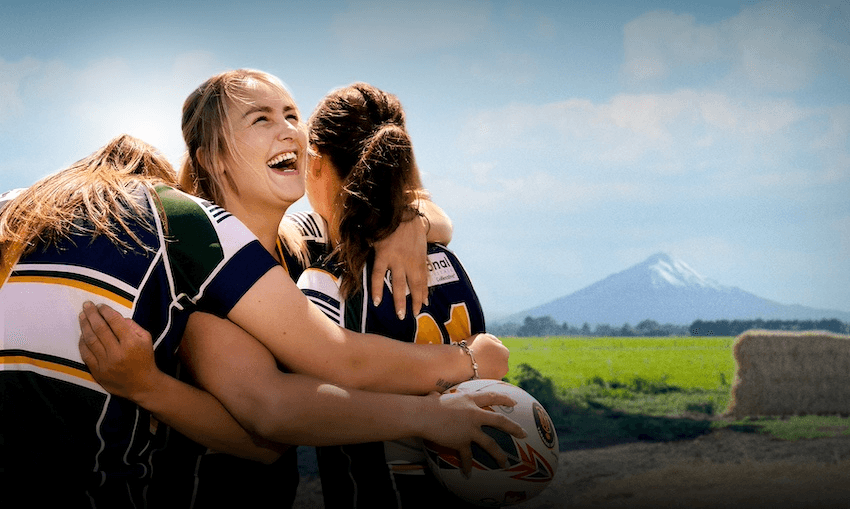
You don’t have to look too hard to find the answer: it’s community. That’s what makes Atalya Fakavamoeanga join the first women’s rugby team in Ngāmotu New Plymouth in 30 years. None of her Tukapa teammates have played rugby before, but the club provides free child-care, which means the single-mum-of-three can play the sport that helps her overcome post-natal depression. It’s also a sense of community that brings the Okaiawa girls team together on a wet Taranaki day, as they play an intense game of footy against a local boys’ team. “I want the girls to thrash them,” their coach Tami says from the sidelines. “We smashed those boys,” one of the girls tells us afterwards.
These young girls don’t know a world where New Zealand hasn’t been a women’s rugby world champion, and could never imagine having to seek written permission from the NZRFU to play the sport they love. But that’s what Taranaki woman Vicky Dombroski had to do in 1988 when she wanted to start a women’s rugby team with the Clifton club. Dombroski later became the Black Ferns coach and selector, and was joined at Clifton by Cherry Blyde, who became a Black Fern in 1992. Back in the 80s and 90s, Blyde never understood all the fuss from “old white men” about women playing rugby. “It’s sport, for heaven’s sake. Just play it.”

The past, present and future of Taranaki women’s rugby comes together in No Tears on the Field, with Blyde’s daughter – Black Ferns sevens legend and double Olympic medalist Michaela Brake – also sharing her love for the sport. There’s some charming scenes as Brake reflects on how playing rugby as a child helped her bond with her dad, and her pride in seeing a Taranaki girls’ rugby tournament created in her name. That message is also at the heart of No Tears on the Field: if you can see it, you can be it. For all of these women, rugby is about much more than just scoring tries, and for the sport to continue to grow in record numbers, it needs more players like Kate, Atalya and Mereana at grassroots level.
Director Burd is born and bred in Taranaki, and her love for the region shines throughout. The documentary is filled with stunning aerial shots of the region, and the true star of the show is a snowcapped Taranaki Maunga, forever sitting proudly against a backdrop of crisp blue skies and soft west coast sunsets. No Tears on The Field is a love letter to Taranaki, but it’s also a tribute to the determination, power and passion of New Zealand’s rural communities. In provincial regions like Taranaki, rugby is both a connector and an escape, a catalyst for women to step outside family and work responsibilities and embrace the freedom to be themselves.
The magic of No Tears on the Field happens when Taranaki women talk about their love of rugby, and the documentary loses some momentum when it strays from the field for too long. But there’s no doubt that No Tears on The Field is an uplifting tale of good people doing great things, and a hearty celebration of the ways that sport brings people together. These wāhine toa might not be crying on the field, but there’s no shortage of emotion in this heartwarming documentary.
No Tears on The Field is playing in cinemas nationwide.