Auckland’s proposed congestion charging, explained

Is it time to move forward? (Image: Tina Tiller/The Spinoff)
In the future, drivers will likely have to pay to drive in certain parts of New Zealand’s biggest city at certain times. Here’s what you need to know.
Beep beep: Auckland Council is moving slowly forward with congestion charging. Last week councillors voted to put three scenarios of what form it might take to Aucklanders, who will no doubt have plenty to say on the matter – councillors already have. What’s being proposed, why does it matter and who else is doing this? Let’s pull over and take a look.
So, what’s all this then?
To use the official terminology, “time-of-use charging” has been proposed for central Auckland in the hope it will help with traffic congestion. The concept establishes an invisible cordon around part of the city and drivers who enter during peak hours (morning and afternoon) are charged a to-be-decided fee. The idea is to incentivise people to travel at alternative times or use public transport instead. Voilà: less traffic.
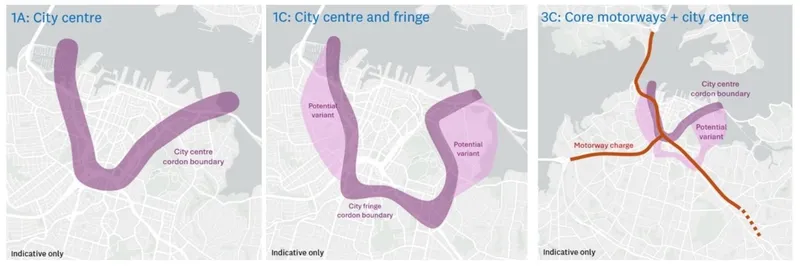
A 2025 report presented six options to council, which councillors have recently voted to whittle down to three to present to the public. The first – and, according to council, “likely most feasible” – option is to put the invisible cordon around the city centre. This scenario features the lowest charge of the three (more on that below) and, combined with the smaller catchment, would create less revenue and behavioural change.
The second option moves the boundary out to encompass the city fringe, probably including Parnell, Newmarket, Newtown and Ponsonby, and increases the charge. This would capture more trips and, combined with the higher charge, make more money.
The third option would include the motorways leading to the central city and have a higher charge still. It’s the “largest and most challenging option” but would provide “significant” revenue, according to council.
The proposed options would affect between 3% and 7% of car trips in Auckland and revenue would be put towards land transport improvements.
OK, and why is this being proposed now?
Because it can be, legally. Last year the government passed the Land Transport Management (Time of Use Charging) Amendment Bill, which allows local authorities to implement targeted time-of-use schemes with the support of the New Zealand Transport Agency (NZTA).
At the time, minister for transport Chris Bishop said the government wanted to prioritise our biggest city due to “the importance of Auckland to the national economy”. Auckland contributes 38% of New Zealand’s GDP and is home to a third of the population, and the main cause of its traffic problem is growth: the population increased 24% in 21 years.
And traffic in Auckland is bad, as Hayden Donnell likes to remind everyone. Each year Aucklanders spend 17 hours stuck in traffic – the equivalent of watching The Odyssey five times. Congestion sucks $2.6 billion from the city’s economy annually. And in the trans-Tasman pissing contest of traffic jams, our roads are more congested than Sydney and Melbourne.
Yeah traffic sucks, but what could this cost me?
That’s TBC. The shortlisted options include potential charges, ranging from $2 during the afternoon (the city-centre-only option) to $7 in the morning (the motorway option). Drivers who pay are expected to save up to 12 minutes per trip during peak hours.
Before making a decision on the exact figure, Auckland Council has said it wants to gather more feedback and do more analysis but suggests $5 will be the likely peak. Specific exclusions are yet to be proposed, but in the past council has suggested that emergency vehicles, buses, motorcycles and scooters would be off the hook.
Whether those who live within the imaginary cordon will have to pay is unclear. Perhaps we’ll follow London’s lead, where residents of its congestion zone can apply for 90% off.
Speaking of which, how does this work overseas?
Singapore pioneered congestion charges, introducing checkpoints in 1975, and since 1998 it’s been charging drivers via electronic gantries and cashcards installed in vehicles. But that’s poised to change; a new satellite-based system, the first of its kind, is being rolled out this year.
London introduced congestion charging in 2003, with drivers paying a daily fee to drive within a specified zone between set times. It’s monitored by a network of automatic number plate recognition cameras and an automated payment system deducts a monthly charge, or payments can be made online or by phone. Motorbikes, scooters, taxis and drivers with “mobility problems” are among those exempt.
Congestion charges arrived in Stockholm in 2006, with a cordon-based approach that relies on electronic control points that recognise licence plates. These register a vehicle’s movements and owners receive a monthly bill.
Congestion charging was first proposed in New York in 1952 but it only arrived last year, with drivers now charged $US9 to enter lower Manhattan.
OK, back to New Zealand. What happens next?
Aucklanders will get the chance to share feedback on the proposed options from November. After that, if a scheme is progressed, a more detailed proposal will be put forward for another round of public consultation in 2027. From there, any confirmed plan would still need to be approved by the Ministry of Transport in 2028. Actual implementation probably wouldn’t happen until 2030-2031.
By then, Auckland’s population will be even higher – it’s projected to hit 2 million by 2033. Traffic’s also predicted to get worse as the population grows.

Emma Gleason
Emma Gleason is a staff writer at The Spinoff and an award-winning fashion journalist. But it’s not just clothes that interest her, you’ll find her exploring tasty cheese, influenza outbreaks and more important things right here. She has experience with some of the country’s leading media outlets as well as the toaster in our kitchen.


