Bledisloe Cup: Unpacking Australia's tumble from rugby greatness

Jeremy Williams of the Wallabies takes the ball from a line out (Photo by Darrian Traynor/Getty Images)
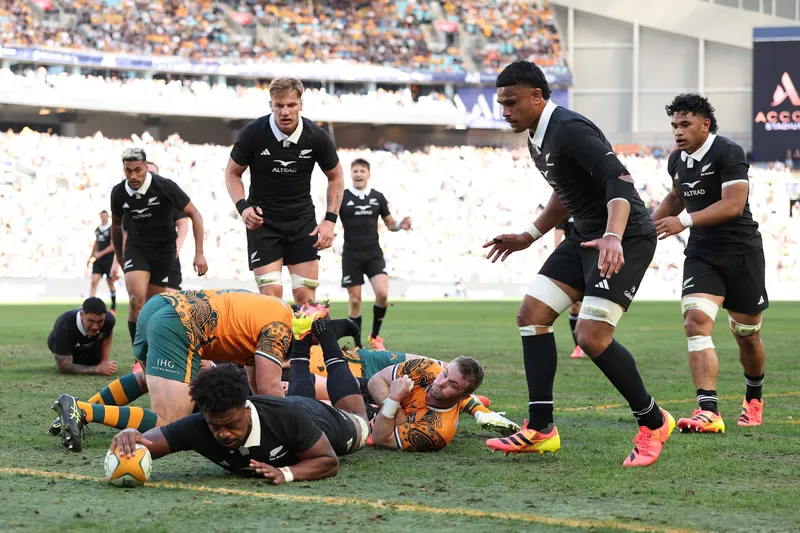
After a sweeping 43-21 win by the All Blacks in Sydney, Paul Thomas wonders when Australia will win again.
The back to back Bledisloe Cup matches confirmed what we already knew:
- The All Blacks are a team on the rise but
- The sixth-ranked Wallabies are a very different proposition to the top-ranked Springboks.
Coming off two months of getting hammered a split-second after receiving the ball, the All Blacks relished the time and space they were given by a passive Wallaby defence. While the Bledisloe breakdowns were contests, they weren’t punishing dogfights; likewise the scrums were orderly restarts, as opposed to physical and psychological confrontations with strategic implications.
(In a previous column I suggested the stars have aligned for the Boks in terms of the laws of the game, the way they are currently officiated, South Africa’s unique and privileged position of having a foot in both hemispheres and demographics. Space didn’t permit mention of another significant advantage: unlike here, the game in South Africa isn’t locked in competition for eyeballs, talent, broadcasting revenue and sponsorship dollars with the juggernaut that is the NRL.)
The Greatest Rivalry series bolstered the argument that the All Blacks’ relative decline can be partly attributed to South Africa’s absence from Super Rugby. Another way of looking at it is that we suffer from too much exposure to Australians.
The Wallabies’ woes have been well-documented: they haven’t held the Bledisloe Cup since 2003 or won any of their last 13 games against the All Blacks. To put this in perspective: in 2003, having cleaned up the All Blacks in the semi-finals, they were a drop goal away from securing their third – of five to that point – World Cup.
Things have reached the stage that, earlier this year, New Zealand Rugby chair and former All Black captain David Kirk blurted out that he “kind of nearly” wants the Aussies to get their hands on the Bledisloe.
Kirk lives in Sydney so he should be careful what he wishes for. I was a Sydneysider in 1998 when the Wallabies regained the cup, beating the All Blacks three times. (The All Blacks went on a five-game losing streak, also losing twice to the Springboks.) Every second taxi driver, upon identifying my accent, trotted out this tiresome riddle: What’s the difference between the All Blacks and an arsonist? An arsonist would never lose five matches one after another.
Less dwelt upon is the fall off in the Australian Super Rugby teams’ competitiveness. In the tournament’s early years – 1996 to 2004 – the Australian sides held their own, winning roughly half their games against New Zealand franchises. Between 2005 and 2014 the Kiwi teams won more than they lost but not to a glaring extent. Since 2015, however, the ledger has tilted dramatically in New Zealand’s favour: Australian victories in trans-Tasman clashes have been few and far between. This year, for the first time in the tournament’s history, the semi-finals were an all-New Zealand affair.
It would hardly be surprising if the current generation of Aussie rugby players suffer a mental block when faced with Kiwi opposition: for many of them, victories come around less frequently than birthdays.
It may be comforting for Kiwi fans to know that, if all else fails, we can still pummel the Aussies at club and international level but are all these soft wins setting the All Blacks up to fail in high-stakes games against the heavyweight nations?
History tells us that permanence is an illusion. Things that seem like permanent fixtures in our lives, times and collective consciousness can wither away, even vanish overnight. In January 1989 East German leader Erich Honecker, the prime organiser of construction of the Berlin Wall 28 years earlier, predicted the edifice would stand for another 50 or 100 years. Demolition began that November.
Next year the Bledisloe reverts to a best of three format with two games in Australia. The inaugural Anzac Day test will be played at Brisbane’s Suncorp Stadium, the Wallabies’ happiest hunting ground, where the All Blacks have a spotty record. The Wallabies will front up knowing that ending the Bledisloe drought would galvanise their long-suffering fans and ensure fervent support heading into a home World Cup.
Then things will get interesting. The All Blacks and Wallabies are in the same pool. The likely reward for the winner of their pool game is a quarter-final against the Springboks and, if they get through that, a semi-final against France.
Having the three best teams on the same side of the draw has prompted the not entirely off the wall suggestion that the All Blacks would be better off losing that pool match to get themselves onto the easier side of the draw. No doubt a similar notion is being floated across the Tasman
Which raises the surreal prospect of both teams putting out second-string line-ups to engage in a race to the bottom.

Paul Thomas
Paul Thomas is an award-winning novelist and columnist who has written extensively on sport.


