Where it’s happening, how many drivers have tested positive, what drugs have been detected and more, provided to The Spinoff under the Official Information Act.
Roadside drug testing kicked off in Aotearoa in December 2025, initially just for drivers in Wellington. In mid-May of this year, it was rolled out to other districts, with the programme in full swing across the country by July 1. The regime tests drivers’ saliva for the presence of cannabis, meth or MDMA and cocaine, but does not test for actual impairment – something that has been criticised by health experts.
So in the first six months, how many drivers were tested, how many returned positive results and what drugs were detected? Here’s what we know from that initial rollout period, with data provided by NZ Police in response to an Official Information Act request.
4,145
The number of roadside drug tests carried out between December 15 and June 30. With testing starting in Wellington some months earlier than elsewhere, the largest proportion of tests took place there: 1,603, or just under 39% of the total. The combined Auckland police districts – Auckland City, Waitematā and Counties Manukau – plus Auckland Road Policing, which operates across the three, conducted nearly as many tests, with 1,285 or 31% of the total.
Police say a “predetermined selection approach” is used to decide which drivers to test, in order to “mitigate any risk of targeted testing or unconscious bias”. Sometimes dedicated drug testing operations are set up, in which case the selection approach might just be the next car to come along the road when a testing bay becomes available. At other times, a driver might be screened for drugs when they’re stopped for another reason – every third driver stopped for speeding might be tested, or every driver of a white car stopped for a seatbelt offence. “The reason for testing the driver should be justified and recorded. It must not be determined based on the driver’s history, affiliations, licence type, ethnicity or demographic profile,” said Superintendent Steve Greally, director of road policing at NZ Police.
136
The number of drivers who returned positive first screening tests across the country, giving an overall positivity rate of 3.3%.
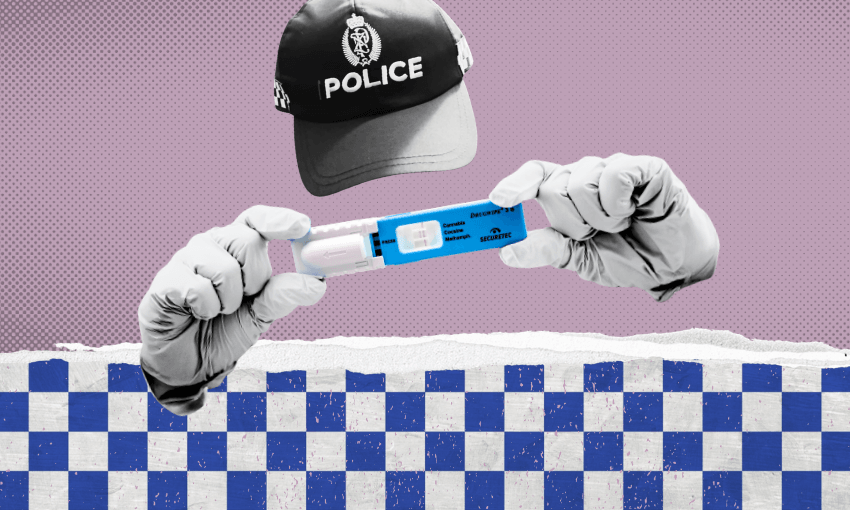
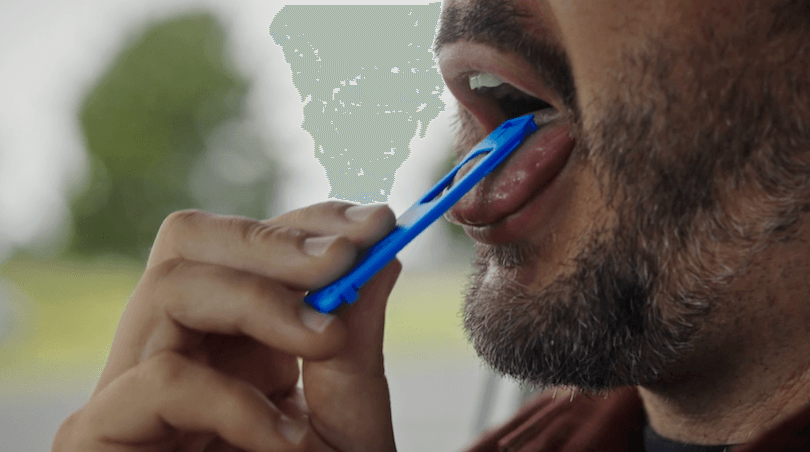
The drug screening process has several steps: firstly, the driver will be asked to wipe their tongue down the front of a device called the DrugWipe 3S, which screens for THC (cannabis), MDMA/methamphetamine (these come from the same chemical family) and cocaine. If the device returns a positive result for any of these, the driver will be asked to provide an oral fluid (saliva) sample to be sent for lab testing, and then to repeat the tongue test.
If that second screening is again positive, the driver is forbidden from driving for 12 hours. If it’s negative, they’re free to go, but the saliva sample will still go to the lab, and if any one of the 25 different drugs that are tested for there is detected, the driver will be fined $200 and receive 50 demerit points. If two or more of those drugs are detected, the penalty is $400 and 75 demerit points. That harsher penalty also applies to any driver who refuses to comply with roadside drug testing procedures, and they’ll also be barred from driving for 12 hours.
146
The number of drug detections at first screening, which is higher than the number of positive first screening results as some drivers tested positive for more than one drug. Methamphetamine/MDMA was the most commonly detected (the screening test can’t differentiate between the two, but laboratory analysis can – more on that below). Cocaine was detected only five times at roadside: twice in Auckland City (making up half of that district’s positive results), once in Bay of Plenty, once in Northland and once in Wellington). In laboratory analysis, however, where drugs are picked up at lower thresholds, cocaine popped up in the Southern and Central districts as well.
9
Cannabis is widely thought to be the most commonly used illicit drug in New Zealand, but in nine out of the 13 police districts, meth/MDMA was detected as frequently or more frequently among drivers. Particularly notable were Waitematā (10 meth/MDMA detections, three cannabis detections) and Southern (eight meth/MDMA detections, four cannabis detections). Methamphetamine use has surged in recent years across New Zealand, with MDMA and cocaine use at much lower levels.
126
The number of positive drug detections in saliva samples (which are collected and sent for lab analysis only if the first roadside screening test is positive). This is lower than the number of positive first screening results because some drivers do not complete the drug testing process, according to police: after an initial positive test, they may refuse to provide a saliva sample (which will land them with a fine of $400, 75 demerit points and a 12-hour ban from driving). There can also be a discrepancy because of lab processing times.
In the lab, nine of the 25 different drugs tested for were detected, with THC (cannabis) and methamphetamine by far the most common. Zopiclone (used to treat insomnia) and methadone (used to treat chronic pain, for example in people with terminal cancer, and to treat opioid dependence) each returned a sole result, both in Wellington. While these are legal if obtained with a valid prescription (as is cannabis), they’re on the list as they’re among those “identified as having the highest risk to road safety”. Drivers who test positive for prescription drugs but can prove they have a valid and current prescription, and have complied with their health practitioner’s instructions, can apply for a medical defence to have the infringement notice withdrawn.
7.7%
The positivity rate for first screening tests in Northland, which was the highest of all districts. (It’s worth noting that outside of Wellington, a relatively small number of tests were conducted, so no firm conclusions about wider trends can be drawn.) In Northland, there were nine positive first screening results out of 117 tests in total, with 11 drug detections: five for THC, five for methamphetamine/MDMA, and one for cocaine.
The Southern district, the largest geographical police district in the country, had the second-highest positivity rate at 5.2% (10 positive results out of 194 tests, with 12 drug detections (eight for meth/MDMA and four for cannabis). Canterbury and Counties Manukau had the lowest positivity rates, both under 1%.
102
The number of infringement notices issued to drivers for positive drug tests. A single drug detection accounted for 72 of these ($200, 50 demerit points), with 30 for two or more drugs ($400, 75 demerit points). The number of infringement notices issued is lower than the number of drugs detected in lab samples because a single driver may have tested positive for multiple drugs.
37
The number of infringement notices issued to drivers who refused the first roadside drug screening test.
16
The number of infringement notices issued to drivers who refused to provide a saliva sample for lab analysis (which is required after returning a positive first screening test).
9
The number of second screening tests – which are carried out only if there’s an initial positive one – that returned a negative result. None of the saliva samples taken from these drivers came back negative. Police say this doesn’t necessarily mean that the second roadside test was a false negative, but rather that “by the time the second screening test was undertaken the drugs in the oral fluid were now below the roadside threshold but remained above the laboratory threshold”.
15ng/ml
The threshold for THC to be detected in the first screening test. What this means differs from person to person, so there’s no hard-and-fast rule for how long to wait before driving after consuming cannabis – but needless to say, don’t drive if you feel impaired. According to medical anthropologist Geoff Noller, the DrugWipe device could potentially detect cannabis eight to 12 hours after use, or up to 30 hours for heavy or frequent users.