The longest commute, day seven: Joel has reached the end*

The end of NZ’s public transport system is a KFC
Joel MacManus attempts to travel from the bottom to the top of the country without a car or plane. Today: the last hurrah.
The mission: Get from Stewart Island to Cape Reinga as fast as possible using only public transport. Wherever I can, I’ll travel by train. In areas that are too rural or too watery for trains, I’ll take buses and ferries.
Why? That’s a great question. I’m honestly not sure. I hope to learn something about New Zealand and gain new insight into the country I call home.
When New Zealanders travel around their own country, public transport is usually an afterthought. Decades of underfunding have left our inter-city rail slow, expensive, and infrequent. I want to find out what it is really like.
The itinerary:
- Ferry from Oban to Bluff
- Bus from Bluff to Invercargill
- Bus from Invercargill to Dunedin
- Bus from Dunedin to Christchurch
- Train from Christchurch to Picton
- Ferry from Picton to Wellington
- Train from Wellington to Auckland
- Bus from Auckland to Paihia
- Bus to Cape Reinga (part of an 11-hour sightseeing tour of the Far North) Kaitaia
The estimated cost: $1,052 in total for the tickets. If everything goes to plan (which it probably won’t), it will take me 150 hours. By comparison, riding the entire length of the Tranz-Siberian railway from Moscow to Vladivostok, which is five times longer than New Zealand, takes 147 hours.
I began on Monday in Oban and am now starting day seven in Paihia. By the end of the day, I hope to be, well, I actually don’t know. Let’s find out.
What I learned about New Zealand at the Waitangi Treaty Grounds

“Where are you visiting from today?” the woman at the counter asked as I paid my admittance to Te Pitowhenua Waitangi Treaty Grounds.
“Wellington,” I replied.
“That’s a long drive,” she said.
“I actually caught the train most of the way,” I said.
“There’s a train?”
“Yeah, there is. It runs three times a week, and it costs too much money.”
“Huh, who knew?”
I swear on the graves of The Northerner, The Southerner and The Overlander that exchange really happened. I wrote it down word for word because it was almost too perfect as a way to conclude my journey through New Zealand via its oft-forgotten public transport network.
I started at 8am on Monday in Oban, Stewart Island. As I publish this post, it’s 7am on Sunday, and I’m in Paihia, Bay of Islands. To get here, I took a ferry, a shuttle bus, a bus, a bus, a Lime scooter, a train, a ferry, a shuttle bus, two local buses, a train, a Lime scooter, a Lime scooter, and another bus.
About 15 minutes before I arrived in Paihia, I received a call telling me my final bus was cancelled. The only way to get to Cape Reinga by bus is an 11-hour sightseeing tour in a return loop from Paihia. I had booked two versions of the same tour through two different companies. Twice, the buses were cancelled.
I ran around frantically for a while, trying to find any other way to Cape Reinga. I called taxis, shuttle services for trampers, and bike rental shops. My editor, Mad Chapman, vetoed my plan to bike the rest of the way. Seemingly out of options, I went to do some sightseeing.
The Waitangi Treaty Grounds are New Zealand’s most important cultural and historic site. It’s where the nation was born. Visiting the treaty grounds was at the top of my bucket list, and yet I had some trepidation about it. I felt inadequate. I was afraid of visiting the grounds and not feeling the full gravity of their importance. So, in preparation, I read The English Text of the Treaty of Waitangi by Ned Fletcher from start to finish (and yes, that is a humble brag because it is a really long book).
When I stood on the lawn between the Waitangi Flagstaff and the Treaty House, it felt like sacred ground. This was never meant to be my end point, but everything about it seemed right. It was as if my entire trip from Stewart Island had been a pilgrimage to reach this place.
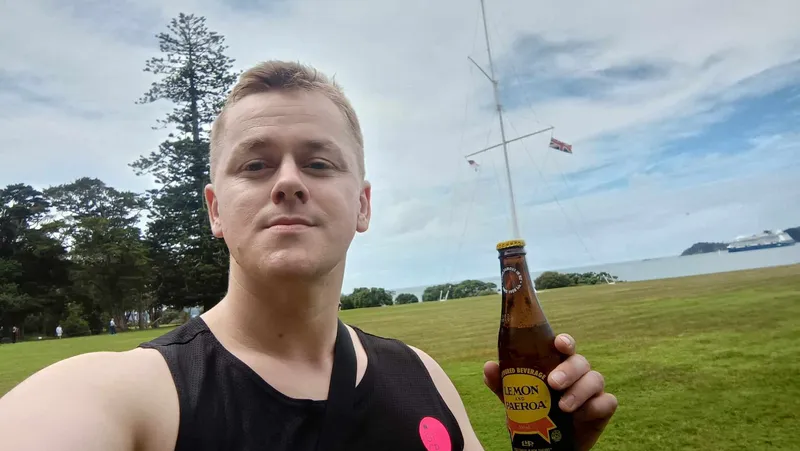
The cruise ship Celebrity Edge was docked in the bay, and its 2,908 passengers were out in force. The grounds were flooded with tourists from around the world wanting to learn about Aotearoa New Zealand.
About half of my time at the grounds was spent following a guided tour. I was the only Kiwi in the group. The tour guide was one of the most fascinatingly engaging speakers I’ve ever had the privilege of listening to. A former high school teacher who threw it all in a year ago to move to Waitangi and give tours, she has a contagious enthusiasm that makes it clear she has found her happy place.
She did an admirable job of explaining the three articles and the differences between The Treaty and Te Tiriti in clear terms without oversimplifying or mythologising. When asked questions, she would launch into hyper-detailed explanations, usually with several tangents along the way, always citing her sources. She would pit Claudia Orange against Anne Salmond and James Belich before offering her own nuanced conclusions.
When William Hobson stood on this lawn and proposed Te Tiriti to an assembly of chiefs on 6 February 1840, what did the chiefs understand? It’s a complicated question that could fill (and has filled) many books. But it is fair to say that everyone who gathered on these grounds, British and Māori, broadly understood some core concepts. Firstly, Hobson would come to New Zealand as governor and exercise kāwanatanga, the powers of a governor. Secondly, he promised he would protect the rangatiratanga, the powers of the chiefs. The fatal flaw of the treaty is that it is too vague; the limits of kāwanatanga and rangatiratanga are never specified, but it fundamentally acknowledges that both shall exist in partnership.
Kāwana is a loan word from the English word ‘Governor’, but kāwanatanga wasn’t a completely foreign concept for Māori. All the chiefs at Waitangi had interests in foreign trade, and many had been to Sydney on trading ships, so they had some idea of what a Governor and a government would do: courts, police, port authorities, that sort of thing. All the chiefs and Crown representatives at Waitangi understood that signing the treaty meant creating a government. They didn’t all agree on what the government’s role should be—we still don’t and never will—but they decided it was worth doing for the betterment of their people.
New Zealand is an ongoing project—and the New Zealand Government is, too. The project of developing the nation is far bigger than any one person or any one lifetime, and there is no end date in sight. It’s grand and majestic, silly and quirky, personal and public, and many other things.
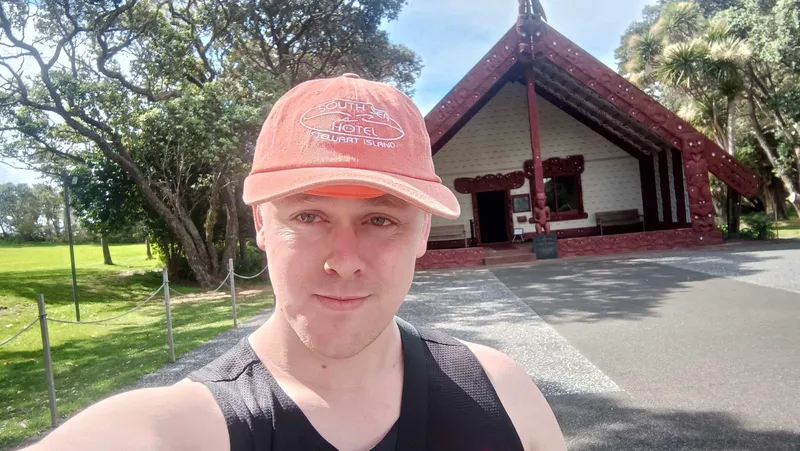
The government is imperfect and has done many bad things, but it has also achieved great feats – including the construction of the national railways. When Prime Minister Julius Vogel, in 1870, announced his intention to build rail lines through the North and South Islands, it was an immensely expensive, complex, and arduous task for a three-decade-old country. But Vogel saw it as essential to nation-building, saying New Zealand would never be truly connected “until the iron horse runs through the two islands.” The iron horse revolutionised the movement of goods and people. It caused economic booms everywhere it went and helped unify New Zealand as one nation rather than a collection of distinct provinces. Building the North Island Main Trunk took 39 years; Vogel had been dead for a decade by the time it opened. It was the act of a forward-thinking nation with aspirations of greatness.
On my journey, I saw the decaying remnants of that aspiration. The fenced-off platform in Invercargill, the abandoned train carriages in Taumarunui, and the long stretches of unused track that passed by my bus window. The decline has many causes, most of which revolve around the rise of road transport. But we shouldn’t have to choose between one or the other. To reach its full economic potential, New Zealand needs all its transport networks to work as efficiently as possible.
I asked the guide if she had a script for her tours. She said no, every tour is different and highly improvised. Her philosophy is “fuck around and find out”. Clearly, it works. Her audience of international travellers was enthralled and eager to absorb everything she said. In the most literal sense, her job is to tell New Zealand’s story to the world.
Stories are the most powerful thing we have. In Sapiens: A Brief History of Humankind, Yuval Noah Harari argues that humans became the dominant species because we have the unique ability to tell stories that motivate people to cooperate in large numbers. This means we can achieve far greater things than any of us could do alone—such as building a nation and a railway line.
The nation of New Zealand is an idea given meaning by stories. The stories we tell about ourselves define who we are and how we act. The guide told the group about the Wi Parata case of 1877 when Chief Justice James Prendergast dismissed Te Tiriti as “worthless” and “a simply nullity”. She briefly described the invasion of the Waikato and the long history of the Crown’s treaty breaches. That’s not a story to be proud of. But she also spoke about the revitalisation of te reo, the increasing mana of Te Tiriti, and how she, as a Pākehā, felt shared ownership of Aotearoa’s national identity. That’s a story that New Zealand can aspire to.
Upholding the promise of our founding document and restoring the efficacy of passenger rail are two completely different goals, yet they share some important commonalities. They’re both areas where the government has failed, and fixing the failures of the past will be immensely difficult. Moving forward will only be possible if we tell ourselves the right stories and believe that New Zealand is capable of reaching its ambitions.
What have I learned from travelling the length of New Zealand on public transport? That New Zealand is great. And it can be better.
After the Treaty Grounds closed, I walked back to Paihia. At dinner, I overheard a Ngā Puhi man explaining the Treaty Principles Bill to a curious American couple. Over my other shoulder, a Westie couple were having a loud public argument. I looked out across the warm blue bay, contemplating the impressive and imperfect country I call home.
I cupped my hands under the water fountain on the Paihia foreshore and drank from them. It was the best water I’ve ever tasted.
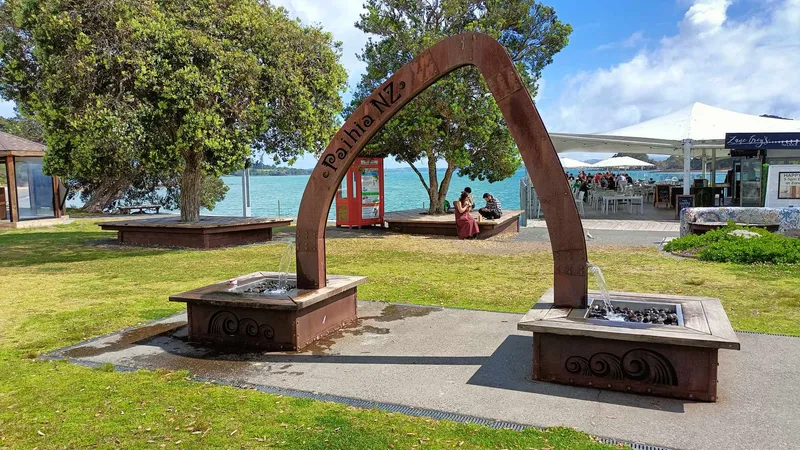
The ferry to Russell
In an effort to squeeze in as much public transport as possible to the last day of my trip, I caught the ferry from Paihia to Russell/Kororāreka
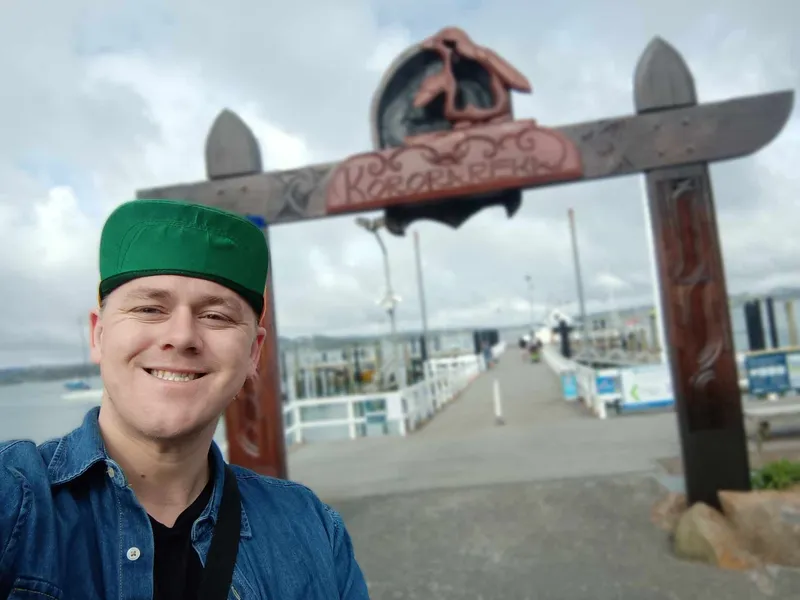
The crossing took 17 minutes and cost me $17 for a return trip. There are three ferry companies operating services across the bay. I caught the Waimarie (‘the happy ferry’) to Russell and the Blue Belle back. The companies have aligned their services so that a boat leaves every 20 minutes from 9am until 5:20pm, with off-peak services starting as early as 7am and ending at 10:30. It’s probably the most regular and reliable ferry service in Aotearoa. It is mostly patronised by tourists, but is affordable and convenient enough that many locals use it for their daily commute.

I only had an hour in Russell, but I wish I’d had longer. I strolled through the old town and imagined what it was like in the early 1800s, when it was the first international settlement in Aotearoa. It was a haven for whalers, merchants, pirates and escaped convicts from around the world. Charles Darwin once dubbed it “the hellhole of the Pacific”. Now, it’s as peaceful of an oasis as a village can be.
I saw Christ Church, the oldest existing church in New Zealand, and Pompallier Mission and Printery, where Catholicism first reached these shores. I walked past the Duke of Marlborough, a pub that is 13 years older than the country it’s in.
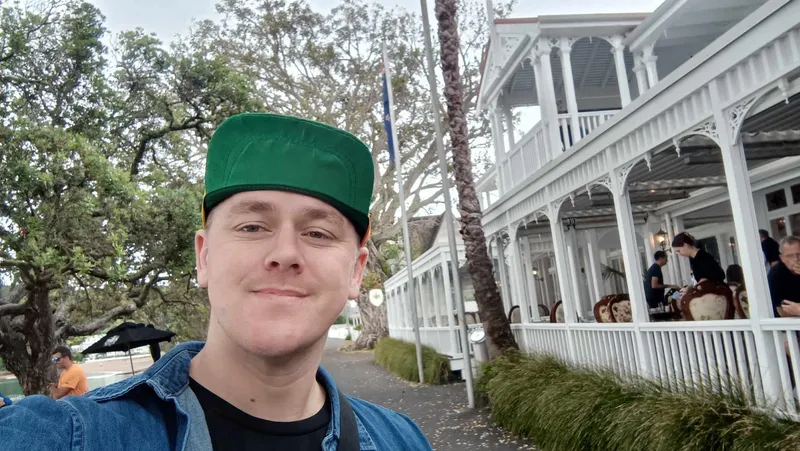
For breakfast, I had a flat white and a lamb and kumara pie. It tasted like New Zealand.
Bussin’
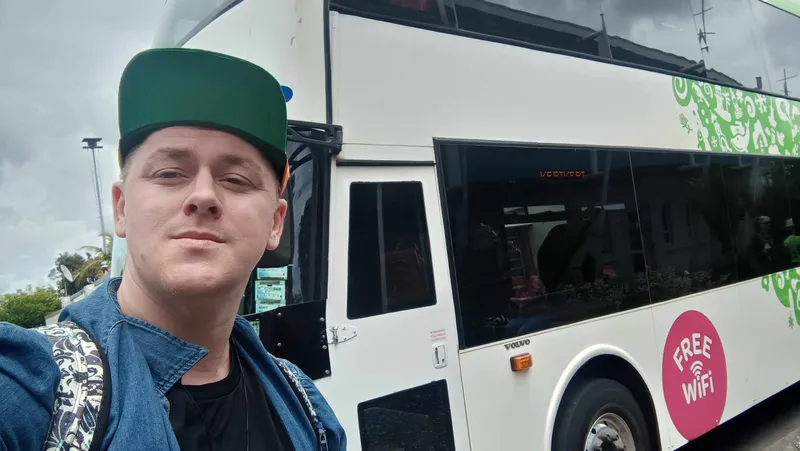
Back on the road, time to see how far this baby can go.
Kerikeri
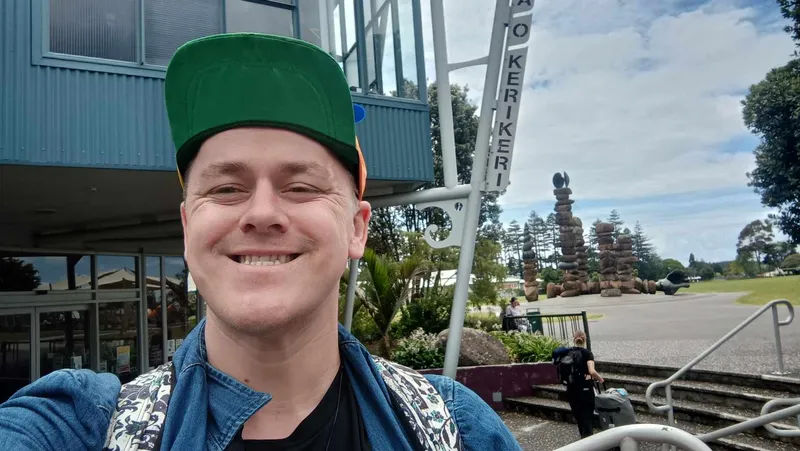
The bus has stopped in Kerikeri and we’ve all disembarked. This is as far as the nice double-decker buses will go. From here, Intercity has transferred us to a standard single-decker, much like the bus I rode from Invercargill to Dunedin.
Kerikeri really likes the helicopter hat. In the twenty minutes I spent there, I received three compliments on it.
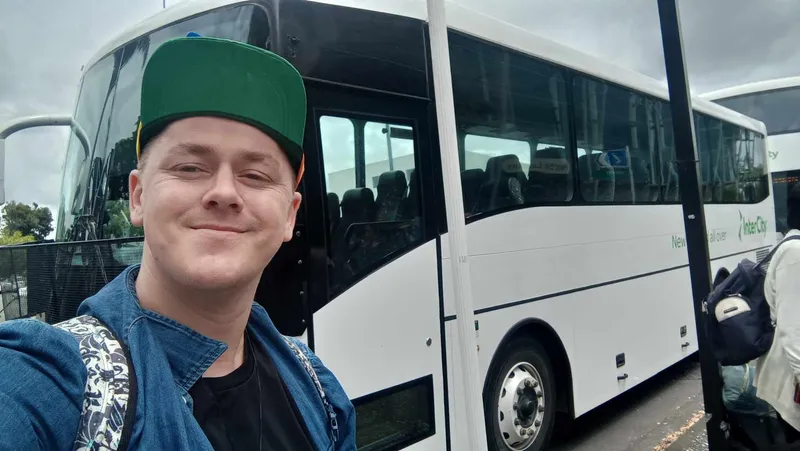
The end of the public transport network – Kaitaia KFC
I’ve arrived at the final stop on the final Intercity regional bus in New Zealand. 235 Commerce Street, Kaitaia, right outside the KFC.
My exact time of arrival was 3:01 pm on Sunday, November 10. It has been 151 hours and one minute since I boarded the ferry at Oban Wharf, Stewart Island.
I declare the Kaitaia KFC marks the end of New Zealand’s public transport network, and I have travelled the entire length of it from south to north.
A couple of caveats:
- The bus to Kaitaia loops back down from the coast, so the northernmost point I reached on my journey was 4554 State Highway 10, just outside Lake Ohia.
- There is technically one more bus that goes further than this. The Far North Link bus, run by the Northland Regional Council, can take you as far as Pukenui, 40km north of here. But it only runs once a week on Thursdays, which is probably not frequent enough to meet my definition of “public transport.”
After all that, this is how it ends. With a bottle of Lindauer outside a KFC.





The longest commute by the numbers
Start: Oban Wharf, Stewart Island, 8:00 am Monday, November 4.
Finish: 235 Commerce Street, Kaitaia, 3:01 pm Sunday, November 10.
Distance travelled: 2,069 kilometres.
Time in transit: 151 hours, one minute.
Time spent on public transport: 42.5 hours.
Public transport trips: 18.
Live updates: 126.
Selfies: 67.
Words: 15,935.
Trip Summary:
- RealNZ ferry from Oban to Bluff: $125
- RealNZ shuttle bus from Bluff to Invercargill: $30
- Intercity bus from Invercargill to Dunedin: $71
- Intercity bus from Dunedin to Christchurch: $66
- Lime scooter from Christchurch CBD to Christchurch Railway Station: $10.80
- Coastal Pacific train from Christchurch to Picton: $219
- Interislander ferry from Picton to Wellington: $67 (free upgrade to premium lounge)
- Shuttle bus from Interislander terminal to Wellington Railway Station: Free
- Metlink number 2 bus from Lambton Quay to my flat: $1.01
- Metlink number 2 bus from my flat to the Bucket Fountain: $2.02
- Metlink number 31x bus from the Bucket Fountain to Wellington Railway station: Free transfer
- Northern Explorer train from Wellington to Auckland: $249 (free upgrade to Scenic Plus carriage).
- Lime scooter from Parnell to Ponsonby: $11.78
- Lime scooter from Ponsonby to Sky Tower bus depot: $5.41
- Intercity bus from Auckland to Paihia: $60
- Waimarie ferry from Paihia to Russell: $17
- Blue Belle ferry from Russell to Paihia: Free return
- Intercity bus from Paihia to Kaitaia: $43
Final cost: $978.02
Joel MacManus
Joel MacManus is a senior writer for The Spinoff. He previously worked at RNZ and Stuff, and began his career at Critic Te Ārohi. His writing explores the political, economic and cultural systems that underpin modern New Zealand. He won the 2025 Voyager Media Award for Best Columnist, Opinion or Critique.


