Can you actually outsource your mental load? I desperately tried to

Composite image: The Spinoff
With the lofty promise of relieving a mother’s mental load, Rose Hirst trials two ‘family assistant’ apps.
I, like many people, carry a heavy weight. It whispers to me as I drift to sleep at night “Did you remember it’s mufti day at school tomorrow?”
It disrupts my most mundane and joyous moments alike. In the shower I’m reprimanded that the shampoo is less than 10% full and needs replenishing. While attending a wedding, I’m interrupted by a distant shriek, “your son’s passport needs renewing!”
The Sisyphean task of laundering my family’s clothes takes on a physical form in Mt Washmore, my affectionate name for the towering laundry baskets. To the untrained eye, it’s just a pile of washing requiring folding, sorting and putting away – but the crumpled sheets are also littered with hidden mental clutter.
“Those socks are getting holes in them, they’ll need replacing.” (Kmart trip?)
“These trousers are too small for our youngest.” (Donate to charity? Or pass on to a friend?)
The mental load, the behind-the-scenes cognitive work required to successfully run a household, isn’t exclusively felt by women, yet research shows that women in hetero-relationships carry a disproportionate share. These micro tasks may seem trivial, but when piled on top of one another, clamouring for attention and action, it can become overwhelming.
So imagine my intrigue when I began being targeted with ads for family assistant apps, making wild yet enticing claims like “the mental load, off your mind”.
These ambitious sounding promises were alluring to me – a life raft thrown to a woman drowing in admin. But the experts are not so sure. Leah Ruppanner, a professor of sociology at the University of Melbourne who researches the mental load, warned me that relying on an app may not be a silver bullet for an uncluttered mind. “The apps are going to take a sliver of your mental load,” she said. “You can hold the mental load, even if you’ve delegated the labour.”
But with a free trial offered, what did I have to lose?
Anna Family Assistant
First I try the Anna Family Assistant. It is not lost on me that this punchy palindrome is a female name. It seems that even when outsourcing our mental load to AI, we must pass it to a woman.
During the sign-up process, Anna asks for my phone number. I then get a text telling me Anna is sifting through my emails (which I’ve somewhat reluctantly given the app access to). Anna invites me to share what’s on my mind.
My son needs to bring a gold coin donation to school the following day, so to test Anna’s merits, instead of adding this to my Google calendar as I usually do, I tell the app. The next morning, I remember of my own accord, and realise that Anna never reminded me. Perturbed, I send a message: “You forgot to remind me about the gold coin.”
Anna “thinks” for several minutes before sending me a grovelling apology taking ownership and then congratulating me for remembering anyway. It’s nice, I suppose, to receive a morale boost from a non-sentient being about my own efficiency, but I start to suspect that I’m now managing Anna’s mental load as well as my own. This echoes what Ruppanner warned me about limitations when outsourcing your mental load to technology
“If you’re going to delegate this out to AI, it needs to be 100% right, because the minute something is forgotten, parents aren’t going to trust it,” she predicted. “You almost need foolproof AI, and we know AI is not foolproof.”
I have an automatic direct debit for our power bill, specifically so that I never have to think about it. Anna, however, places it firmly back in the front of my mind when it sends me a text at 2.18am letting me know the power bill is due.
To reassure myself, I revisit the website, where there are various examples of how Anna helps others.
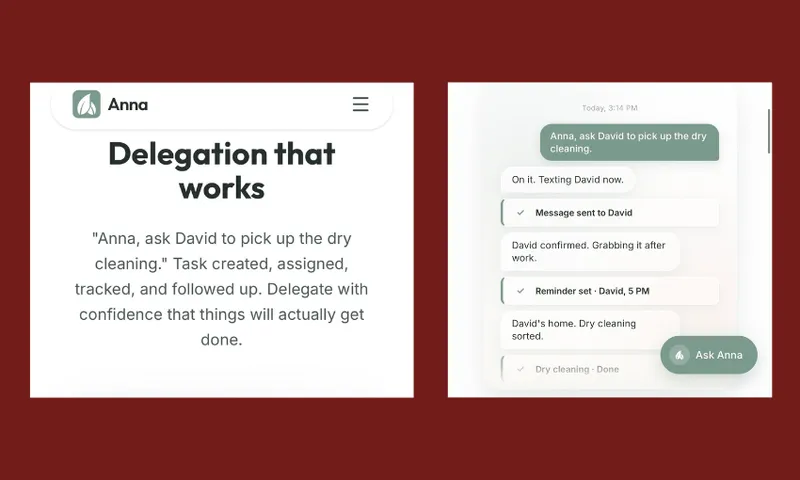
I stare at the screen wondering why the woman doesn’t simply text her husband? Are they not on speaking terms, yet somehow have shared custody of the dry cleaning? This (I presume) woman still had to remember that the dry cleaning exists, remember that it needs to be picked up, decide who will pick it up, and put that request into words. Why bother involving Anna at all?
Dr Ana Catalano Weeks, a political scientist who holds a PhD from Harvard University and researches gender and the mental load, agrees it’s an ironically admin-heavy process. “In order for technology to help, there has to be a process through which the thinking work you do to support family life is made visible to the app,” she said. “You have to write it down, tell it, forward emails, etc – otherwise how will it know what to keep track of? This adds a layer to your mental load work.”
Lumi
Lumi’s gender-neutral name and adorable cloud mascot boldly proclaims “Put the load down. Pick up your life.”
There’s a three-day free trial after which it’s $79 a year. The first thing I ask Lumi to do is remind me to cancel itself before my trial runs out. “Anna” lacked a way to link to my school/kindy apps, leaving me to manually extract the info and relay it.
Lumi claims to offer a solution: “Photograph the paper pile, Lumi files it”
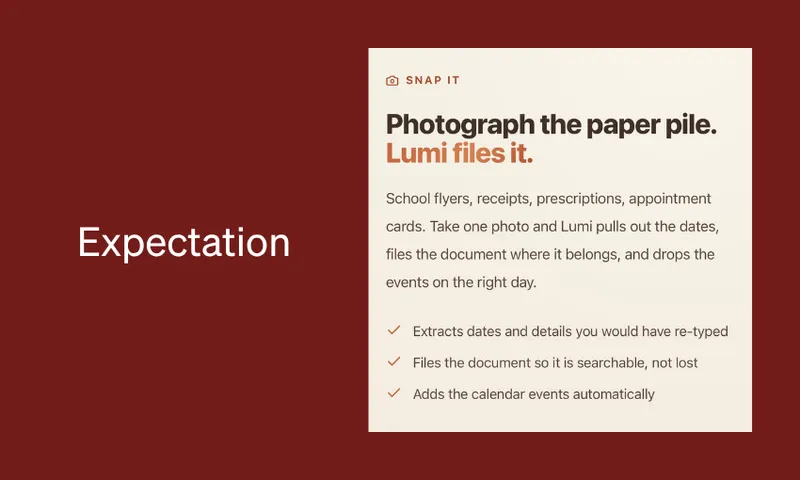
Buoyed by the prospect of pelting Lumi with screenshots of the copious reminders my childcare and school apps pepper me with, I search the app for the button to do this. Coming up short, I ask Lumi how to do it and am essentially told, “I can’t do that, go do it yourself.”
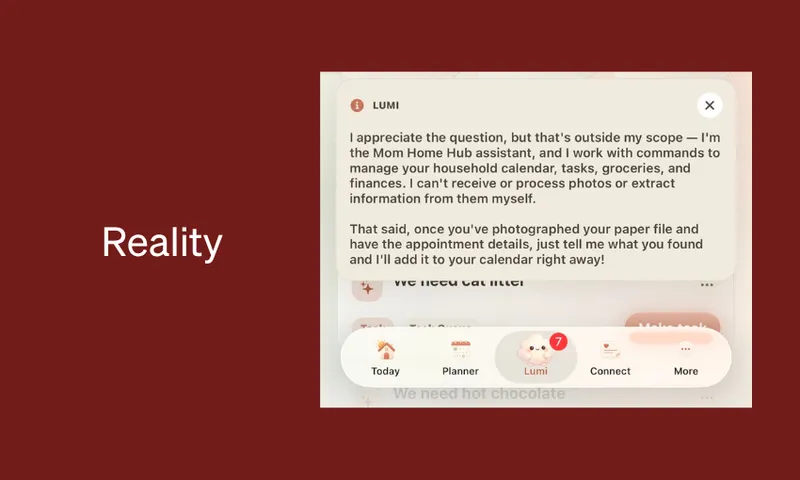
Perhaps Lumi can be helpful in other ways. My usual strategy for remembering what to replace at home is to write “milk” in my notes app to consult at the supermarket. Unfortunately, outsourcing this simple process to Lumi isn’t quicker or easier, quite the opposite.
I tell Lumi we need hot chocolate.
It adds hot chocolate to my “floating list” where the ball is left firmly in my court to turn it into a task, specify a due date and assign it to someone (me). When I ask Lumi why the hot chocolate isn’t on my “app shopping list”, it becomes… defensive? “I don’t have a record of you mentioning hot chocolate before this message, so I wasn’t able to add it. But I can do that now. Should I add hot chocolate powder, hot chocolate mix, or cocoa powder to your grocery list?”
I feel like I’m micromanaging a rather incompetent employee who requires an unreasonable amount of guidance for a very low-stakes task. It would’ve taken me three seconds to write “hot choc” in my notes app. Instead, I’m left discussing unnecessary cocoa categories with a robot.
Slightly chillingly, seemingly in an act of self-preservation, Lumi fails to remind me to cancel my three-day free trial. Maybe it’s smarter than I gave it credit for, just not in any way that’s helpful to me.
While I find the technology decidedly lacking, if the Lumi app could genuinely intercept and scan through school and kindergarten apps, distilling relevant information and adding it to my calendar, that would be helpful.
Verdict
Despite bold claims that this technology can dramatically reduce the mental load, invisible labour is fiendishly difficult to outsource, because setting a reminder and keeping notes and lists isn’t the whole picture. Much of the burden is noticing that you needed to make a reminder or list in the first place.
Weeks has a potential solution, or at least a new customer base. “Honestly, I think the technology should be targeted at men, who typically do less of the mental load. Women are doing it already without apps.”
There’s a space for it to be used as a tool for delegating tasks between couples where there’s an uneven split in household labour. Some apps do offer this service, and while it could help in theory, someone still needs to do the initial thinking and relaying of jobs in order for it to work (and no prizes for guessing who that person is more likely to be in a hetero relationship).
Perhaps for some couples, simply having a digital record of the sheer volume of tasks could help make the invisible jobs become visible, validating that work.
So would I use it again?
All signs point to no, but I’ve diarised a mental window to consider it, slotted neatly between appointments for ruminating about ordering a new gas bottle and settling on a baby shower gift idea.

Rose Hirst
Rose Hirst is a Christchurch-based mother and freelance writer who writes humorous observations about modern Kiwi life, nostalgia and the strange rules we all live by.


