Meet the man behind New Zealand’s largest hairdressing collection

Michael Turner and his collection. (Image: Alex Casey / additional design: Tina Tiller)
Alex Casey spends an entertaining and enlightening morning with Michael Turner, owner of the largest collection of hairdressing memorabilia in the Southern Hemisphere.
Michael Turner presents a delicate ivory cylinder to me like a magician pulling a rabbit out of a hat. It’s the same colour as his tremendous handlebar moustache, curled with the kind of confidence and panache that can only come with four decades dealing in hair. “This is what we call a hair safe,” he says. “When you brush your hair and take it all out of the hairbrush, you can store it in here.” I stare gingerly into the empty hair tomb. Why would you ever want to do that? “Braid it, curl it, turn it into a keepsake, a locket, a bracelet, a necklace – anything.”
A few metres away, from behind an original 1965 Helene Curtis conetop dyer, Eden from Ferrymead Heritage Park chips in with some additional historical context. “Women would often reuse the old hair to puff up and bulk out their own hairdo.” Turner snaps his fingers and points straight up at the air. “Of course Eden – the higher the hair, the closer to god.”
We are standing on the second storey of a Ferrymead warehouse and, despite my own pitifully flat mop, have ascended to hairdressing heaven. As hail pelts down on the roof and Westlife croons ‘Flying Without Wings’ from a nearby workshop, Turner takes me on a tour of his hairdressing memorabilia exhibit, the largest in the southern hemisphere. “The biggest collection in the north is in Barcelona, and [the owner] says he has over 5,000 pieces,” he says, smirking. “Well, I know I’ve got well over 2,500 pieces up there, and about as many at home.”
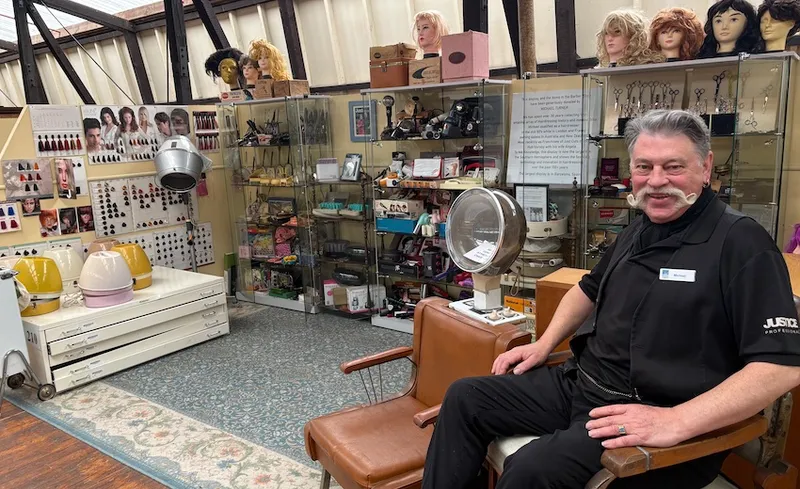
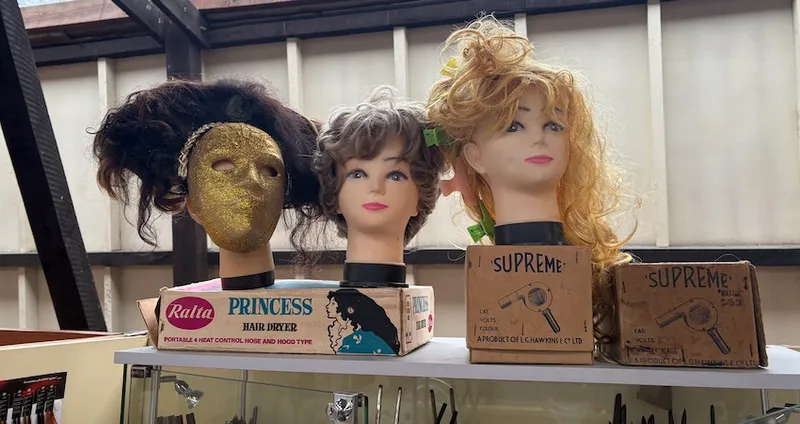
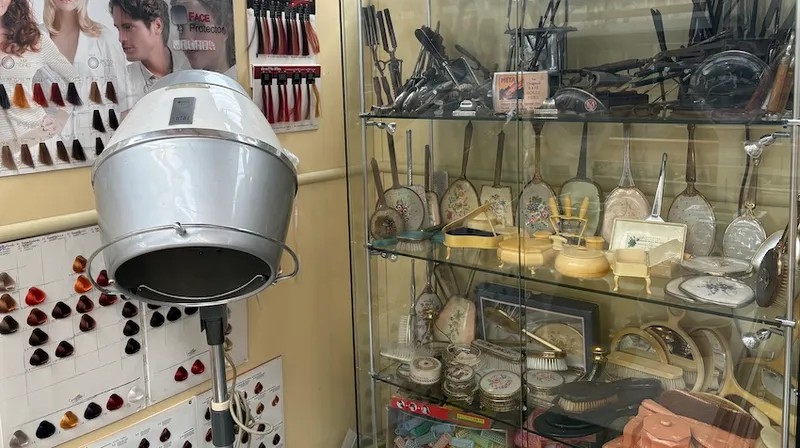
And what a collection it is. There’s a brood of pastel 1960s Ralta hairdryers, nested like eggs in a carton, backdropped by a technicolour array of hair dye swatches. Glass cabinets contain an array of ornate antique hand mirrors and brushes, along with 1800s hair curlers that look like medieval torture devices. Turner holds up what appears to be a pair of large wrought iron Grain Waves on the end of metal tongs, soon revealed to be 1820s flame-heated hair crimpers. “We actually haven’t changed much,” he says. “We’ve just moved from solid fuel to electrickery.”
In the shaving section, Turner pulls out a large silver shaving bowl, compete with chin rest, that contains a particularly shocking surprise rattling around within. “Oh there’s a tooth, sorry. We’ll get to that later.” I need answers now, and Eden pipes up again with some much-needed context: “The original barber shops were also bloodletters and dentists,” he explains. “That’s where the red, blue and white comes from on the striped poles – the red represents the blood, the white is dentistry, and the blue is hair.” Turner doesn’t miss a beat: “or those of us with blue blood.”
Reptilian or not, Turner has been collecting hairdressing memorabilia since he started his career as a 15-year-old in north London, following in the footsteps of his grandfather. From there he worked onboard the Queen Elizabeth II, before heading to Harper’s magazine and then to the south of France. There, he placed third in L’Oreal’s World Champion colourist competition in 1989, worked on a few French films, and had a memorable stint as a hair stylist with Cirque du Soleil. “Freaky styles and freaky colours, sex and drugs and rock and roll, honey,” he says.
He then moved to Western Australia, which is where he met his wife Angela – “my goddess, my queen, my love” – and levelled up his collection by salvaging old pieces of equipment from the salon bin. “My boss would be saying, ‘well, that’s broken, let’s throw it away’ and I’d be saying ‘but it’s pretty, let’s cut the electric cord off, stick it in a box, and the kids can play with it as a toy’.” His boss didn’t agree. “And so I thought I better start saving everything myself.”
During this time Turner was also the director of the International Hairdressing Society, and did a lot of stage work which involved using formaldehyde for hair straightening. “It works bloody brilliantly, but I was sniffing it in for over two years which unfortunately led to my nose becoming very difficult to manage.” Turner soon had chronic sinusitis, polyps, and needed multiple surgeries. “That’s why you’ve got health and safety standards today when it comes to ironing hair and using different products,” he says.
Turner ended up in Christchurch following the 2011 earthquake to help out Angela’s daughter and children. His memorabilia collection came with him, but he had to leave parts of his hairdressing career behind in Australia. “By the time I arrived here, I couldn’t do full service anymore – no bleaches, no colours, because it all just hurt my nose too much.” He found a new job at Just Cuts, and relished the quick client turnover. “I like the change. I like the rapid movement, I like to be entertained and I like to entertain. I basically get 20 minutes to show off.”
And when he wasn’t working on his tight five at Just Cuts, Turner was still adding to his collection. “Over the last 10 years, I’ve really focussed on finding stuff that’s physically from families here in Canterbury,” he says. “Things that may have been made overseas, but owned by somebody here.” Scouring Woolston antique shops, Riccarton markets and accepting local donations, Turner’s collection soon began to outgrow their garage. “One day Angela said to me: ‘what are you going to do with it all?’ and that’s when I started to think about donating it.”
Just six months later, that collection is now available to view every Sunday at Ferrymead Heritage Society. “This is local history which has to be shared,” Turner says. “People always come through all excited saying ‘I had one of these in the house. I had one of those in the house,’ and it’s just great.” And even though hair might seem a frivolous subject for a museum, Turner says the collection is of “exceedingly important” social significance. “We have to learn about where we have come from to work out where we’re going,” he says.
And where I’m going is off home, to crack open my hair safe and start saving up my strands.
Alex Casey
Alex Casey is a senior writer at The Spinoff with over a decade of experience writing about popular culture and social issues in Aotearoa. She lives in Ōtautahi and likes watching reality TV and walking the dog, occasionally at the same time.


