Pacific profiles: Tōtara Hospice and the importance of culturally relevant care

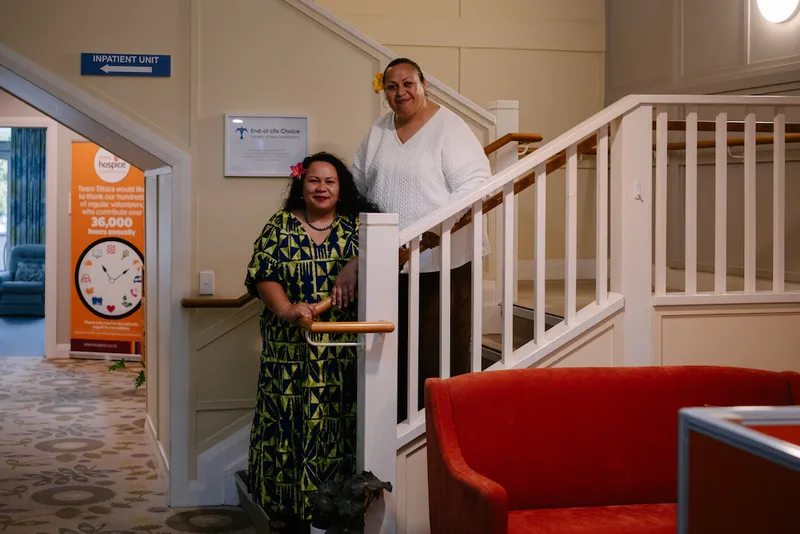
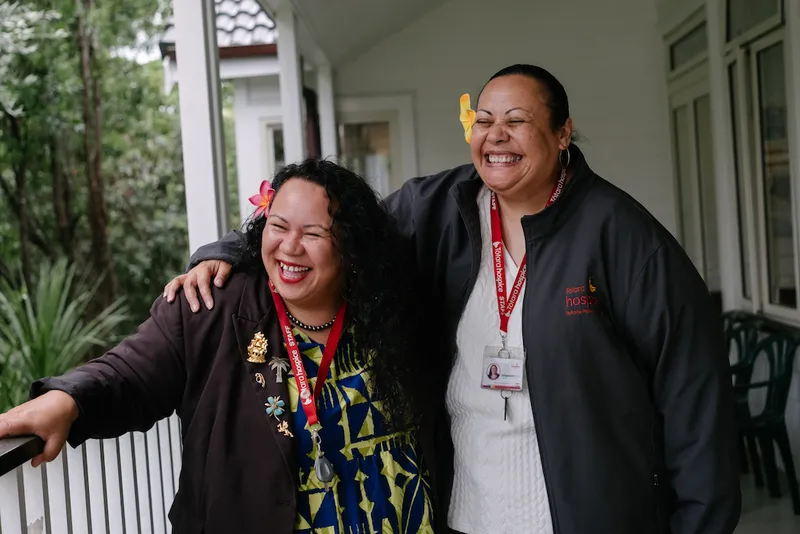
Tōtara Hospice’s Marleen Tuigamala and Genevieve Simati (Photo: Geoffery Matautia)
Made with the support of

The Pacific profiles series shines a light on Pacific people in Aotearoa doing interesting and important work in their communities, as nominated by members of the public. Today, we meet Genevieve Simati and Marleen Tuigamala, staff members at South Auckland’s Tōtara Hospice.
All photos by Geoffery Matautia.
Since 1981, Tōtara Hospice has been South Auckland’s leading palliative care provider, offering free, holistic care for terminally ill patients and their families. I spoke with two of their staff members – Genevieve Simati and Marleen Tuigamala – about the importance of culturally relevant care for their patients, what myths they want to dispel about hospice care, and finding joy in the dark times.
Hello! Please introduce yourselves.
Genevieve: Talofa, I’m Genevieve. Both my parents are from Samoa, and they came to New Zealand in 1970. I’m a first-generation New Zealand-born Samoan from the villages of Vaie’e, Faleasi’u, Safotu and Manono. I’m the Pacific Cultural Liaison at Tōtara Hospice, and have worked here for three years.
Marleen: Kia ora Im Marleen, I’m from the Cook Islands, Palmerston, Penrhyn, Manihiki and Mitiaro. I sit in a leadership role that oversees two teams, one is education and advocating for Pacific people in primary care, and the other team is supporting our cultural and spiritual team, which also means I get to work with wonderful people like Genevieve. I value my mahi working with Pacific people and its also important to recognise tangata whenua and tiriti o Waitangi.
What called you both into palliative care work?
Genevieve: I’m now in the same position Marleen once held – and I truly love it. After my husband Tala died, I felt called to work in a role that supports families on their journey. Marleen inspired me when she introduced hospice care to my family during Tala’s illness, and that experience shaped the path I’m on today.
Marleen: I’ve also had personal experiences in the hospice sector, and I saw how, as a family, we were able to uphold our Pacific values in caring for our loved ones in those last days. I wanted other Pacific families to experience what we had. My previous work in the health sector was focused on primary care prevention and management, but I wanted to dedicate my time to this part of the life cycle. I want our Pacific families to feel safe in this space, and to normalise our cultural ways of knowing, being and doing.
What’s the genesis of Tōtara Hospice?
Marleen: Tōtara Hospice began 44 years ago, when a group of women from the local church began caring for their sick members. Those women happened to be nurses, and they’d go and look after members in their final days. They saw the need for palliative care work in their community and sold flower arrangements to secure a mortgage and purchase a building. It started as a volunteer-based organisation and has grown into a charitable organisation with over 100 staff and nearly 500 volunteers. We serve the largest Pacific community in New Zealand. We get 50% of our funding from the government, and the other 50% from our shops. This keeps us at no cost to families.
So much of your work involves providing culturally responsive palliative care to families. What does that look like on a day-to-day basis?
Genevieve: For many Pacific patients, healthcare feels clinical and rushed. At hospice, we do things differently – we take time to know them and their families, their values, and how they make decisions. Families are often surprised because no one has asked before.
When we visit, we listen first. That makes families feel seen and heard. Every family is unique, so we provide patient- and carer-centred care in culturally appropriate ways – like our Pasifika Talanoa every Friday, where families can share openly and be themselves.
Marleen: If you come to one of our talanoa, it’s like a party in full swing. There are deep emotions, but it’s also a time for them to enjoy their company, learn something, and not think about being sick. We also have an intergenerational focus to our work. So at our talanoa sessions, there can be three generations in attendance. It’s a collective model as everyone has a role in caring for someone. We’re patient directed and aiga (family) centred.
There are many misconceptions about hospice care – what’s something you’d like people to know about your work, or a myth you’d like to dispel?
Genevieve: There are many misconceptions about hospice – that it’s a rest home, only for pālagi, or simply a place where people come to die. When we introduce our services, we often hear questions like, “Are you going to take my nana? Will she have to live in hospice?” The truth is, hospice isn’t a rest home. We provide episodic care – someone might come in for pain management and then return home.
Ultimately, people choose where they want to be. Some come here for end-of-life care, others stay at home. Our goal is simple: to make life better for people who are dying and help them find joy. Our Zumba Gold class, for example, is loud, vibrant and full of life!
I keep a note on my laptop from a mother whose daughter was a patient here. It says, “Hospice is not about dying, it’s about living.” That’s the message we want to multiply throughout the community.
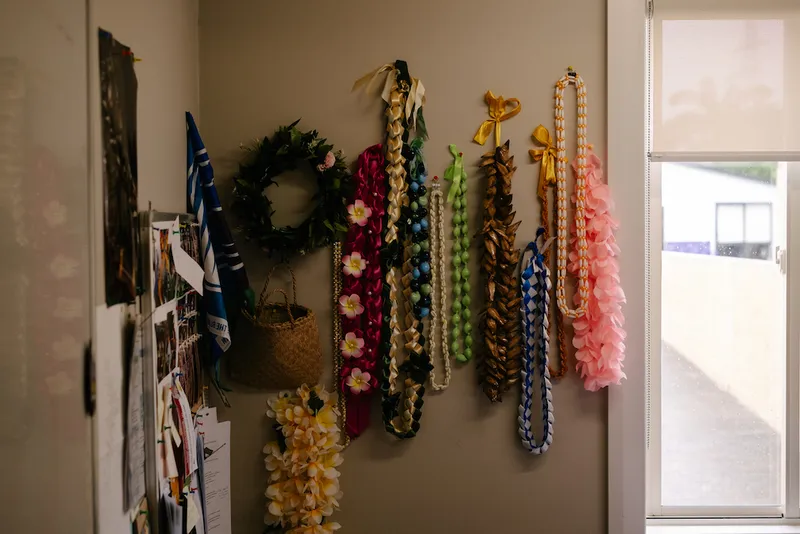
Marleen: We look after 320 people in the community. There’s no charge for our service. That’s a huge access point for our Pacific families. We let families know that our focus is on being together and improving their quality of life. We might find holiday homes for them to have special memories and to do bucket-list activities. We also run Pacific pamper days where patients receive free haircuts, nails, clothes – it’s all about taking care of each other.
How can people support your work to ensure your service remains free for families?
Marleen: We have to fundraise $8.5 million a year to keep operating at no cost. We rely on donations, fundraisers, and sponsorship. Every dollar counts. With our retail stores, 100 per cent of the proceeds go back into our services. From my perspective, the whole life cycle deserves quality care and adequate funding.
Genevieve: We were part of a TV series called Hospice Heroes, which showed all the different areas we work in. In the series, you see that we can’t do what we do without our volunteers. Everyone has a way of giving. We have floral art volunteers who provide their own flowers and make arrangements and place them around the hospice to make the place look lovely. We have hairdressers who volunteer their time. If you want to give, just reach out. We can always find something for your skills or availability. People don’t have to give money; you can give your skills or your time.
What part of your work do you take the most pride and joy in?
Genevieve: I love that I can put my lived experience into a role that helps people. I love leaving someone’s home knowing I can connect them with a service that they might not have known about. It’s a privilege to serve in this way.
Marleen: This has been the most meaningful work. I feel really encouraged that we’re also trying to make a difference for our community and bring our ways into a Western healthcare system. I once asked my Aunty, who has worked in the health sector and in community for many of her professional years, what we did back in the Cook Islands when someone in our family was dying. She described it as: bringing someone their favourite foods, offering massage, feeding soft foods, singing, fanning or prayers and offering coconut water on the end of a wet cloth when swallowing became difficult. In our work this is what we call “comfort care”, but it’s something that Pacific peoples have also done for hundreds of years.
Genevieve: When patients don’t need our specialist care anymore, they are transferred back to their GP, but some of them don’t want to leave! That speaks volumes about the level of care they receive with us.
This is Public Interest Journalism funded by NZ On Air.

Litia Tuiburelevu
Litia Tuiburelevu is a professional teaching fellow at the University of Auckland’s Faculty of Law, overseeing the Pacific law students’ academic programme. She teaches an elective course titled “Pacific Peoples and the Law: Critical Perspectives” and is also interested in film and photography.


