


A million plus viewers. Millions in losses. Players heading offshore and billionaires at the door. What the hell is going on with professional netball?
Is netball broken?
Short answer: no. And yes. The sport isn’t broken, the business model is.
Netball in Aotearoa is enormous: more than 300,000 people participate every year. Netball New Zealand (NNZ) is its kaitiaki, responsible for everything from grassroots participation and pathways to high performance and the Silver Ferns. It has already survived the small matter of Silver Ferns coach Dame Noeline Taurua’s dramatic 51-day suspension, leadership resignations, governance chaos and a fractured international season that somehow ended with Commonwealth Games gold. But that’s another explainer.
Today’s crisis is money. Somehow NNZ, a sports organisation, not a broadcaster, has found itself underwriting a professional television product: the ANZ Premiership.
Hang on. If netball is enormous, why is there a money crisis?
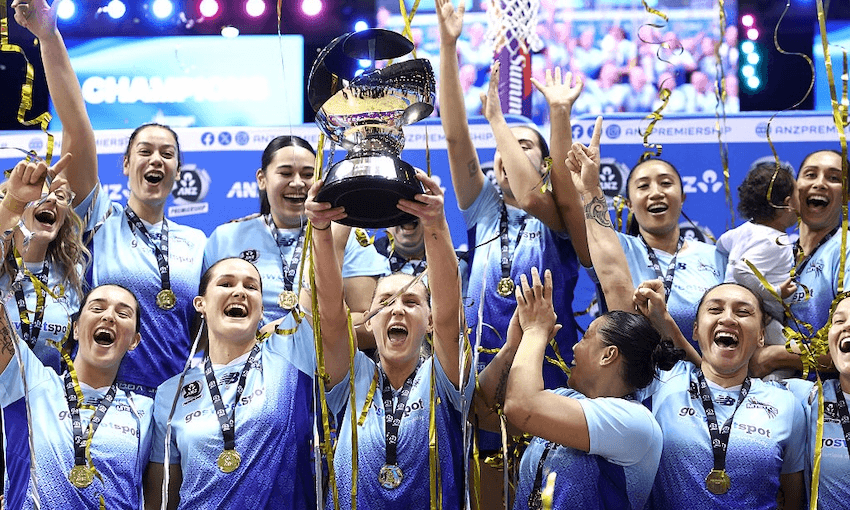
For years, Sky held the ANZ Premiership broadcast rights. Then the broadcast market changed and TVNZ took it on, making the competition free-to-air. And, funny that: when you make women’s sport accessible, people watch. The 2026 ANZ Premiership attracted 1.05 million unique linear-TV viewers, up 16% on 2025 and 64% on 2024. Even more watched on TVNZ+, and tens of thousands of fans showed up to the games.
The catch? TVNZ’s rights agreement did not include traditional broadcasting fees or production funding, meaning Netball NZ had to produce the ANZ Premiership themselves. And television is bloody expensive to produce. NNZ is estimated to be paying between $600,000 and $700,000 to get the competition on air. It was originally thought the free-to-air larger audience reach would bring in bigger sponsors, but that hasn’t eventuated … yet.
The ANZ Premiership is forecast to lose about $3.7 million in 2026, while Netball NZ’s overall deficit could reach $6m.
In short, free-to-air has solved an accessibility problem. It hasn’t solved the commercial one.
Maybe the athletes should just play for the love of it?
Sure. And the All Blacks can be paid with a pat on the back and a new tracksuit. We expect professional athletes to eat, sleep and train like professionals. They deserve to be paid like professionals too. ANZ Premiership players have already taken a 20% pay cut this season, and there’s no guarantee there will even be an elite domestic competition in 2027. Options raised include putting the Premiership on ice or returning to amateurism.
If New Zealand can’t offer elite netballers professional opportunities, someone else will.
So everyone’s buggering off to Australia?
Not everyone. But upwards of 15 players are reportedly heading offshore for 2027, most across the Tasman. Ameliaranne Ekenasio and Maddy Gordon are heading to West Coast Fever, while Saviour Tui is off to Wales.
Australia can offer money, certainty and elite competition. But playing the best can also make our players better. Maybe we should stop thinking about overseas leagues as the enemy. Cricket already allows players like White Ferns captain Melie Kerr to compete around the world and come home to play domestically. Could netball do the same?
Sure, but what would even be left to play domestically?
Enter entrepreneur Anna Mowbray, former All Black Ali Williams, and two words capable of making sports administrators simultaneously excited and nervous: private capital. Mowbray and Williams have proposed taking over the licence to operate New Zealand’s elite domestic competition, one of several options being considered by NNZ.
They already have skin in professional sport through their stake in A-League club Auckland FC, which has quickly built a successful team and passionate fan base. Plus, netball has one big advantage. Auckland FC had to build a club and then build a community around it. Netball already has the community.
Why would anyone invest in a competition losing $3.7m?
Because netball is enormous! They wouldn’t necessarily be investing in today’s loss, they’d be investing in what the product could become. More than a million viewers. Hundreds of thousands of participants. Established teams. Existing fans.
That means potential revenue from sponsorship, broadcast rights, tickets, merchandise and commercial partnerships. Netball could get capital, commercial expertise, marketing, better events and better-paid athletes. NNZ could get relief from bankrolling the professional competition.
Commercialisation doesn’t have to mean selling the game. It could mean finding a sustainable way to pay for the professional version of it.
So we just sell netball to billionaires?
Steady on. Private investment doesn’t have to mean handing the keys to the person with the biggest cheque. NNZ can remain kaitiaki of the game without being the sole financier of professional netball.
A future model could include hybrid ownership, an NNZ stake or even community involvement, with safeguards around player welfare, sporting independence and pathways. A salary cap and floor could also stop one billionaire creating Real Madrid Netball while everyone else fields three university students and somebody’s auntie.
Personally, would I pay $250 to own a tiny piece of the Central Pulse? Take my money!
The audience exists. The players exist. The community absolutely exists. Who will get into position?