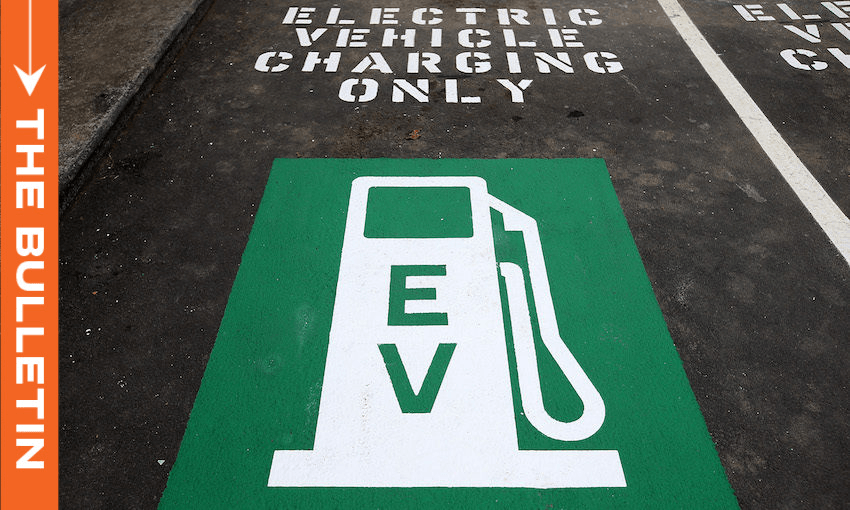

Fear of missing out on cheaper running costs has sent EV registrations soaring four-fold – and now dealers are selling cars that haven’t even left Japan, writes Catherine McGregor in today’s excerpt from The Bulletin.
To receive The Bulletin in full each weekday, sign up here.
The great EV rush
New Zealand’s fuel crisis has triggered an EV buying surge not seen since the clean car discount era. As RNZ’s Kate Newton reports, monthly registrations of full battery EVs jumped nearly four-fold in March, from an average of 800 a month to 3,100. EV dealer Hayden Johnston described the mood as pure fomo: buyers had gone from carefully researching models to “What EVs have you got? OK, we’ll buy it.” When RNZ spoke to Johnston last week, his company had sold through its existing cars, sold the consignment that arrived the previous week, and was now selling stock still on its way, not due in New Zealand until May or later given shipping constraints.
Driven Car Guide editor David Linklater, whose headline “So you want to panic-buy an EV?” sums up the situation pretty nicely, urges prospective buyers to do the sums before rushing in: for average drivers, the fuel crisis may add an extra $20 or so to their weekly fuel bill, while buying an EV means thousands in upfront capital costs.
A challenge to hybrid dominance
For years, hybrids have been New Zealand’s dominant low-emissions option thanks to their cheaper upfront cost, petrol-backed familiarity and freedom from range anxiety. Writing in The Press (paywalled), Blayne Slabbert says the fuel shock is testing that loyalty, with pure EV registrations up 174% between the first and last weeks of March. But hybrids haven’t surrendered the field. They carry lower road user charges than EVs, and Drive Electric chair Kirsten Corson notes that “the upfront cost is still the biggest barrier” to full EV adoption.
Yet the hybrid’s core compromise – it still runs on petrol – is exactly the problem the past few weeks have highlighted, Slabbert writes. That compromise leaves New Zealand “exposed to the global fuel shocks now hitting motorists at the pump – not just for the current crisis, but for years to come if today’s new vehicles remain in the fleet for a decade or more”.
The EV-hybrid price gap is also narrowing, thanks to the influx of cheaper Chinese EV brands: BYD’s Atto 1 starts at $30,000, for example, below a Toyota Corolla Hatch GX Hybrid at just under $38,000.
The psychic labour of EV ownership
For those already driving EVs, the crisis has brought quiet vindication – with a few caveats. Writing in The Spinoff, Henry Oliver charts seven years with a Nissan Leaf, from the early days when he rarely queued for a charger, through a disastrous road trip to Ohakune where, after cascading failures at charging stops, he arrived “hours late, driving slowly through the dark to conserve what little battery remained”.
“Planning a long drive in an EV is a special kind of psychic labour,” he writes. “You begin with a map of charging stations, like a medieval pilgrim plotting monasteries.” Battery degradation eventually cut his range to 60km, before a $4,000 second-hand battery replacement brought it back to a higher range than the car had when new. Now, as petrol approaches $4 a litre, his Leaf “feels like a modest form of independence, even if only in increments of 145km”.
More chargers, but will they be enough?
Oliver’s chronic range anxiety points to the greatest structural obstacle to widespread EV uptake: a lack of public chargers, in some areas at least. The government has announced a $50 million interest-free loan scheme for ChargeNet and Meridian Energy, which will invest a further $60 million to lift the national network from 1,800 to around 4,500 charge points – still less than halfway to the government’s target of 10,000 chargers by 2030.
Writing in The Conversation, the University of Auckland’s Mingyue Selena Sheng welcomes the scheme but argues loans alone won’t be enough. They lower upfront costs without removing providers’ underlying risk in low-demand areas, and do nothing to address when or how drivers charge, which can strain electricity networks. What’s needed, Sheng argues, is a “system-wide approach”: infrastructure investment combined with time-of-use pricing, coordinated planning across central and local government, and incentives that shape driver behaviour – not just more chargers, but smarter deployment of them.