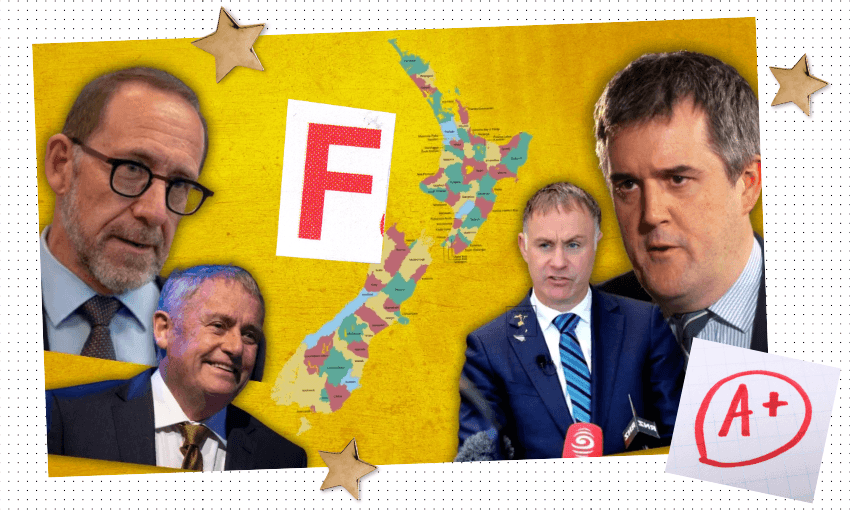



The government’s economic turnaround job is increasingly looking like magical thinking, writes Joel MacManus.
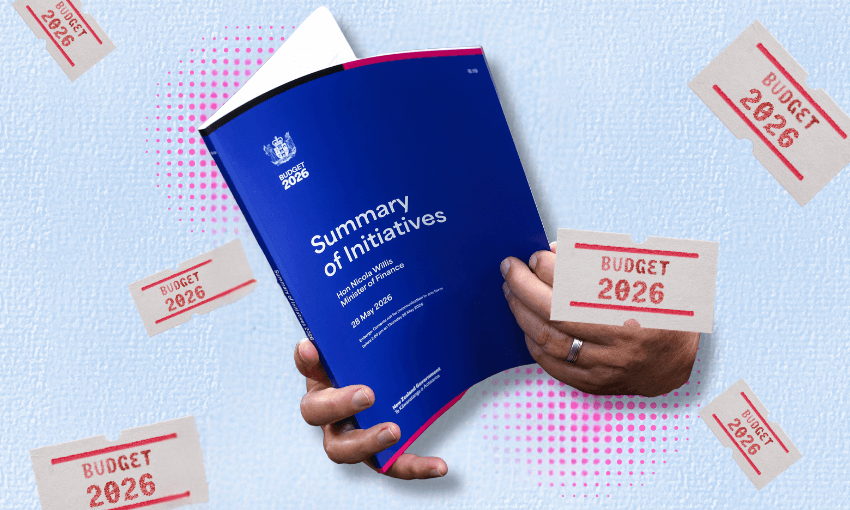
Tucked away on one of the back pages of the fiscal strategy report in Budget 2026, there’s a single graph that may explain the economic situation this government faces.
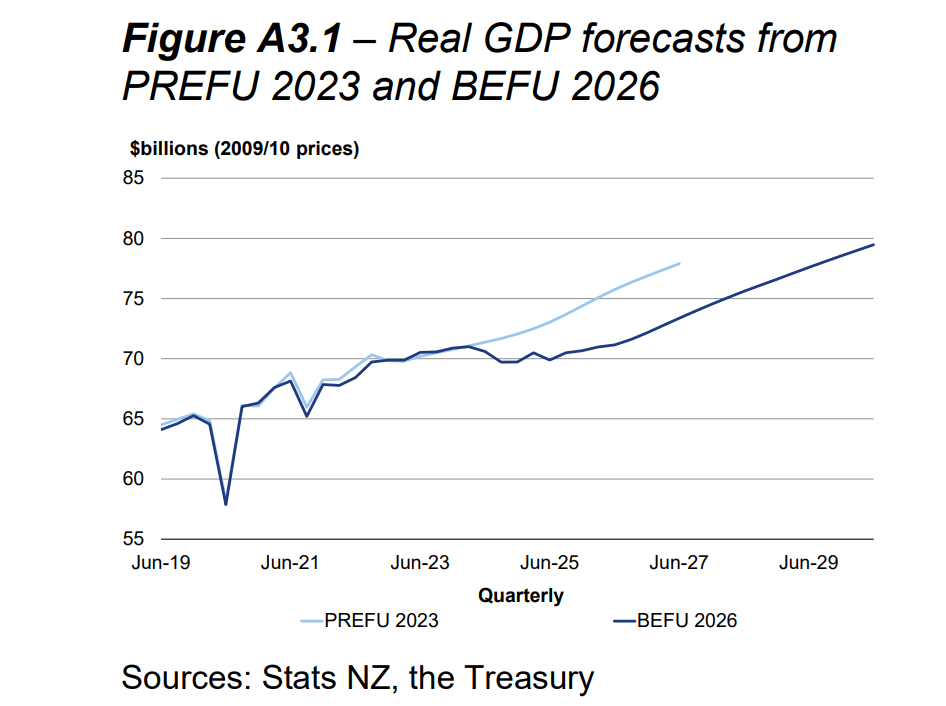
The light blue line shows the GDP growth Treasury predicted in 2023. The dark blue line shows what actually happened. Rather than shooting upwards after the coalition government came into power, the economy has meandered along listlessly with no sign of progress. Conveniently, the forecasts now show that the long-awaited economic boom is just around the next corner. Tomorrow, tomorrow, tomorrow.
The good people of the Treasury are a bunch of big-brained quants who know as much about the economy as anyone in the country, but they’ll be the first to admit that economics is just a big guessing game. It’s astrology with spreadsheets.
The opening pages of Budget 2026 contain a series of warnings about everything that is going wrong or could go wrong in the near future: the conflict in the Middle East, the price of oil, inflation, global trade disruption and rising interest rates.
The government’s total net worth is down and core Crown debt is up. Aggregate growth is slower, household spending is weaker, the property market is “soft”, and the percentage of children living in “material hardship” is at 14.3%, up 0.8%.
It doesn’t help that the government has significantly less money to spend. There has been a $1.6bn reduction in revenue from tobacco excise after the government slashed the excise rate on vapes by 50%. Debt is still higher than fiscal conservatives would like, and the growth-focused investment that progressives desire is barely existent.
And yet, the pages of Budget 2026 are awash with optimistic projections of a better future. The government promises that costs will come down, unemployment will drop, inflation will drop, Crown debt will drop and the economy will boom… all at some ever-changing point in the future. “Of course, numbers can always change,” finance minister Nicola Willis acknowledged in her speech inside the budget lockup.
Through cuts to public service, social housing subsidies and the university fees-free scheme, Willis has funded a few populist perks which may play well ahead of the election. There is the previously-announced extra $50 per week tax credit for some low-income families, a big boost in healthcare spending, and a $1.8bn expressway extension in Waikato. (For a full breakdown of Budget 2026, read Lyric Wairiri-Smith’s story here).
The budget contains $7bn in new capital investments, but these are more of a catch-up effort than an economic stimulus package. A new tower block at Whangārei Hospital, new courthouses in Rotorua, and new police stations in Greymouth and Whanganui are all much-needed but hardly represent a fiscal strategy that drives growth in frontier industries.
The government has essentially boxed itself into a corner, restricted by National’s ideological debt-to-revenue targets and the dual handbrakes of Act and New Zealand First (once again, there are no cuts to the Ministry of Foreign Affairs and Trade, whose minister happens to be NZ First leader Winston Peters, while the rest of the public service has seen almost $2bn slashed). There is none of the serious tax reform or Think Big-style initiatives that one might expect from government trying to break the country out of a long malaise. It just doesn’t vibe like an election year budget.
Willis and prime minister Christopher Luxon have often referred to their economic strategy as a “turnaround job”. But rather than grabbing the wheel and steering in a clear direction, this budget looks more like they’re just shuffling the deck chairs around on a drifting Interislander ferry while they cross their fingers and hope that the storm will pass.
And in fairness, that could still happen. Economic cycles don’t last forever. Eventually, things will probably turn around – or at least revert to the mean – whether driven by government initiatives or just the power of time. It’s just that the time keeps changing. Plus, the books are now forecast to return to surplus a year earlier than expected when Treasury published forecasts last December.
“This budget is not just about the numbers, it’s about you and your future,” Willis told media inside the lockup. The question is: does the public believe her predictions?