Atarangi Anderson wants aute to be more than a museum piece

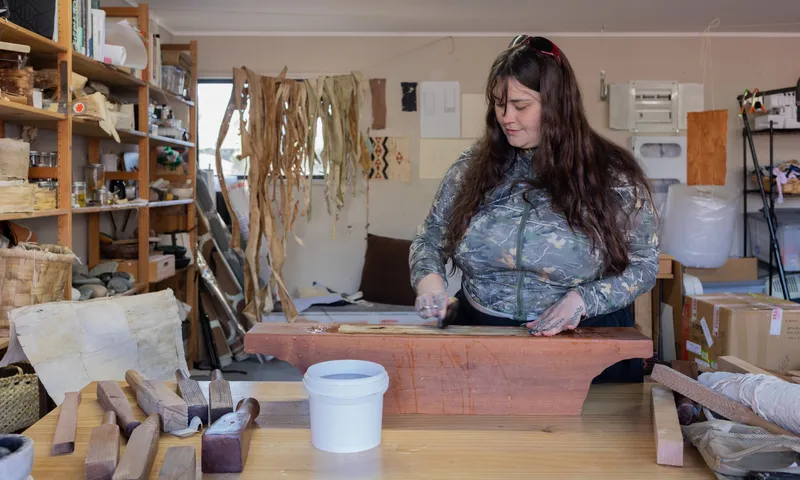
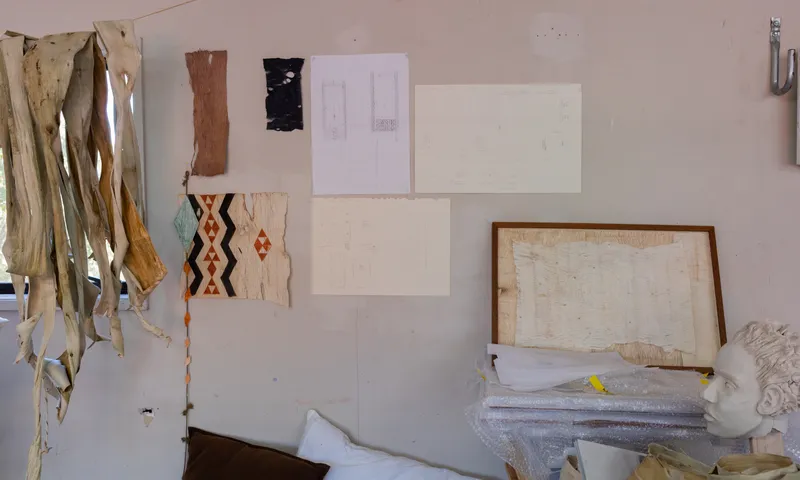
Atarangi Anderson in her Grey Lynn studio, where she's pushing the boundaries of aute, an ancestral Māori art form with a contemporary future.
The Māori artist is pushing the boundaries of traditional barkcloth, creating works that have travelled from Auckland to Seoul. But her ambitions for aute extend far beyond the gallery walls.
All photos by Chevron Hassett.
Atarangi Anderson is one of the country’s most exciting contemporary artists. Working with aute, or Māori barkcloth, she is at the forefront of a growing generation of artists pushing the boundaries of how we understand the practice and its potential within contemporary art and culture.
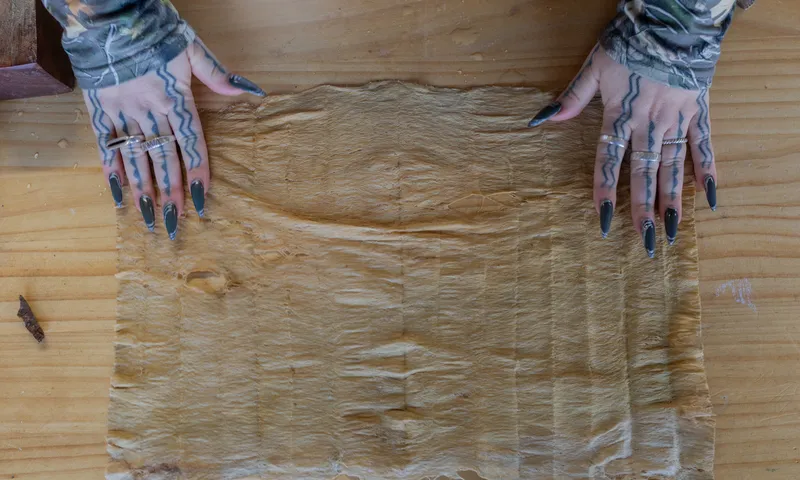
Anderson’s works range from intimate pieces to large-scale forms that occupy and transcend space. Atarangi grows, harvests and prepares her own aute, working with the material from its beginnings through to the marks she lays on, within and behind its surface.
She's been on a tear recently, presenting work in two exhibitions: Mau Āhua at Grace Aotearoa in Auckland and Vanilla at Caption Gallery in Seoul, South Korea.
With the rhythmic beating of her patu aute echoing from her Grey Lynn studio, we sat down with Atarangi to talk about her practice, the importance of aute, and how she continues to stretch the possibilities of the material.
Kia ora Atarangi, tell us a little bit about yourself and your art practice?
Kia ora, ko Atarangi Anderson tōku ingoa. He uri ahau nō Te Aitanga-a-Hauiti me Ngāti Hauiti. I'm a Māori artist who works primarily with aute, or paper mulberry barkcloth. My practice sits within the reclamation, research and remembering of kiriaute as a living material practice.
A lot of my mahi is concerned with the relationship between onamata and anamata. Onamata refers to the eyes of those who have come before us and anamata refers to the eyes of those who come after us. In essence, I'm interested in the past and future, and how we might bring these two spaces into conversation through material.
I'm also interested in the whakapapa of aute, not just as a textile, but as a material that has held our histories, pūrākau, bodies, atua and understandings of the world. Through my practice, I'm exploring how aute can continue to exist and evolve within contemporary Māori life, rather than being understood solely as something belonging to the past.
Do you see your mahi as an art practice? Cultural practice? Or something in between?
I don't necessarily see a separation between the two. I think the distinction between art and cultural practice is something that has largely been constructed through Western ways of categorising and understanding objects. For me, aute is inherently cultural.
The process of growing, harvesting, preparing and working with the material is deeply connected to mātauranga Māori, whakapapa and tikanga. But it is also a space for artistic exploration, experimentation and expression. I don't think something has to remain unchanged to retain its cultural integrity. In fact, I think the ability for a practice to evolve is part of what keeps it alive.
I'm not particularly interested in preserving aute as a static tradition. I'm interested in participating in its continuation. For example, how do we use it now within births and tangihanga, and how does it live with us today?
What was your first connection with aute?
Growing up, aute wasn't something I saw being made around me. But as a young child, my nana Rangituhia would recount stories of her youth, whānau names, her mother and her mother's mother. Within these names of my tīpuna, Nanny held the names of aute and their pūrākau. Nanny Te Pora had a weaving shed in Ūawa, where aute once grew along the Ūawa River. These pūrākau and names of aute have been remembered in my whānau.
It wasn't until 2016, when I was living with Nikau Hindin, that I saw how aute was made. I also saw Rosanna Raymond's Backhand Maiden dress made of tapa, and I knew I had to do this practice. Through my research, I began uncovering more stories. In 2020, I travelled to Sāmoa to learn the process of making aute. I've been interested in tracing these fragments of knowledge and understanding what they tell us about the material's presence in our communities.
What keeps drawing you back to aute?
I think it's the endless possibilities. Aute has this incredible ability to exist in so many different states. It begins as a living tree, becomes bark, then fibre, then cloth, and eventually kahu aute, something that wraps around and guides our wairua through life's biggest transitions.
You can be conceived on aute, born and birthed on aute, and when we die, we are then wrapped in aute, which navigates not our physical form, but our wairua into the safekeeping of Hinenuitepō. There's something really beautiful about that transformation.
I'm fascinated by the relationship between aute and the human body. Aute has this extraordinary ability to hold both the physical and metaphysical. When these works are shown in a gallery space, they cannot be divorced or removed from their whakapapa. Exhibiting work allows a place for these expressions to be witnessed and connected with by many people before they go on to live with another whānau.
There seems to be a growing generation of contemporary artists working with aute. Do you feel part of a wider movement or conversation happening right now?
Yeah, I think we're witnessing a really exciting moment in the contemporary life of aute. What interests me is that we're not all approaching aute in the same way. There are different relationships, different whakapapa, different processes and different ideas emerging. I think that's really important.
Sometimes, when we talk about revitalisation and remembering, there's an expectation that there should be one correct way of doing something, or one lineage through which knowledge must pass. But historically, aute existed across the Pacific in incredibly diverse forms, and we had our own distinct relationships with aute and the practice.
I can't wait to see what differences continue to grow. I think a healthy cultural practice should have room for many voices, many approaches and even disagreement. That's how knowledge continues to develop.
When you work with a material that carries such cultural history, how do you find space to experiment, play, or even break the rules?
I think experimentation is part of tradition. Sometimes we speak about ancestral knowledge as though our tūpuna were simply repeating what had been done before them, but they were innovators, researchers, artists and makers themselves. The practices we inherit exist because generations of people experimented with materials, developed techniques and responded to the environments around them.
For example, when we arrived here on waka, we didn't arrive in korowai. We came in the clothing and fashions of the times and places, which was tapa. It was through experimentation and trial and error that we found muka and shifted to the invention of looming practices, while still retaining some memory and visual language.
What is your process for making aute?
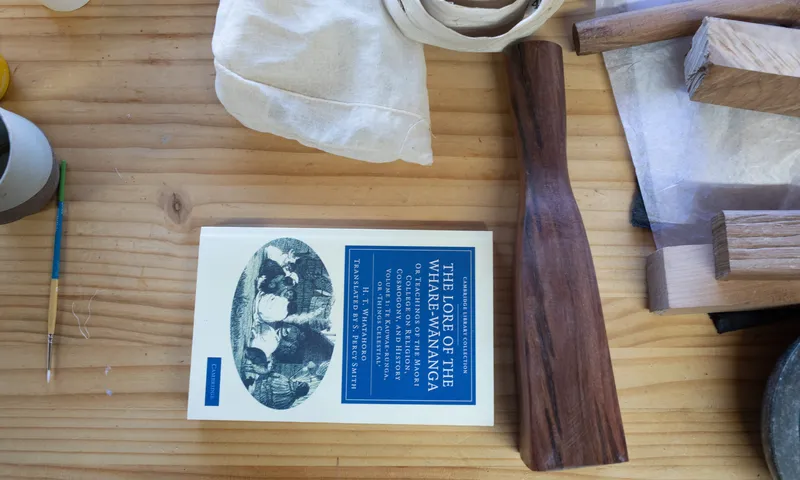
From a very practical sense, I grow and harvest aute, which can take anywhere from a year and a half to two and a half years before it's ready. Once harvested, the bark is removed and prepared. I scrape it using shells and then begin the process of beating the fibres with patu aute over a wooden anvil, or papa.
It's a process of gradually transforming the bark into cloth. There's a lot of repetition, observation and listening to the fibers. You begin to understand how it responds to moisture, pressure, movement and time. The process of making is a conversation between the maker and the aute.
Your work has also travelled to Seoul. What was it like exhibiting work in a completely different cultural context, and how did the audience read the work there?
Exhibiting in Seoul was a really interesting experience because it allowed the work to exist outside the cultural context in which it was made. I was interested in how the material might communicate through its physical presence, scale, texture and form, even when the audience didn't have that same cultural understanding.
The work I exhibited, Whakamaua, was approximately seven metres long and covered in Whakamauāhua – or embossing paua – and long lines of muka stitching. It had a really strong physical presence. I think there's something interesting about allowing a material to speak beyond language while still maintaining the specificity of where it comes from.
I'm not interested in making the work culturally neutral so that everyone can understand it. I think there's value in audiences encountering something they don't immediately recognise and becoming curious about the whakapapa and pūrākau it carries.
If we spoke again in five years, what would you hope had changed about your practice?
I hope I'm still curious and still dreaming – I think that's probably the most important thing. Of course, I'd love to see the work become more ambitious in scale and complexity, and I'd love to continue exhibiting internationally. But beyond my own practice, I'd really like to see aute become more accessible to Māori communities. I'd love for there to be more people growing it, making it, researching it and developing their own relationships with the material.
I think success for me would be seeing aute become something that exists beyond galleries and museums. Something that belongs in our homes, on our marae, within our ceremonies and throughout our everyday lives. Ultimately, I don't want aute to be remembered simply as something we once made. I want it to be something we're still making, and something future generations will continue to transform.
Quick Fire
One tool in the studio you must have?
You must have a relationship with a pā aute, with your trees. They will teach you.
Favourite colour at the moment?
Not sure, maybe black.
Early morning or late at night artist?
Late at night. Definitely not a morning person.
One place you would like to exhibit your work in the world?
The Metropolitan Museum of Art in New York.

Chevron Hassett
Chevron Hassett (Ngāti Porou, Ngāti Rongomaiwahine, Ngāti Kahungunu) is an artist based in Tāmaki Makaurau Auckland. His work spans sculpture, photography, and public installations, exploring urban Māori experiences, memory, and place. He has exhibited across Aotearoa and Australia, and is currently developing new sculptural works that respond to community, architecture, and whakapapa.


